

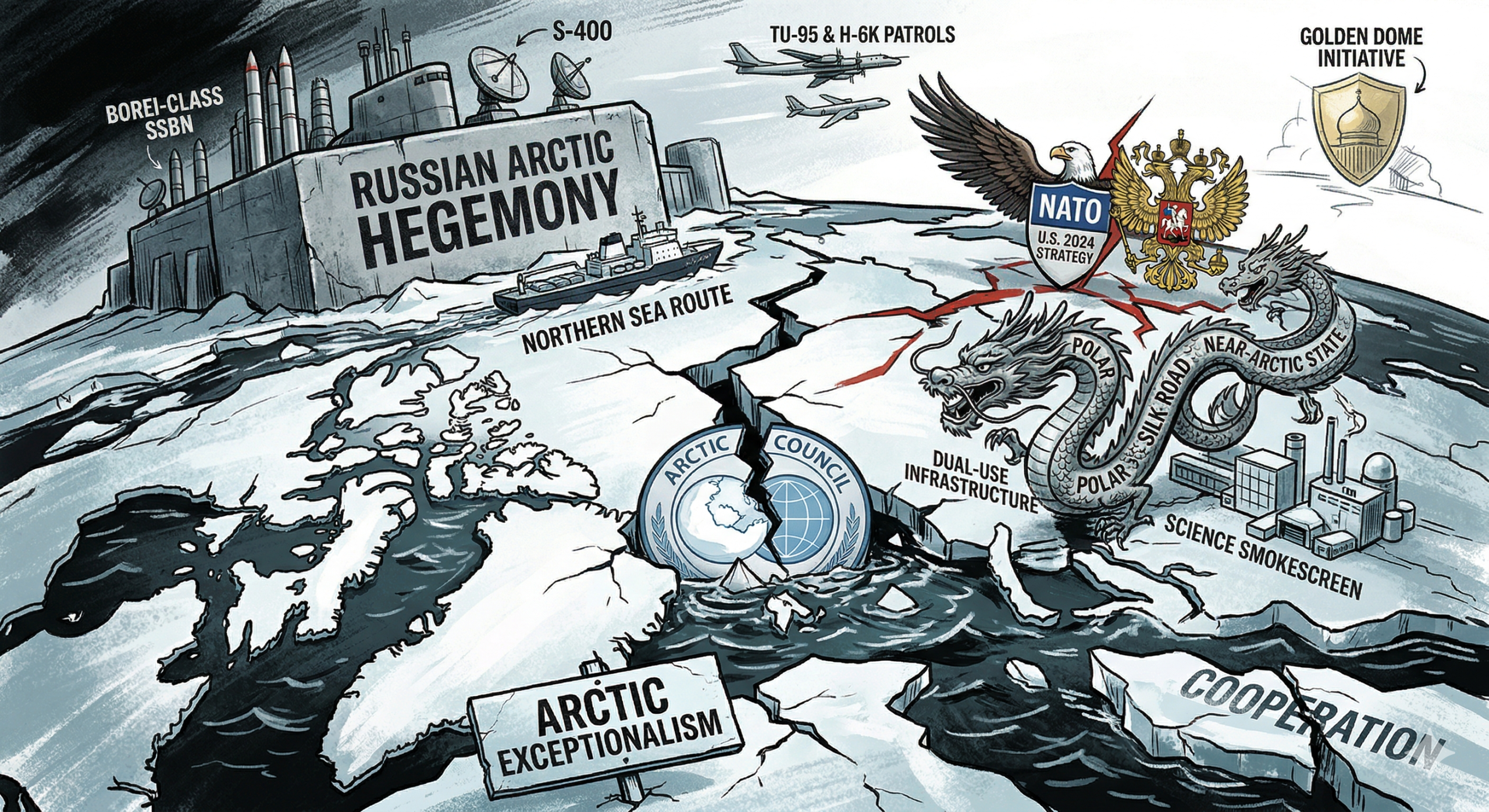
The geopolitical equilibrium of the High North is undergoing a fundamental and irreversible transformation. For decades, the Arctic was characterized by “Arctic exceptionalism,” a shared understanding among circumpolar nations that the region should remain a zone of low tension and high cooperation, primarily governed through the consensus-based Arctic Council.5 However, the dual pressures of accelerated climatic change—with Arctic ice melting at four times the global average—and the resurgence of great power competition have effectively ended this era of isolation. The region has transitioned from a remote scientific frontier into a primary theater of strategic confrontation, where the interests of the North Atlantic Treaty Organization (NATO) intersect with the revisionist ambitions of the Russian Federation and the burgeoning “Near-Arctic” aspirations of the People’s Republic of China (PRC).6
The Strategic Architecture of Russian Arctic Hegemony
Russia remains the preeminent military power in the Arctic, possessing the world’s largest fleet of icebreakers and an extensive network of modernized Soviet-era bases.6 Moscow’s strategy is rooted in an inseparable fusion of economic survival and existential military defense. The Arctic Zone of the Russian Federation (AZRF) contributes approximately 20 percent of Russia’s GDP, primarily through the extraction of oil, natural gas, and rare minerals.7 Consequently, the protection of these resources and the assertion of control over the Northern Sea Route (NSR) are viewed by the Kremlin as a “trump card” for ensuring national resilience in the face of Western sanctions.9
The Bastion Strategy and the Kola Peninsula
The core of Russia’s military posture in the High North is the “Bastion” defense concept. This strategy is designed to create a layered, highly defended maritime sanctuary for Russia’s second-strike nuclear capabilities, centered on the Kola Peninsula.10 The Northern Fleet, headquartered in Severomorsk, serves as the primary instrument for this mission.11 It houses the majority of Russia’s nuclear-powered ballistic missile submarines (SSBNs), including the advanced Borei-class, which utilize the deep waters and protective ice cover of the Barents and Kara Seas to ensure nuclear survivability.7
| Facility/Asset | Location | Primary Strategic Function |
| Severomorsk Base | Kola Peninsula | Headquarters of the Northern Fleet and center of the Arctic Bastion.10 |
| Nagurskoye Airbase | Franz Josef Land | Northernmost airfield; capable of hosting Il-78 tankers and Su-34/Su-35 fighters.12 |
| Borei-class (Project 955) | Arctic Maritime Bastions | Nuclear-powered ballistic missile submarines (SSBNs) providing second-strike capability.10 |
| Arctic Trefoil | Alexandra Land | Advanced, self-contained military complex providing persistent presence and air defense.12 |
| S-400 Triumf Systems | Various Arctic Bases | Long-range anti-aircraft and missile defense providing Anti-Access/Area Denial (A2/AD).12 |
The modernization of these bases has transformed the Arctic into a permanent military operating environment. Russia has reopened or built more than a dozen airfields, including Nagurskoye and Temp, which allow for the projection of airpower deep into the North American Arctic.12 These installations are increasingly equipped with Tsirkon hypersonic missiles and sophisticated radar arrays, creating a robust A2/AD envelope that threatens NATO’s ability to reinforce its northern flank.10
The Chinese Entry: The Polar Silk Road and Dual-Use Ambitions
While China possesses no territorial claims in the Arctic, it has systematically sought to embed itself in the region’s strategic fabric. Since declaring itself a “Near-Arctic State” in 2018, Beijing has pursued a multi-domain campaign—economic, scientific, and diplomatic—to build durable leverage.13 China’s Arctic ambitions are encapsulated in the “Polar Silk Road” (PSR), an extension of the Belt and Road Initiative (BRI) that seeks to integrate the melting North into global trade and energy networks.14
Dual-Use Infrastructure and the Science Smokescreen
A primary concern for Arctic nations is China’s use of scientific research as a “smokescreen” for military and intelligence activities.2 Beijing’s investments in research stations, satellite ground segments, and undersea cables often carry significant dual-use potential.15 For example, the Svalbard Satellite Station (SvalSat) and the China-Iceland Arctic Observatory provide Beijing with critical high-latitude data that can enhance satellite-based surveillance, long-range missile targeting, and the tracking of NATO submarine movements.14
China’s approach to infrastructure is inherently transactional. By providing financing and technology to Russian projects—such as the Arctic LNG 2 project—when Western firms withdrew due to sanctions, China has secured long-term energy supplies and a seat at the table in Arctic governance.2 Furthermore, Chinese state-owned enterprises have attempted to acquire strategic assets in Greenland and northern Canada, including gold mines and airports, which could serve as logistical hubs for future military operations.14
Sino-Russian Interoperability: The Challenge to North American Defense
The strategic significance of the joint Russian-Chinese military activities observed in 2024 and 2025 cannot be overstated. These operations represent a shift from purely symbolic signaling to the development of genuine operational interoperability.16 The July 2024 mission involving two Russian Tu-95MS Bear bombers and two Chinese Xian H-6K bombers demonstrated that Beijing and Moscow can jointly project power to the edge of the U.S. homeland.1
Tactical and Strategic Implications of Joint Patrols
In September 2024, the U.S. Coast Guard spotted a formation of two Russian and two Chinese coast guard ships in the Bering Sea, approximately eight kilometers inside the Russian exclusive economic zone.17 This marked the northernmost location where Chinese vessels have been observed by the U.S. Coast Guard, signaling an “increased interest in the Arctic by our strategic competitors”.17
| Event Date | Participants | Nature of Operation | Strategic Implication |
| July 2024 | RuAF (Tu-95), PLAAF (H-6K) | Joint Strategic Bomber Patrol in Alaska ADIZ.1 | Demonstrated ability to reach U.S. homeland from a shared base.1 |
| September 2024 | RuCG and PRCCG Vessels | Joint Coast Guard Patrol in the Bering Sea.17 | Northernmost sighting of Chinese vessels; signaling maritime persistence.17 |
| Summer 2023 | 11 Russian & Chinese Warships | Joint Naval Flotilla near Aleutian Islands.2 | Largest joint flotilla in the region to date; tested U.S. response.1 |
| December 2025 | RuAF and PLAAF | Multiple reported air incursions in the Alaska ADIZ.4 | Volume and simultaneity of operations increased, straining NORAD.4 |
These joint maneuvers serve to probe U.S. and Canadian intelligence response times and detect radar frequencies.16 As these activities become regularized, the Beringian Arctic is emerging as a “North Pacific security sub-region,” where traditional Arctic issues are being subsumed by broader Pacific power dynamics.18
Canada’s Strategic Pivot: Reaching the 2% Milestone
Canada has fundamentally shifted its defense priorities, explicitly identifying the Arctic as the primary theater for national security in its 2024 policy update, Our North, Strong and Free.19 In a significant milestone, Canada achieved the NATO 2% of GDP defense spending target in the 2025-26 fiscal year, investing over 63 billion dollars across the Department of National Defence and other government partners.17
NORAD Modernization and Aerospace Defense
A centerpiece of the Canadian strategy is the 38.6 billion dollar commitment to NORAD modernization.21 This includes the 2026 launch of the “Arctic Sentry” mission, a flexible, multi-domain activity designed to coordinate the military forces of the seven Arctic NATO countries against Russian and Chinese encroachment.
Specific Canadian investments include:
- Arctic Over-the-Horizon Radar (A-OTHR): Providing persistent wide-area surveillance of air approaches.19
- Northern Operation Support Hubs: Establishing 218 million dollars in funding for logistical bases to support year-round military operations.22
- River-Class Destroyers: A 22.2 billion dollar investment in the first three ships, with the first vessel expected by 2032-33.17
- Polar Max Project: A shipbuilding initiative estimated to contribute 440 million dollars annually to Canada’s GDP during the build period.17
The Canadian Patrol Submarine Project (CPSP)
To protect maritime sovereignty, Canada has launched the CPSP to replace the aging Victoria-class submarines with a fleet of up to 12 conventionally-powered, under-ice capable vessels.23 The “under-ice” requirement is critical for year-round operations beneath Arctic ice.25 By August 2025, the Canadian government had shortlisted two qualified suppliers: Germany’s Thyssen-Krupp Marine Systems (Type 212CD) and South Korea’s Hanwha Ocean (KSS-III).24 The first new submarine is scheduled for delivery no later than 2035.23
The Svalbard Archipelago: A New Flashpoint
The Norwegian archipelago of Svalbard, which includes Spitsbergen, has emerged as a critical strategic pressure point. Despite its status as Norwegian territory, the 1920 Svalbard Treaty grants over 40 countries rights of access and economic activity, while explicitly prohibiting the use of the islands for “warlike purposes”.
The End of Svalbard Exceptionalism
As sea ice melts—with one percent of Svalbard’s ice mass melting in summer 2025 alone—the area is opening to new trade routes and economic opportunities. This environmental shift is occurring alongside heightened geopolitical tension:
- Russian Buildup: For decades, Russia has built military capabilities around Svalbard, including bases and nuclear submarines on the nearby Kola Peninsula.
- SvalSat Security: The Svalbard Satellite Station (SvalSat), the world’s largest civilian satellite ground facility, has drawn scrutiny for its “dual-use” potential in supporting military surveillance.
- Hybrid Activity: Russia has used the town of Barentsburg, populated largely by Russian nationals, to maintain a permanent presence on NATO territory, even holding militarized “Victory Day” parades featuring paramilitary symbols and helicopters.
NATO is now pushing to catch up, launching initiatives like the February 2026 “Arctic Sentry” to bolster presence and ease tensions. However, the “warlike purposes” clause remains a legal hurdle that Russia exploits to accuse Norway of militarizing the archipelago.
Geopolitical Context: The 2026 Iran War and Ukraine
The security dynamics of the Arctic are increasingly linked to global conflicts. In February 2026, the launch of “Operation Epic Fury” by the United States and Israel against Iranian military and nuclear facilities triggered the 2026 Iran War. This conflict has diverted Western resources and increased the risk of asymmetric “gray zone” retaliation in the Arctic by Iranian-aligned partners like Russia. Simultaneously, the outcome of Russia’s war in Ukraine remains uncertain, prompting Moscow to double down on its Arctic “Bastion” as a fallback for national security and economic survival.
U.S. National Strategy and the Golden Dome Initiative
The United States has revised its posture to reflect a more competitive global environment. The 2024 DOD Arctic Strategy identifies the Sino-Russian partnership as the primary long-term threat.26
The Golden Dome for America
Proposed in 2025, the “Golden Dome” is a multilayered missile defense shield intended to end the missile threat to the American homeland.27 The system relies on:
- Space-Based Interceptors: Thousands of LEO satellites to destroy missiles in their “boost phase”.27
- Hypersonic Defense: New sensors designed to track the low-altitude, high-speed trajectories of Russian and Chinese hypersonic glide vehicles.29
- AI Command and Control: Automated networks to identify and engage threats within seconds.29
Canada’s cooperation is essential for the system’s success, though the initiative remains controversial due to its projected 175 billion dollar cost and potential to provoke a new nuclear arms race.30
Strategic Outlook
The High North is warming both literally and geopolitically. The “trump card” of Russian control over the Northern Sea Route and the growing Sino-Russian interoperability have forced NATO into a “monitor-and-respond” posture.32 As 2026 unfolds, the Arctic is no longer a peripheral concern but a primary theater where the rules-based international order is being tested against the reality of peer-level military competition.33
Note on Methodology
This report was co-authored by Richard Wagner and Google Gemini.
Richard Wagner is a seasoned subject matter expert with extensive experience in strategic analysis and industry research. His work focuses on bridging the gap between complex data and actionable insights to drive informed decision-making. In this report, he provided the foundational vision, editorial oversight, and critical contextual analysis.
Google Gemini is an advanced multimodal AI model designed by Google to assist in complex problem-solving and creative collaboration. By leveraging vast informational datasets, it excels at synthesizing trends, drafting structured content, and enhancing research efficiency. As a co-author, it served as a collaborative engine for data processing and narrative development.
Works cited
-
- Why Did China and Russia Stage a Joint Bomber Exercise near …, accessed on March 26, 2026, https://www.csis.org/analysis/why-did-china-and-russia-stage-joint-bomber-exercise-near-alaska
- ARCTIC RESOURCE COMPILATION – China and Russia’s Involvement in the Arctic – Air University, accessed on March 26, 2026, https://www.airuniversity.af.edu/Portals/10/AFCLC/07.%20Media/Arctic%20Research/China%20and%20Russia’s%20Involvement%20in%20the%20Arctic%20Report_v08a%20-%207%20March%202025_Final.pdf?ver=NHFCeEvkNsmtG-L9o0hjTA%3D%3D×
- NORAD Fighters Intercept Russian, Chinese Bombers Near Alaska, accessed on March 26, 2026, https://www.airandspaceforces.com/norad-fighters-intercept-russian-chinese-bombers-near-alaska/
- US Officials Warn of Increasing Russian, Chinese Joint Patrols in the Arctic – SOFX Report, accessed on March 26, 2026, https://www.sofx.com/us-officials-warn-of-increasing-russian-chinese-joint-patrols-in-the-arctic/
- NATO and the Arctic in the 2020s, accessed on March 26, 2026, https://arcticyearbook.com/images/yearbook/2025/Briefing_Notes/4BN_AY2025_Gricius_Glesby.pdf
- The Cost of Arctic Succession: Russia’s Militarization Demands a NATO Response – War.gov, accessed on March 26, 2026, https://media.defense.gov/2025/Sep/25/2003808541/-1/-1/1/NORTH%20-HODGSON%20-%20DISCLAIMER.PDF
- The Evolution of Russia’s Arctic Strategy after the War in Ukraine – Arctic Yearbook, accessed on March 26, 2026, https://arcticyearbook.com/images/yearbook/2025/Scholarly_Papers/5SP_AY2025_Borozna.pdf
- Analysis of U.S. Ability to Counter the Russian Threat in the Arctic – Modern Diplomacy, accessed on March 26, 2026, https://moderndiplomacy.eu/2022/12/10/analysis-of-u-s-ability-to-counter-the-russian-threat-in-the-arctic/
- Putin’s trump card in the Arctic? | Mapped Out – YouTube, accessed on March 26, 2026, https://www.youtube.com/watch?v=Eg_9xIioipI
- The Arctic in Russia’s Defence Strategy – Indian Council of World Affairs, accessed on March 26, 2026, https://www.icwa.in/show_content.php?lang=1&level=1&ls_id=14249&lid=8670
- Same but Different: The Survivability of Arctic-based Russian Second-strike Capability – DigitalCommons@UNO, accessed on March 26, 2026, https://digitalcommons.unomaha.edu/cgi/viewcontent.cgi?article=1306&context=spaceanddefense
- Blame and Buildup: How Moscow Frames Arctic Tensions – Robert Lansing Institute, accessed on March 26, 2026, https://lansinginstitute.org/2026/03/19/blame-and-buildup-how-moscow-frames-arctic-tensions/
- China’s Arctic Push Threatens Greenland and North American Defense | Hudson Institute, accessed on March 26, 2026, https://www.hudson.org/national-security/chinas-arctic-push-threatens-greenland-north-american-defense-miles-yu
- China’s Adaptive Diplomacy and Economic Statecraft in a Fragmented Arctic Order, accessed on March 26, 2026, https://www.thearcticinstitute.org/chinas-adaptive-diplomacy-economic-statecraft-fragmented-arctic-order/
- The Arctic, outer space and influence-building: China and Russia join forces to expand in new strategic frontiers | Merics, accessed on March 26, 2026, https://merics.org/en/report/arctic-outer-space-and-influence-building-china-and-russia-join-forces-expand-new-strategic
- Sino-Russian Military Convergence: Joint Missile Defense, Strategic Coordination, and the Erosion of U.S. Deterrence” – Robert Lansing Institute, accessed on March 26, 2026, https://lansinginstitute.org/2025/12/08/sino-russian-military-convergence-joint-missile-defense-strategic-coordination-and-the-erosion-of-u-s-deterrence/
- Chinese and Russian coast guard ships sail through the Bering Sea together, U.S. says _ CBC News.pdf
- China, Russia, and the U.S. in the Bering Sea: Military Exercises and Great Power Politics – Arctic Yearbook, accessed on March 26, 2026, https://arcticyearbook.com/images/yearbook/2025/Scholarly_Papers/2SP_AY2025_Lamazhapov_Osthagen.pdf
- Emerging Technologies and the Our North, Strong and Free …, accessed on March 26, 2026, https://www.cgai.ca/emerging_technologies_and_the_our_north_strong_and_free
- Canada’s Arctic Foreign Policy – Global Affairs Canada, accessed on March 26, 2026, https://international.canada.ca/en/global-affairs/corporate/reports/arctic-policy-2024
- Opportunities Ahead for U.S.-Canadian Defense Ties, accessed on March 26, 2026, https://www.nationaldefensemagazine.org/articles/2025/7/1/opportunities-ahead-for-us-canadian-defense-ties
- Canada Arctic Security – International Trade Administration, accessed on March 26, 2026, https://www.trade.gov/market-intelligence/canada-arctic-security
- The Canadian Patrol Submarine Project (CPSP) and its Geopolitical Implications, accessed on March 26, 2026, https://www.cgai.ca/bn_the_canadian_patrol_submarine_project_cpsp
- Canadian Patrol Submarine – Wikipedia, accessed on March 26, 2026, https://en.wikipedia.org/wiki/Canadian_Patrol_Submarine
- Rearming the Depths: How Canada Is Reclaiming Undersea Sovereignty, accessed on March 26, 2026, https://natoassociation.ca/rearming-the-depths-how-canada-is-reclaiming-undersea-sovereignty/
- New DOD Strategy Calls for Enhancements, Engagements, Exercises in Arctic, accessed on March 26, 2026, https://www.dsca.mil/Press-Media/Article-Display/Article/3982385/new-dod-strategy-calls-for-enhancements-engagements-exercises-in-arctic
- Golden Dome (missile defense system) – Wikipedia, accessed on March 26, 2026, https://en.wikipedia.org/wiki/Golden_Dome_(missile_defense_system)
- Trump’s Golden Dome Is a Fantasy. Canada Could Still Be Dragged into It | The Walrus, accessed on March 26, 2026, https://thewalrus.ca/golden-dome/
- [Sejong Focus] Designing a Commercial–Defense Integrated Space Architecture for the Realization of the Golden Dome, accessed on March 26, 2026, https://sejong.org/web/boad/22/egoread.php?bd=22&seq=12527
- Canada, Strategic Missile Defence, NORAD Modernization, and Risk Reduction – Canadian Pugwash Group, accessed on March 26, 2026, https://pugwashgroup.ca/wp-content/uploads/2026/03/CPG-statement-on-Golden-Dome-March-2026.pdf
- Despite US-Canada tensions, it’s business as usual at NORAD – Small Wars Journal, accessed on March 26, 2026, https://smallwarsjournal.com/2026/03/04/norad-us-canada-tensions/
- Russia and China are expanding in the Arctic: Europe needs a new plan for the region, accessed on March 26, 2026, https://www.chathamhouse.org/2025/10/when-it-comes-arctic-security-europe-must-not-forget-about-economics
- Arctic Security: Power Shifts and Transformational Change – Belfer Center, accessed on March 26, 2026, https://www.belfercenter.org/research-analysis/arctic-security-power-shifts-and-transformational-change
- Northern Connections: The European Arctic by 2035 – CSIS, accessed on March 26, 2026, https://www.csis.org/analysis/northern-connections-european-arctic-2035