

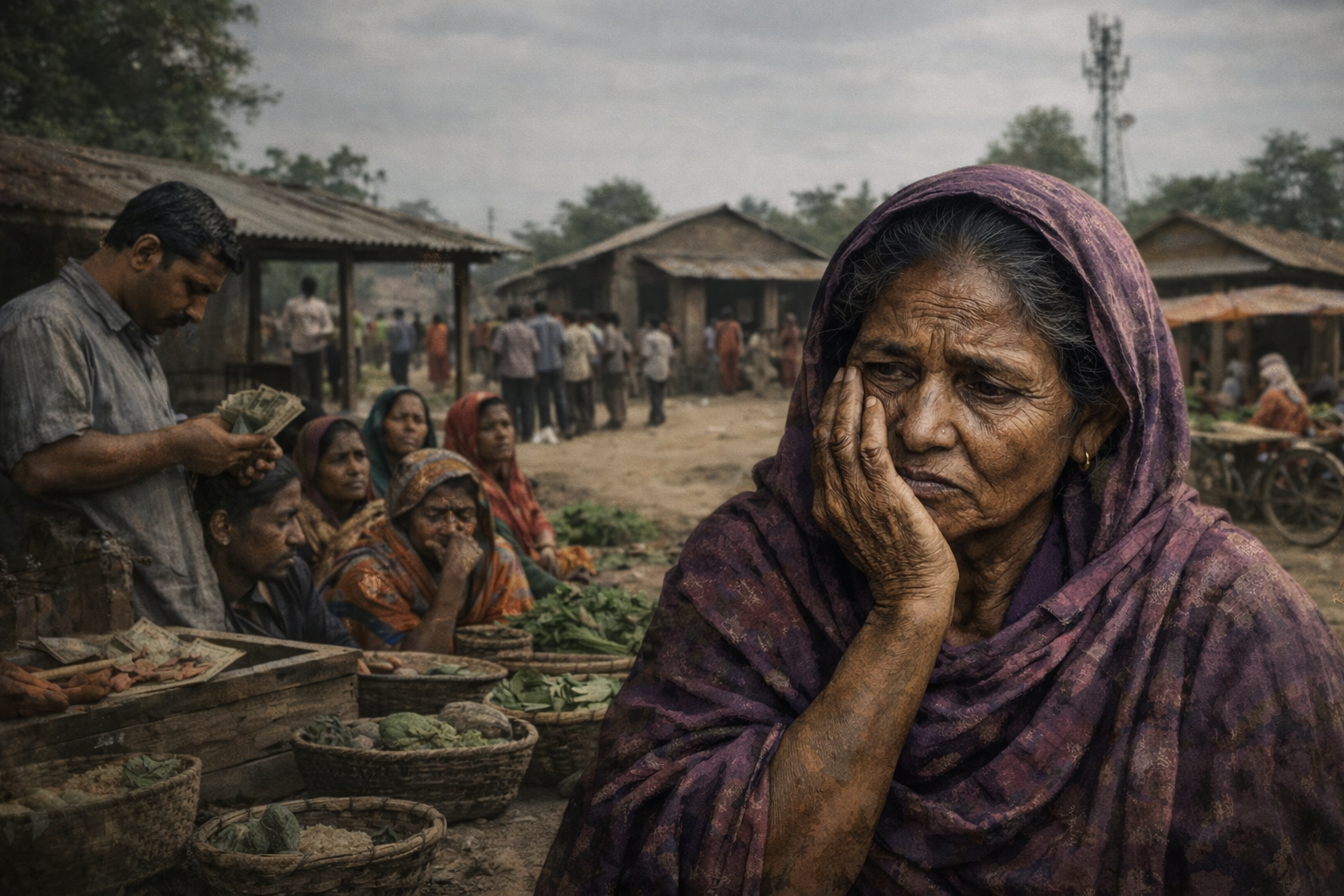
For decades, microcredit was promoted as a quiet revolution in poverty reduction. Small loans, delivered largely to rural women, were meant to unlock entrepreneurship, self-reliance and dignity. In international forums, the model was celebrated as a humane alternative to exploitative moneylending. Yet across large parts of rural Bangladesh, the lived experience of microcredit has unfolded very differently—producing not just economic strain, but deep social stress with consequences that extend beyond the country’s borders.
In many villages, microloans initially felt like an opportunity. Women borrowed to sell vegetables, raise poultry, run tailoring units or manage tiny roadside shops. But these ventures operated in fragile local economies. Markets were limited, infrastructure was weak and demand was uncertain. As more borrowers entered identical trades, profits fell. What followed was not sustainable growth, but a cycle of debt management.
The defining feature of this system was not the loan itself, but the repayment structure. Weekly instalments left little room for error. Illness, crop failure, a family emergency or a seasonal downturn could disrupt income instantly. When repayments fell short, penalties followed. In numerous documented cases, borrowers took out new loans—sometimes from multiple microfinance institutions—to repay existing ones. Debt ceased to be a tool for enterprise and became a mechanism for survival.
This pressure reshaped household dynamics. Although loans were issued in women’s names, men often controlled how the money was used. Responsibility for repayment, however, rested squarely on the women. Failure was personalised and publicly enforced. Weekly collection meetings became moments of exposure, where default carried social stigma. The psychological burden was intense, particularly in tightly knit rural communities where reputation matters as much as income.
Field research by economists and development scholars has long noted that a significant share of microloans were never invested in income-generating activity. Instead, they were absorbed into daily consumption—food, school fees, medical expenses or weddings. This reality undermined the core assumption of microcredit: that borrowing would create new income streams to support repayment. When loans financed survival rather than growth, repayment was sustained only through sacrifice.
Over time, these pressures accumulated into broader social stress. Families sold livestock, land fragments or jewellery to keep up with instalments. In extreme cases reported by local media and NGOs, borrower suicides were linked to relentless repayment demands and public humiliation. Each such case punctured the international narrative of empowerment, revealing a harsher truth beneath the polished success stories.
For India’s Northeast, this experience is not a distant development failure. Historically, economic distress in rural Bangladesh has functioned as a push factor for cross-border movement. The border-adjacent districts of Assam, Tripura and Meghalaya have repeatedly absorbed the spillover effects of instability across the frontier. When livelihoods collapse under debt pressure, migration becomes not a choice but a coping strategy.
This linkage is often missing from development discourse. Microcredit is discussed as a financial instrument, but its social consequences—family stress, erosion of trust, and community-level anxiety—rarely enter strategic assessment. Yet these factors shape patterns of mobility, informal labour flows and social friction in border regions. For the Northeast, such movements are not abstract statistics; they affect local economies, policing and community relations.
Another overlooked dimension is gendered vulnerability. Women bore the visible burden of microcredit failure, while structural constraints remained unchanged. Access to healthcare, education, land rights and stable employment did not improve simply because loans were available. Without these foundations, credit is redistributed risk downward rather than reducing poverty upward. This dynamic weakened social resilience instead of strengthening it.
The implications for regional stability are clear. Economic models that generate chronic stress rather than durable livelihoods create conditions for unrest. When combined with weak social protection and limited state capacity, such stress can lead to migration, informal economies, and long-term insecurity. Border regions experience these effects first and most acutely.
Critically, this does not mean all microfinance was harmful. Community-based savings groups and cooperative lending models have shown better outcomes precisely because they grow slowly, emphasise mutual support and allow flexibility in crisis. The problem lay in scale, rigidity and the transformation of poverty alleviation into a volume-driven financial system.
For strategic observers in the Northeast, the lesson is not about rejecting development finance, but about understanding its second-order effects. Debt-led inclusion, when detached from real economic opportunity, can become a source of social strain with cross-border consequences. Stability in the neighbourhood depends as much on livelihoods as on law enforcement.
Rural Bangladesh’s microcredit experience demonstrates how well-intentioned economic tools can reshape societies in unintended ways. The stress generated by debt did not remain confined to balance sheets or repayment charts. It entered households, communities and, ultimately, regional dynamics. For India’s frontier states, recognising this connection is essential—not as a matter of charity, but as a matter of security and long-term stability.