

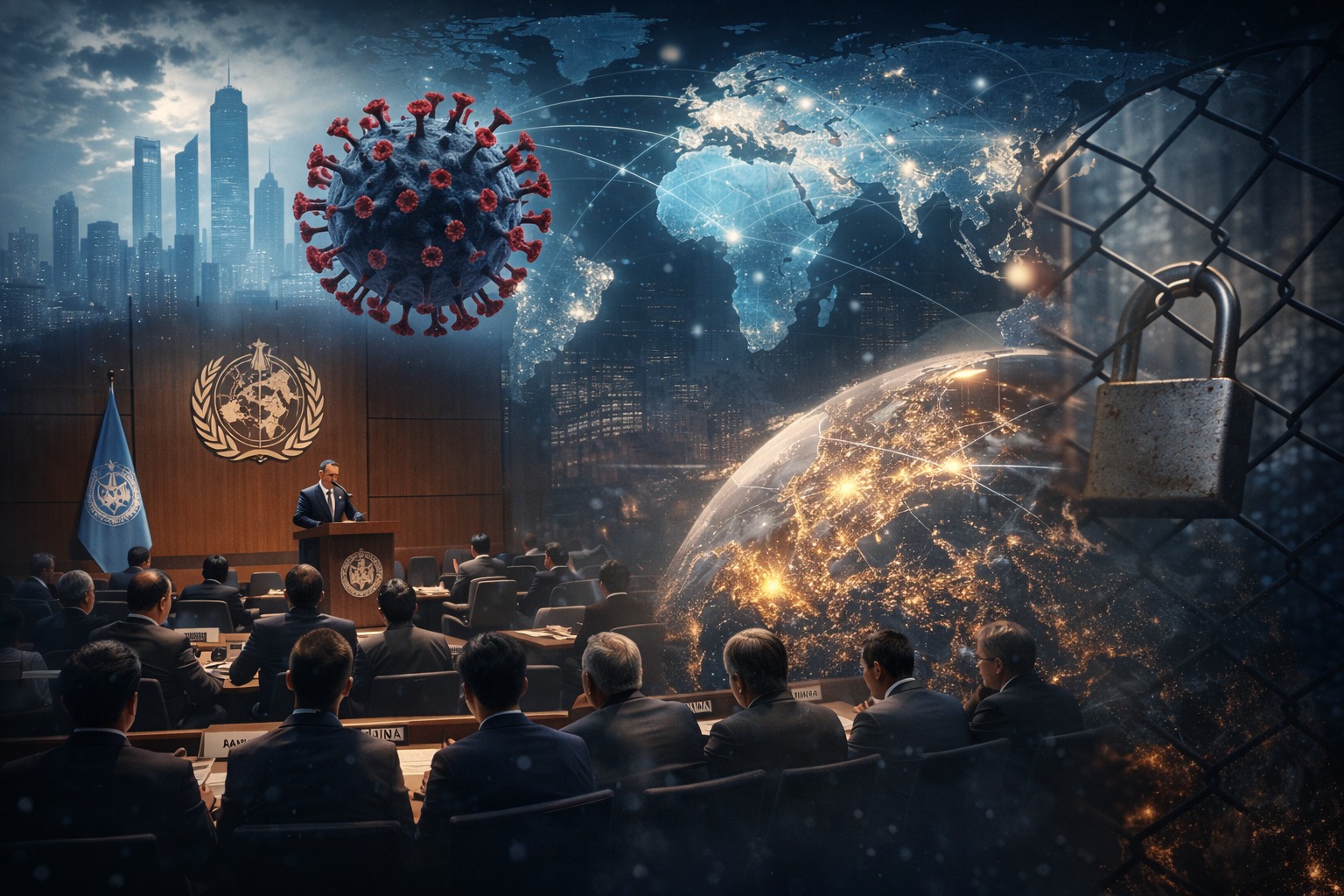
The Covid-19 pandemic is often remembered as a biological shock. In reality, it was a governance shock. The virus exposed not only vulnerabilities in public-health systems, but deeper weaknesses in how the world manages information, authority, and responsibility during crises.
Wuhan was not simply the site of an outbreak. It became a stress test for global health governance — and the results were sobering.
A System Built on Trust, Not Enforcement
The international health system is anchored in cooperation rather than coercion. The World Health Organization (WHO) operates under the International Health Regulations (IHR), a framework that obliges states to report potential public-health emergencies and share relevant information.
But the IHR has a fundamental limitation: WHO cannot independently verify outbreaks inside sovereign states. It cannot compel disclosure, access raw data, or override domestic political decisions. Its authority depends on trust, transparency, and timely cooperation.
Wuhan demonstrated what happens when those assumptions collide with political reality. Information was shared, but incrementally. Notifications were made, but cautiously framed. Uncertainty was managed domestically before being escalated internationally.
The result was not procedural violation, but functional failure.
Why the System Struggled When It Mattered Most
Global outbreak response relies on a chain reaction: Local detection to national escalation to international alert towards global preparedness.
In Wuhan, that chain slowed at its weakest link: early escalation. The world received signals, but not the full picture. By the time clarity emerged, the virus had already crossed borders.
This reveals a critical flaw in crisis governance. The system is calibrated for certainty, not ambiguity. Yet pandemics begin in ambiguity. When uncertainty is treated as something to be minimised rather than surfaced, response lags become inevitable.
Wuhan showed that global health security is less about scientific capacity than about institutional incentives.
The Politics of Delay
States face competing pressures during crises. Rapid disclosure can trigger panic, economic disruption, and political scrutiny. Delay can preserve calm — temporarily.
In tightly managed systems, the cost of overreacting is often higher than the cost of underreacting. Officials are rarely punished for reassurance that proves wrong; they are more often penalised for alarm that proves unnecessary.
This asymmetry matters. It creates a bias toward delay, even in the face of growing risk. Wuhan was not an anomaly in this respect. It was an extreme example of a broader governance dilemma.
WHO’s Dilemma
Much of the post-pandemic debate has focused on WHO’s performance. But Wuhan illustrates a more uncomfortable truth: WHO can only act on what it is given.
The organisation issued situation reports, coordinated expert missions, and communicated evolving assessments based on available data. What it could not do was force faster disclosure or override domestic controls.
This limitation has become central to current reform efforts. Discussions around a pandemic agreement, pathogen-sharing frameworks, and early-warning systems all grapple with the same question: how can global institutions respond faster when sovereignty slows information flow?
Wuhan did not expose incompetence so much as structural constraint.
From Case Study to Policy Blueprint
Five years on, Wuhan has become a reference point in global health debates. It is cited in discussions about. Mandatory data-sharing standards. Protections for whistleblowers and clinicians. Early-warning mechanisms independent of political hierarchy. Clearer triggers for international escalation.
Yet progress remains uneven. Pandemic preparedness is politically easier to discuss than to institutionalise. Reforms that require states to surrender discretion in the early stages of a crisis remain controversial.
The danger is that Wuhan becomes a lesson acknowledged but not applied.
Why This Is a Global Problem
It would be misleading to treat Wuhan as a uniquely Chinese failure. The underlying vulnerabilities exist everywhere. Governments across systems struggle to balance transparency with control, health with economics, and science with politics.
The difference lies in degree, not kind.
The next outbreak may emerge in a different political context, but it will encounter the same structural question: will uncertainty be escalated or contained?
If escalation carries political cost, delay will follow — regardless of geography.
The True Legacy of Wuhan
Wuhan’s most enduring lesson is not about blame. It is about design.
A global health system that depends entirely on goodwill will always be vulnerable when goodwill conflicts with power. A system that waits for certainty will always be late to exponential threats.
Pandemics reward honesty, speed, and institutional humility. They punish systems that mistake control for competence.
What Must Change Before the Next Crisis
If the world is serious about preventing another global health catastrophe, reforms must address incentives, not just procedures. That means. Protecting those who raise early alarms. Valuing uncertainty as actionable information. Reducing the political cost of transparency. Strengthening international mechanisms that respond to signals, not just confirmations.
Wuhan showed that the greatest risk in a pandemic is not ignorance. It is hesitation.
The virus moved faster than institutions designed to manage it. Unless that imbalance is corrected, the next outbreak will follow the same path — different city, same failure.