

This study examines the socio-political landscape of the Jaffna Peninsula during the height of Eelam War III through the lens of two primary source documents: the Eelanadu National Tamil Daily (Vol. 5, no. 135) and Jaffna Uthayan (Vol. 10, no. 204), both published on June 19, 1995. Recovered and digitized by the Noolaham Foundation, these concurrent issues provide a critical snapshot of the region immediately prior to the Sri Lankan military’s “Operation Riviresa.” By analyzing the editorial stance, reported events, and public notices contained within these specific issues, this research highlights the resilience of local print media operating under conditions of conflict and the tradecraft of Spy Tigers. The juxtaposition of Eelanadu and Jaffna Uthayan serves as a case study in how information was disseminated to the Tamil-speaking populace during a period of isolation, offering valuable insights for historians reconstructing the daily realities of civilian life in 1995 Jaffna.
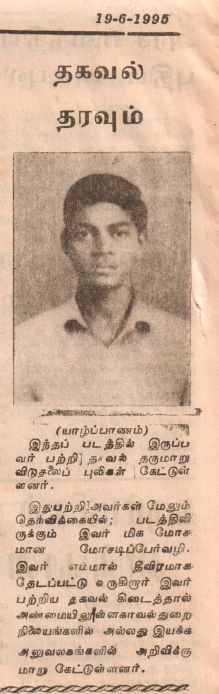
The content of the poster, written in Tamil, is as follows:
The Liberation Tigers of Tamil Eelam (LTTE) request the public’s assistance in locating the individual depicted in this photograph. This subject is considered highly dangerous and is wanted in connection with fraudulent activities. The organization is conducting an intensive search for this suspect. If you possess any information regarding his whereabouts, please report it immediately to the nearest LTTE police station or the movement’s camp.
Introduction: The Smoking Gun
My name is Kagusthan Ariaratnam, and I was a spy. I’ve had many aliases, including the Tamil Tigers nom de guerre Oppilamani and the codename at the Sri Lanka’s Directorate of Military Intelligence, which is “05,” as if I were a Sri Lankan James Bond. For decades, the story of my life has been buried under layers of code names, redacted files, and the shifting sands of geopolitical deception. In my book, Spy Tiger, I detailed the harrowing journey of a child soldier turned intelligence operative, and finally, a double agent caught between the lethal machinery of the Liberation Tigers of Tamil Eelam (LTTE) and the Sri Lankan state between 1990 to 1997. A central pillar of my testimony has always been the claim that my dramatic “defection” to the Sri Lankan military in 1995 was not an act of cowardice or genuine betrayal, but a meticulously orchestrated intelligence operation—a “staged defection” masterminded by the LTTE’s own intelligence elite.
For years, skeptics might have viewed this as a convenient cover story. But today, I present a piece of physical evidence and artifact that cuts through the fog of war: a faded, newsprint “Wanted” notice, published by the LTTE themselves. To the untrained eye, this scrap of paper appears to be a standard hue and cry for a traitor. But when examined against the backdrop of the events I chronicled in Spy Tiger, this image transforms into the ultimate corroboration of my narrative. It is the physical manifestation of the lie that saved my life and the “legend” that allowed me to infiltrate the highest levels of the Sri Lankan military.
This article serves as an extensive analysis of this new evidence. I will deconstruct the discrepancies within this “Wanted” notice—the civilian photograph, the omission of my rank, and the paradox of a manhunt for a man they sent away—to prove how the LTTE weaponized the media to create a perfect cover for their mole, code-named “Oppilan” by them, and “05” by the Army.
The Context: The Architect of Deception
To understand the significance of this notice, one must first understand the desperate circumstances under which it was conceived: necessity is the mother of invention. By June 1995, my life hung in the balance. I had been blackmailed into working for India’s Research and Analysis Wing (RAW) after an illicit affair with a fellow cadre, Nala. When I confessed this betrayal to my superior, Sasikumar Master, I expected a firing squad. Instead, I was taken to Thinesh Master, a top LTTE leader and military advisor to Velupillai Prabhakaran.
Thinesh did not order my execution. He saw an opportunity. He knew the Sri Lankan military and RAW were planning a massive offensive to retake Jaffna, an onslaught the Tigers could not withstand conventionally. The LTTE needed to evolve; they needed eyes and ears inside the enemy’s war room. Thinesh Master looked at me—a compromised intelligence officer with a talent for survival—and saw the perfect vessel for a grand deception.
He ordered me to surrender to the Sri Lankan military. The plan was audacious: I was to pose as a defector, fleeing the LTTE’s wrath. But to make the Sri Lankan Army believe a trained Tiger intelligence officer would turn traitor, we needed a story so convincing that no interrogation could crack it. We needed “tradecraft.” Thinesh told me explicitly that they would publish my picture and make arrests to make it look like I had switched sides.
This “Wanted” notice is the result of that order. It was not a call for justice; it was a prop in a geopolitical theatre.
Discrepancy #1: The Civilian Photograph
The first and most glaring anomaly in this “Wanted” notice is the image itself. The photograph shows a young man in civilian attire—a simple shirt, unkempt hair, looking for all the world like a frightened student or a refugee.
This visual choice was deliberate and deeply deceptive. At the time this notice was circulated, I was not a civilian. I served as the Head of Naval Intelligence for the LTTE, overseeing intelligence operations for the Sea Tigers and the Air Tigers—the organization’s rudimentary naval and aerial wings. I had been trained in the Imran-Pandiyan Regiment, graduated from the elite “Base 22” Spy Tiger Academy, and was responsible for training Black Tiger suicide cadres. I was a militarized, high-value asset who had built models of Sri Lankan naval bases and planned suicide attacks.
So, why would the LTTE, an organization obsessed with martial pride and military hierarchy, circulate a photo of one of their top intelligence officers looking like a common civilian as the most wanted man by them?
The answer lies in the objective of the mission: Infiltration.
If the LTTE had published a photo of me in my Tiger fatigues, holding an AK-47, or wearing the cyanides capsule around my neck, it would have signaled to the world—and specifically to Western immigration authorities and human rights organizations—that I was a combatant. Thinesh Master knew that the long-term goal was not just infiltration of the Sri Lankan Army, but potentially moving me abroad as a sleeper agent or strategic asset. A photo of a uniformed soldier would have made it impossible for me to ever claim refugee status or political asylum later. It would have branded me a “terrorist” instantly.
By using a civilian photo, the LTTE was crafting my “legend,” a spy’s cover story. They were painting a picture of “Kagusthan Ariaratnam,” the wayward youth, the thief, the fraud, or the traitor—not “Oppilan,” the Naval Intelligence Officer. This allowed the Sri Lankan Army to view me as a salvageable asset rather than a hardened ideologue who needed to be executed immediately. It played into the narrative I gave the Army: that I was just a boy who fell in love and ran away from the strict rules of the Tigers. The civilian photo supported my lie that I was not a “true” believer, just a kid caught in the machine.
Discrepancy #2: The Omission of Rank and LTTE Membership
Closely tied to the photograph is the text of the notice itself. A standard military “Wanted” poster for a deserter usually lists their rank, unit, and service number to aid military police in identification. Yet, this notice is conspicuously silent on my status as a member of the LTTE, let alone my rank as a major-equivalent or my role in the Intelligence Wing.
Why hide my membership?
This omission was a strategic masterstroke by Thinesh Master. If the “Wanted” notice had identified me as “Oppilan, Head of Naval Intelligence,” the Sri Lankan Army would have been on high alert. High-ranking intelligence officers do not simply walk out of the jungle with a white flag unless it is a trap. If my true value had been advertised on a poster, the Sri Lankan Army might have tortured me to death immediately for specific secrets or traded me.
However, by omitting my rank and framing me as a generic “wanted” individual—implying criminal behavior or low-level betrayal—the LTTE lowered the temperature. It allowed me to walk into the Palaly Army Base and sell a story of personal grievance rather than ideological defection. I told the Army I defected because of an affair with a woman, Nala, and fear of punishment. The “Wanted” notice, with its lack of military specifics, corroborated this. It made it look like I was wanted for breaking rules, for “crimes” against the organization’s discipline, rather than for holding state secrets.
Furthermore, Thinesh Master had warned me that the National Intelligence Wing didn’t know about this operation. To them, I was still a traitor. By keeping the notice vague, Thinesh protected the compartmentalization of the mission. The rank-and-file Tigers and the National Intelligence Wing (rivals to our Military Intelligence) would hunt me as a traitor, making the threat to my life real and convincing to the Army, without exposing the specific intelligence secrets I held. It was a needle-threading exercise in information warfare.
Discrepancy #3: The Paradox of the Manhunt
The most damning piece of logic that this “Wanted” notice supports is the very existence of the manhunt itself. On the surface, it makes no sense. As I revealed in my memoir Spy Tiger, it was Thinesh Master and Prabhakaran—the supreme leadership—who ordered me to leave. They briefed me, they gave me the map of the Palaly base, and they prepared my cover story.
So, why would they expend resources printing posters and sending hit squads to kill me?
This paradox is the ultimate proof of the operation’s sophistication. This was the “King Maker” strategy. Thinesh Master knew that the Sri Lankan Army’s intelligence directors, men like Colonel Rizvy Zacky and Brigadier Janaka Perera, were not fools. They would be suspicious of a walk-in defector. As Brigadier Perera told me, you can smell a lie a mile away.
To convince them I was genuine, I needed to be in mortal danger. The Army needed to see that the Tigers wanted me dead. This “Wanted” notice provided that validation. It was the external verification that my bridge back to the LTTE was burned.
When I was later confronted by LTTE hit squads in Jaffna—former comrades like Sotko who were sent to assassinate me—it terrified me. But in hindsight, it was part of the theater. Thinesh Master had told me to act independently. By putting a genuine price on my head, the LTTE leadership ensured that if I ever wavered, I had no choice but to cling to the Sri Lankan Army for protection. It forced me to be “useful” to the Army to survive.
Moreover, the “Wanted” notice served a domestic purpose. It explained my disappearance to the local population and, crucially, to my family, without revealing the truth. Thinesh had told me that even my family would believe it was true, that they would be ashamed of their traitor boy, but they would live as long as I did my job. The notice was a tool of coercion against my own parents. It branded me a traitor, putting my family in a precarious position where they had to rely on the narrative that I was a “bad apple,” thereby sparing them from the collective punishment usually meted out to the families of defectors. It effectively put my family under house arrest and later forced them to flee to Army-controlled areas, cementing my dependence on the military.
The “05” File: How the Notice Created the Spy
The impact of this “Wanted” notice was immediate and profound. When I surrendered to the Sri Lankan military at Palaly, waving a white flag and climbing a tree, I was naked, vulnerable, and terrified. But I was armed with the invisible shield this notice provided.
When I faced interrogation by Captain Liyanage and later the formidable Major General Srilal Weerasooriya, their suspicion was intense. They suspected I was a spy. But they couldn’t prove it. The narrative of the “Wanted” man—the boy who broke the rules and ran—held up because the LTTE’s public actions supported it.
Because of the credibility this “legend” gave me, I was inducted into the Directorate of Military Intelligence (DMI). They gave me the code name “05”. I became their star informant. I helped them build models of Jaffna. I sat in their radio rooms intercepting Tiger communications. I even identified the bodies of my former friends.
The irony is tragic and staggering. The “Wanted” notice was designed by the LTTE to plant me as a mole who would feed disinformation to the Army and eventually be called in for a bigger win. Thinesh Master hoped I would be his “little drummer boy,” waiting for the signal to strike or even blow myself up inside the Army HQ.
But the plan worked too well. The “Wanted” notice cut me off so effectively from the LTTE that I became trapped by the Army. I gave the Army real, actionable intelligence—not just disinformation—because I had to survive. I helped them win the Battle of Jaffna (Operation Riviresa). Thinesh Master’s plan to use the “Wanted” notice to create a super-spy backfired; instead, it created an asset that helped dismantle his own organization’s stronghold.
Conclusion: The Evidence of Betrayal and Survival
The attached “Wanted” notice is not just a piece of paper. It is a historical document and an artifact that encapsulates the tragedy of the Sri Lankan civil war. It represents the ruthless pragmatism of the LTTE, who were willing to brand their own loyal officer a traitor and hunt him down just to place a pawn on the chessboard.
It substantially supports every claim I made in Spy Tiger. It explains why I appeared to be a civilian refugee when I was an intelligence wing cadre. It explains why I was hunted by the very men who trained me. It explains how I survived the lion’s den of the Sri Lankan Army.
I look at this notice now, and I do not see a criminal. I see a young man, “Oppilan,” who was used as a tool by Thinesh Master, by Prabhakaran, by Indian intelligence, and by the Sri Lankan Army. This notice was the cage they built for me. But it was also the key that eventually allowed me to escape, to reinvent myself as “Murali” in Canada, and to finally tell the truth that no “Wanted” poster could ever contain.
As I wrote in my book, “Trust no one, deceive everyone”. This notice was the ultimate deception. And now, the truth is finally out.
The Future: A Path of Unresolved Exile
As I look toward the years ahead, I realize that escaping the LTTE was merely the end of physical captivity, not the beginning of true freedom. The archival evidence from June 19, 1995—those ‘Wanted’ notices preserved in Eelanadu and Uthayan—will likely stand not just as history, but as a permanent warrant against my character. I face a future where I must walk among a diaspora that largely remains frozen in its reverence for the Tigers as the sole saviors of the nation. In this prevailing worldview, which allows space only for the Thiyagi (martyr) or the Thurogi (traitor), there is still no distinct category for the ‘survivor.’ Consequently, the road before me is paved with the silence of my own family and the averted gazes of friends who view my very existence as a betrayal of the cause. My challenge now is not merely to live, but to discover if redemption is even possible in a community that measures loyalty by death, leaving me to wonder how I can ever reclaim my name in the eyes of the people I still call my own.
Source Origin Citation
These primary source documents are preserved and digitized by the Noolaham Foundation (நூலகம்), a non-profit digital archive dedicated to documenting the knowledge, history, and culture of the Tamil-speaking communities in Sri Lanka.
Works cited
- Eelanadu Clipping
Eelanadu. (1995, June 19). Eelanadu National Tamil Daily, Vol. 5, no. 135, p. 6. Digital Library. Noolaham Foundation. Retrieved December 31, 2025, from https://noolaham.net/project/220/21985/21985.pdf
- Jaffna Uthayan Clipping
Jaffna Uthayan. (1995, June 19). Jaffna Uthayan, Vol. 10, no. 204, p. 1. Digital Library. Noolaham Foundation. Retrieved December 31, 2025, from https://noolaham.net/project/924/92301/92301.pdf