

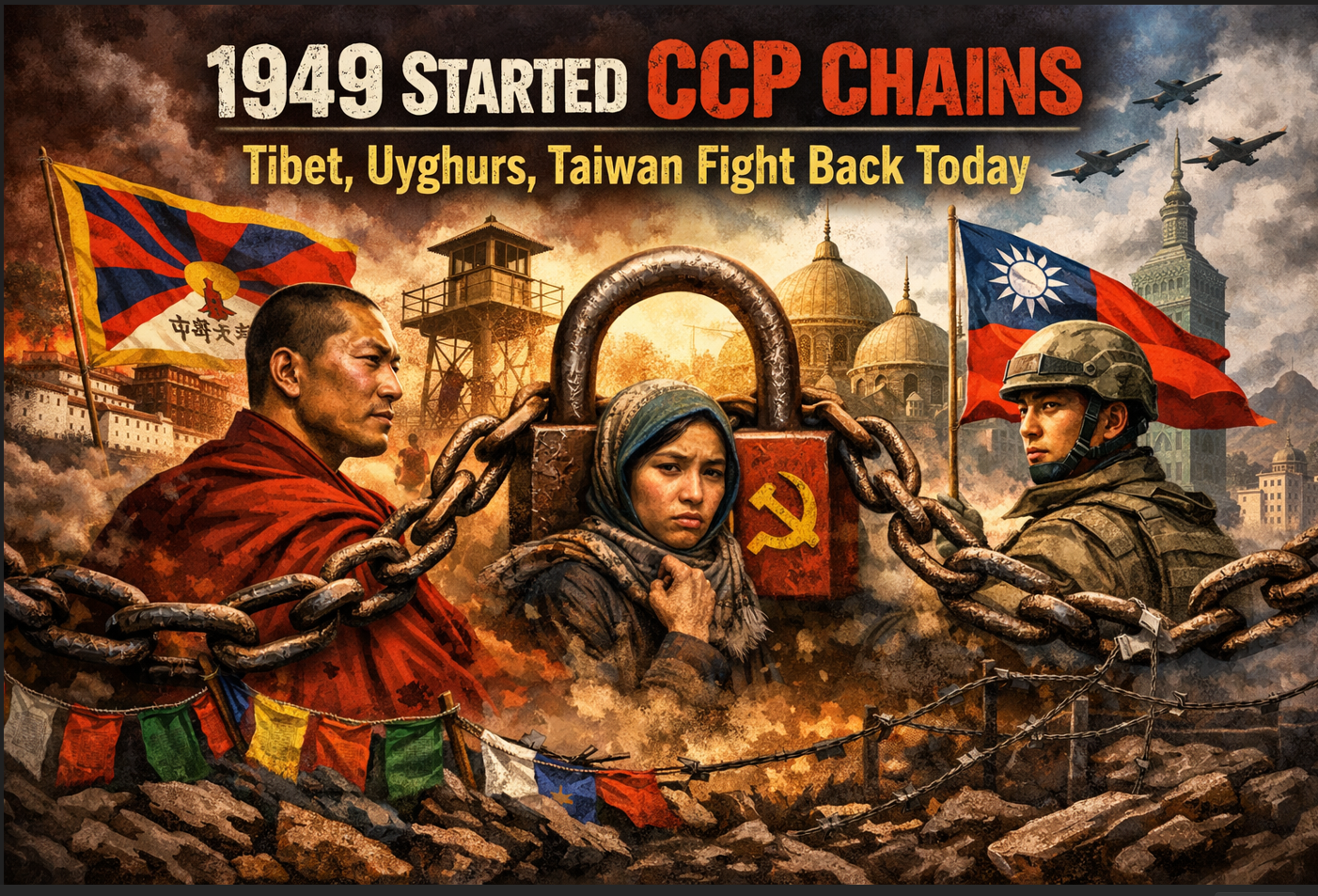
When the Chinese Communist Party (CCP) took control in 1949, it promised unity, prosperity and peace for all of China’s diverse people. But what we see today, nearly 77 years later, is far from that promise. China is a nation marked by repression, struggle and fractured relationships. The very regions that were meant to be part of its unified vision are struggling for autonomy.
Tibet, Xinjiang, and Taiwan—regions that were never fully incorporated into this vision of “unity” are fighting back and holding onto their identities, cultures and aspirations for freedom.
The Chains of 1949
1949 wasn’t just the year China was “unified” under the CCP. It was the year the chains were forged. The party, led by Mao Zedong, replaced a struggling republic with a single-party rule that tightly centralised control in Beijing. While the idea of a strong nation held appeal, it came at a high cost. The dream of a united China, where all ethnicities and peoples lived together in harmony, was immediately tested in regions such as Tibet, Xinjiang and Taiwan.
Tibet, for instance, was invaded by the People’s Liberation Army (PLA) in 1950 only a year after the CCP assumed power. The Seventeen-Point Agreement, signed under duress, was supposed to guarantee Tibet’s autonomy. But in reality, it was the beginning of Tibet’s suppression. By 1959, the Tibetans had enough and they revolted. It was an uprising that was crushed brutally by the PLA. Despite years of protest and calls for independence, Tibetans have never been allowed to live freely. Even their religious and cultural identities have come to be targeted by Beijing’s policies.
The Struggles of the Uyghurs
In Xinjiang, the Uyghur people, a Muslim minority, have faced harsh treatment from the CCP since 1949. Over time, the reality of Beijing’s control became clearer and today, the Uyghurs’ culture, religion and very existence are under threat.
Millions of Uyghurs have ended up in “re-education” camps, forced into labor and watched around the clock. The Chinese government says it’s about fighting extremism, but really, it looks more like an effort to wipe out Uyghur identity. Honestly, all this just proves that the CCP’s talk about freedom and equality was empty from the start.
Taiwan’s Resistance
Taiwan’s story isn’t like anyone else’s. After the Chinese Civil War, the Republic of China packed up and moved to Taiwan, setting up its own government there. The Chinese Communist Party never bought into the idea of Taiwan being independent. They still want to take charge of the island. But here’s the thing—Taiwanese people, with their democracy and strong sense of who they are, keep showing they won’t let Beijing call the shots.
Taiwan is fighting not just for political independence. But it is doing so to preserve its way of life, freedoms and future. The island stands as a symbol of resistance to Beijing’s authoritarian rule. Despite the pressure, Taiwan remains determined to stay independent.
The Price of Centralisation
Beijing calls the shots in all these regions. The government leans on the military, squeezes the economy, and plays mind games to keep Tibet, Xinjiang, and Taiwan in line.
But instead of pulling everyone together, this hardline style just stirs up more trouble. The country’s packed with internal conflicts now, and you can feel the resentment against the CCP’s heavy-handed rule getting stronger.
Back in 1949, people hoped for unity, but the push to centralize everything ended up breaking that promise. Sun Yat-sen wanted a country where different cultures could actually live side by side. Now, under the CCP, that idea’s pretty much gone. Instead, there’s tight control everywhere, and honestly, there’s barely any room left for regional freedom or for people to keep their own cultural identities.
Why It Matters Today
Tibet, Xinjiang, and Taiwan aren’t just history—they’re still fighting. Every time the CCP breaks its promises, these are the places we are reminded of. Even in 2026, with China throwing its weight around, people there keep resisting. They won’t let Beijing erase their identity or squeeze them into a mould they never chose.
Tibetans, Uyghurs, and Taiwanese aren’t just after independence—they want the chance to live their lives freely, without someone breathing down their necks. The way the CCP tries to tighten its grip has only made the cracks deeper. No amount of propaganda or brute force can patch that up. The pushback we see now isn’t just noise; it shows just how determined these communities are to hold on to their freedom and who they are.
In 1949, the CCP thought it had achieved unity. But more than seven decades later, it’s clear that the fight for true freedom in China is far from over. Tibet, Xinjiang and Taiwan are still pushing back. The question that remains is when will the CCP understand that true unity can only come from respecting diversity and not by forcing control?