

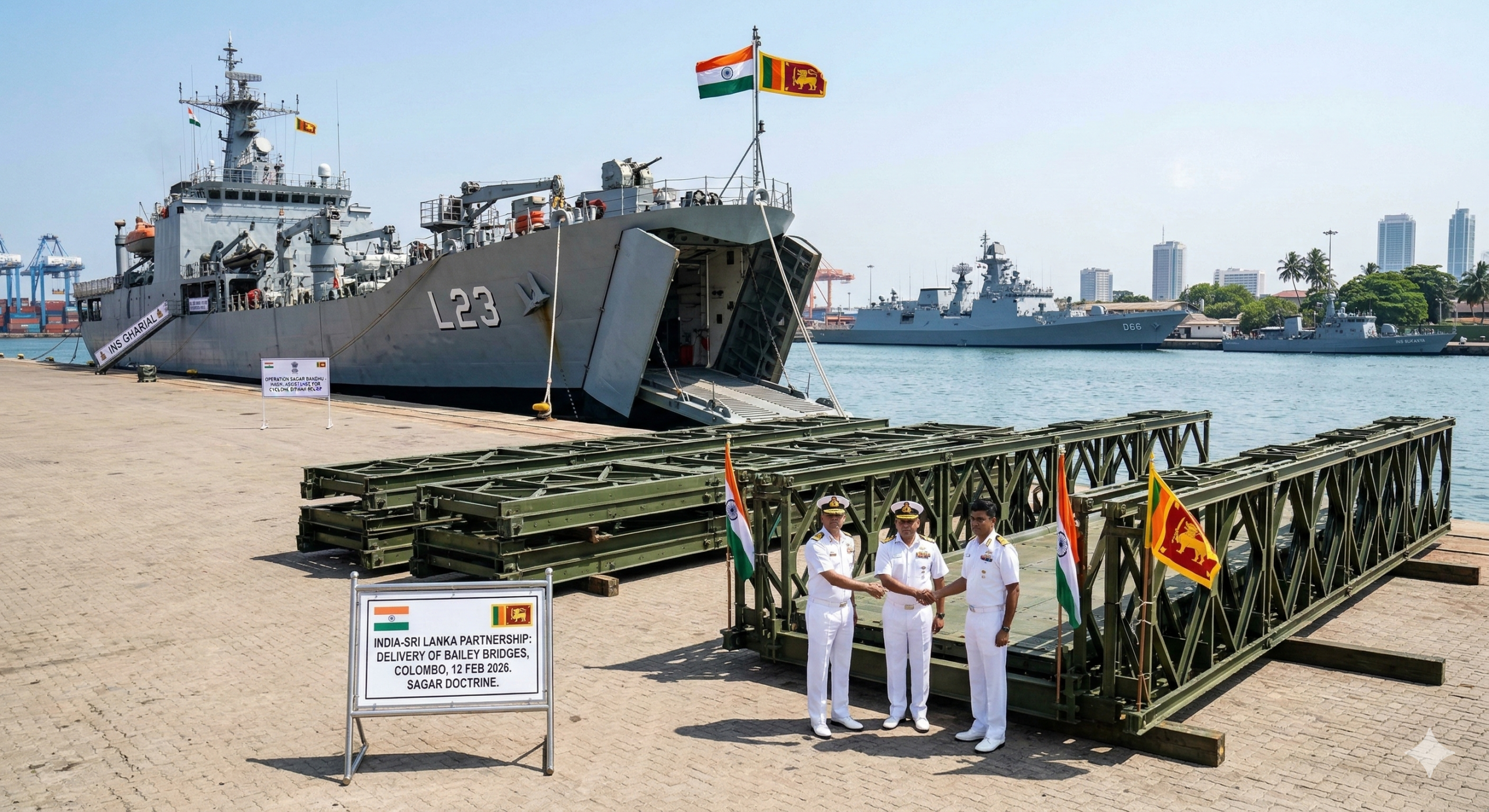
Naval exchanges, humanitarian missions, and cooperative security frameworks now play roles once dominated by embassies and summits. India’s delivery of ten Bailey bridges to Sri Lanka in February 2026—carried aboard INS Gharial and handed over on Sri Lanka’s 78th Independence Day—fits squarely within this emerging pattern. The bridges will restore mobility in districts ravaged by Cyclone Ditwah, but they also illustrate how India’s maritime outreach has evolved into one of New Delhi’s most reliable foreign-policy instruments.
Cyclone Ditwah struck Sri Lanka late last November, cutting through several districts and leaving entire communities stranded behind collapsed bridges and broken highways. Within a day, India launched Operation Sagar Bandhu, dispatching trained disaster responders who reached Sri Lanka even before local authorities had finished assessing the scale of destruction. Naval helicopters, diversion of vessels, and rapid logistics—the kind of coordination that usually takes days—happened almost immediately. Hundreds of people were rescued during those early hours when, as officials often say, “the clock matters more than the equipment.”
The relief effort did not stop there. Over the next several weeks, India continued to expand its support: INS Gharial, LCU 54, LCU 51, and LCU 57 delivered close to 1,000 tonnes of dry rations and emergency supplies. INS Vikrant, INS Udaygiri, and INS Sukanya had already carried out aerial relief drops and transported essential goods to areas that could not be reached by road. For many Sri Lankans watching the Navy’s steady presence, the pattern felt familiar.
India’s Navy has long acted as a first responder in the Indian Ocean Region. For Sri Lanka, this memory dates back to Operation Rainbow during the 2004 tsunami, when Indian vessels were among the earliest to arrive at Galle and Trincomalee. Assistance followed again in 2016 during the Cyclone Roanu floods, in 2017 after heavy monsoon rains, and most notably in 2021 when the X-Press Pearl caught fire and threatened to trigger a severe maritime pollution crisis.
While these missions are humanitarian at their core, they also serve another function—they strengthen India’s credibility as a dependable neighbour in the Indian Ocean. Diplomats often refer to “trust capital,” a somewhat abstract term, but in India–Sri Lanka relations, this trust has been earned through repeated, on-the-ground delivery. This is where naval diplomacy becomes significant.
In the last few decades, the Indian Navy has become an integral part of India’s foreign-policy playbook. India has used maritime capability not only to secure sea lanes or conduct patrols but also to engage partners, support coastal states, and respond quickly when disaster strikes.
In June 2024, Sri Lanka commissioned its Indian-funded Maritime Rescue Coordination Centre, a major boost to its maritime safety architecture. In the same year, India also gifted a Dornier maritime reconnaissance aircraft, providing Sri Lanka with much-needed surveillance capability. These moves deepened trust and demonstrated that India’s engagement extended beyond episodic crisis response.
Such diplomacy becomes even more important in light of recent geopolitical developments. Between 2022 and 2024, India flagged the surge in visits by Chinese research vessels. Sri Lankan officials maintained that the visits were scientific and routine; however, in deference to the concerns of neighbouring countries, Colombo eventually imposed a year-long pause on foreign research vessels. It later introduced a new Standard Operating Procedure to regulate overseas naval and air force visits. At least one naval exercise with Pakistan, scheduled near Trincomalee, was reportedly postponed after India conveyed its reservations. These were not isolated gestures; they helped lay the groundwork for a more structured defence partnership.
The turning point came in April 2025, when Prime Minister Narendra Modi travelled to Colombo to sign a Memorandum of Understanding on Defence Cooperation. It was described as the most substantial defence agreement between the two countries since 1987. This marked a shift for both sides—from reactive coordination to a more strategic approach that included joint training, improved interoperability, and a shared understanding of the maritime environment.
None of these decisions occurred in isolation. They reflected, in part, Colombo’s recognition that India’s security concerns are intertwined with its own. India’s humanitarian support—including missions such as Sagar Bandhu—played a quiet but steady role in reinforcing that understanding.
Naval diplomacy also operates through high-level engagements. In September 2025, India’s Chief of Naval Staff, Admiral Dinesh K. Tripathi, visited Colombo and held discussions with Prime Minister Dr. Harini Amarasuriya and senior military leaders. The talks focused on interoperability, joint training, and Sri Lanka’s participation in regional naval initiatives. While such meetings may appear ceremonial, they help build familiarity between officers, strengthen communication channels, and create habits of cooperation that prove critical during crises.
India frames this approach under the SAGAR doctrine—Security and Growth for All in the Region. It is an ambitious concept, but missions like Sagar Bandhu make it tangible.
For Sri Lanka, the long-term benefits extend beyond disaster relief. Strong maritime coordination helps protect fisheries, deter illegal activities, and improve emergency response. It also gives Colombo greater space to navigate the pressures of major-power rivalry, knowing it has a neighbour whose assistance arrives without overt conditions.
India’s naval diplomacy, therefore, is not an abstract idea. It is visible on the ground—in reconstructed roads, rescued lives, and the quiet confidence that Sri Lanka can rely on a neighbour that understands both its vulnerabilities and its ambitions.