

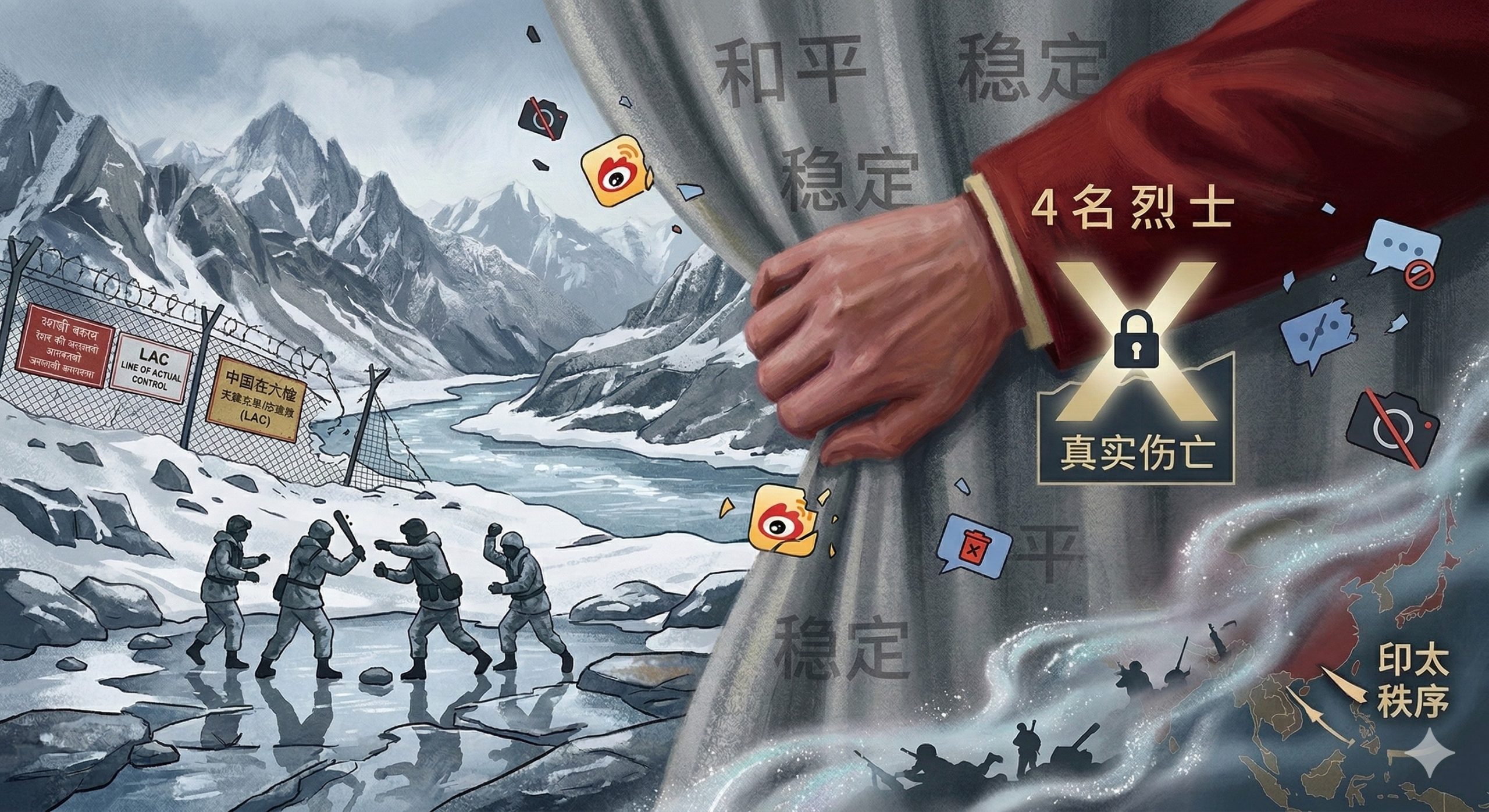
The Chinese Communist Party’s delayed and disputed admission of casualties from the June 15, 2020 Galwan Valley clash continues to cast a long shadow over India–China relations and the wider Indo-Pacific security landscape.
While India publicly acknowledged the loss of 20 soldiers within days of the confrontation in eastern Ladakh, Beijing waited eight months—until February 19, 2021—to confirm that four People’s Liberation Army (PLA) personnel had died. Independent research, media investigations, and Russian assessments, however, suggested that the true number of Chinese fatalities may have been significantly higher, with some estimates exceeding 30.
The disparity between China’s official account and external assessments has since become emblematic of what critics describe as Beijing’s strategic opacity—an approach that blends operational assertiveness with tight narrative control.
Infrastructure, Escalation, and the Galwan Clash
The Galwan Valley clash marked the first combat fatalities along the Line of Actual Control (LAC) in 45 years. Tensions had been mounting since April 2020, when the PLA undertook forward deployments and infrastructure expansion in eastern Ladakh, including road-building and fortifications near contested areas.
New Delhi viewed these actions as attempts to unilaterally alter the status quo.
On the night of June 15, Indian and Chinese troops engaged in brutal hand-to-hand combat, adhering to longstanding agreements prohibiting firearms along the LAC. Twenty Indian soldiers were killed in action. India swiftly disclosed the casualties, held public funerals, and briefed Parliament.
China, by contrast, remained silent about its own losses for months. Official statements framed Beijing as the aggrieved party, accusing India of provocation—even as satellite imagery and intelligence assessments indicated coordinated Chinese mobilisation preceding the clash.
Delayed Admission and Information Control
When Beijing eventually acknowledged four fatalities in February 2021, the announcement was accompanied by state-curated “martyr” narratives and patriotic commemoration campaigns. By then, foreign analysts and investigative journalists had uncovered digital traces suggesting a higher toll.
Silenced Weibo posts, briefly published local reports referencing additional casualties, and online obituaries that were swiftly removed raised further questions. Researchers documented censorship patterns and the detention of bloggers who publicly challenged the official figure.
The contrast in approaches was stark. India’s open acknowledgment of its losses stood against China’s criminalisation of domestic scrutiny. The episode reinforced perceptions that the CCP prioritised narrative management over transparency—even in matters of military accountability.
Beyond Galwan: A Broader Strategic Pattern
The Galwan controversy did not unfold in isolation. Analysts have noted parallels with Beijing’s behaviour in the South China Sea, where incremental territorial assertions are often paired with legal ambiguity, information control, and calibrated escalation.
In both contexts, infrastructure expansion on contested ground is accompanied by tightly managed public messaging. The objective, critics argue, is to consolidate tactical gains while limiting reputational costs.
Such patterns have deepened mistrust across the region. The Quad—India, the United States, Japan, and Australia—has increasingly emphasised transparency, rules-based order, and maritime security cooperation amid concerns over Chinese assertiveness.
For India, Galwan became a strategic inflection point, accelerating military infrastructure upgrades along the LAC, expanding defence partnerships, and pushing supply-chain diversification efforts.
Trust Deficit and Deterrence
Transparency in crisis situations is critical for confidence-building, particularly between nuclear-armed neighbours. By delaying casualty disclosures and shifting blame, Beijing weakened the credibility of its diplomatic messaging during subsequent disengagement talks.
The gap between official Chinese claims and independent findings has fed broader scepticism—whether regarding border negotiations, maritime claims, or military posture. Once eroded, trust is difficult to restore.
Deterrence in Asia increasingly rests not only on military capability, but on credibility. When official narratives diverge sharply from observable evidence, strategic ambiguity can harden into enduring distrust.
Transparency as a Strategic Imperative
The Galwan Valley clash remains a watershed in contemporary India–China relations. Beyond the tragic loss of life, it exposed the fragility of confidence-building mechanisms and the dangers of opaque military manoeuvres along contested borders.
For policymakers and researchers, the lesson is straightforward: transparency is foundational to stability. Open-source intelligence, independent journalism, and multilateral engagement play a growing role in scrutinising state narratives and deterring unilateral attempts to reshape facts on the ground.
As Asia navigates an increasingly contested security environment, the legacy of Galwan underscores a fundamental principle—credible peace depends not only on disengagement agreements but also on truth.
Without transparency, distrust deepens. And in volatile border regions, distrust can escalate faster than diplomacy can contain it.