

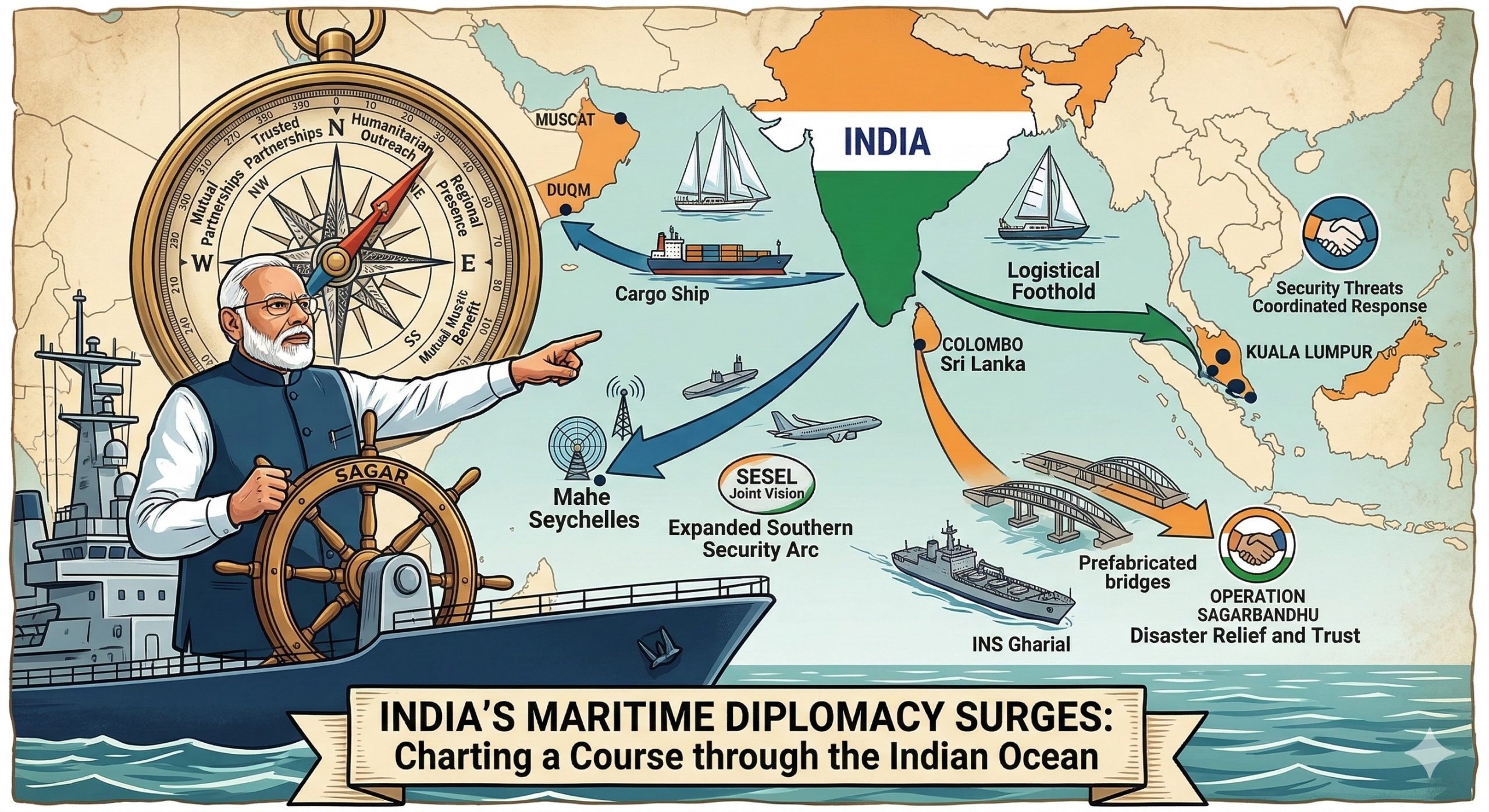
India’s maritime diplomacy surged with visible momentum this past week, though the developments on display were the result of long-building efforts rather than sudden action. Behind the headlines of naval sailings, summit visits and economic pledges lies a strategy that New Delhi has been calibrating for years. This strategy rests on three pillars: trusted partnerships, humanitarian outreach and sustained regional presence.
The first hint of that strategy’s scale emerged not from the Indian Ocean itself but from Kuala Lumpur, where Prime Minister Narendra Modi’s visit on February 8 deepened ties with Malaysia. In the Year of India–ASEAN Maritime Cooperation, the visit was as much about geopolitics as it was about diplomacy. Both countries agreed to elevate their relationship to a Comprehensive Strategic Partnership, a label that signals much more than ceremonial goodwill. Two years back, in 2024, both countries agreed to elevate their relationship to a Comprehensive Strategic Partnership, a label that signals much more than ceremonial goodwill.
The partnership reflects India’s intent to contribute to stability there, especially through joint drills like Samudra Laksamana, which encourage coordinated responses to shared security threats. In recent years, several Indian naval ships have been making more frequent calls in Southeast Asian waters—notably INS Sahyadri and INS Sandhayak—to build familiarity with Malaysian forces. But the real strategic pull lies in geography: Malaysia sits astride the Strait of Malacca, a conduit for Asia’s trade. To the west, in Oman, the naval narrative took on a different texture. Sail-training vessel INS Sudarshini dropped anchor in Salalah as part of the Lokayan 26 expedition—a ten-month journey meant to trace India’s historic seafaring routes. Earlier in the year, INSV Kaundinya had visited Muscat, reinforcing Oman’s role as a reliable partner. But this relationship is about more than symbolism. Oman’s importance lies in its strategic location and its willingness to cooperate. India’s access to Duqm Port gives its navy a logistical foothold beyond the unpredictable Strait of Hormuz. In recent years, joint activities such as Naseem Al Bahr drills have expanded under a 2025 Vision Document on Maritime Cooperation, addressing everything from piracy deterrence to sustainable marine trade.
Further south, India’s focus shifted toward island security. On February 9, New Delhi announced a 175 million USD special economic package for Seychelles—a compact archipelago whose waters span a vast stretch of the southern Indian Ocean. In discussions with President Patrick Herminie, India and Seychelles launched the SESEL Joint Vision, a roadmap that marries economic resilience with maritime security. India’s cooperation with Seychelles has already yielded tangible assets–radar stations that widen maritime surveillance, Dornier aircraft to patrol fisheries and waters, and support for a hydrography unit in Victoria that strengthens ocean mapping. In 2025, Seychelles became a full member of the Colombo Security Conclave, bringing it into a network of regional security coordination. For India, expanding this southern security arc is vital; the Indian Ocean’s southern reaches have long suffered from gaps in maritime domain awareness, inviting risks like illegal fishing and trafficking. Yet the most emotionally resonant chapter of India’s maritime outreach this week took place in Sri Lanka. External Affairs Minister S. Jaishankar was in Colombo for the island’s 78th Independence Day celebrations—but his presence was tied to something far more practical–the continuation of Operation Sagarbandhu, India’s disaster relief initiative.
After Cyclone Ditwah struck Sri Lanka in late 2025, India responded swiftly. This week, the Indian Navy’s INS Gharial delivered ten Bailey bridges to northern districts where roads had been washed away. These prefabricated bridges will restore essential links for civilians and commerce alike. India’s humanitarian footprint in Sri Lanka stretches back years, from Operation Rainbow in 2004 to emergency missions during the 2016 floods and relief flights in 2017. These efforts have built trust, and India’s role as Sri Lanka’s principal partner for naval training and equipment helps maintain the neutrality of Sri Lankan waters at a time when strategic competition in the Indian Ocean is intensifying.
What unites all these actions—the diplomatic visit in Kuala Lumpur, the port calls in Salalah, the security cooperation with Seychelles and the humanitarian work in Colombo—is a coherent philosophy. India’s approach stems from the doctrine of SAGAR (Security and Growth for All in the Region), extended more recently into a broader framework called MAHASAGAR. Unlike power-centric models that seek dominance, this philosophy emphasises mutual benefit: shared economic opportunity, cooperative security efforts and respect for sovereignty. In the coming months, India will host MILAN 2026, one of its largest planned multilateral naval exercises. Analysts say the recent week’s engagements foreshadow what many observers expect to be an expanded invitation list and deeper operational collaboration.