

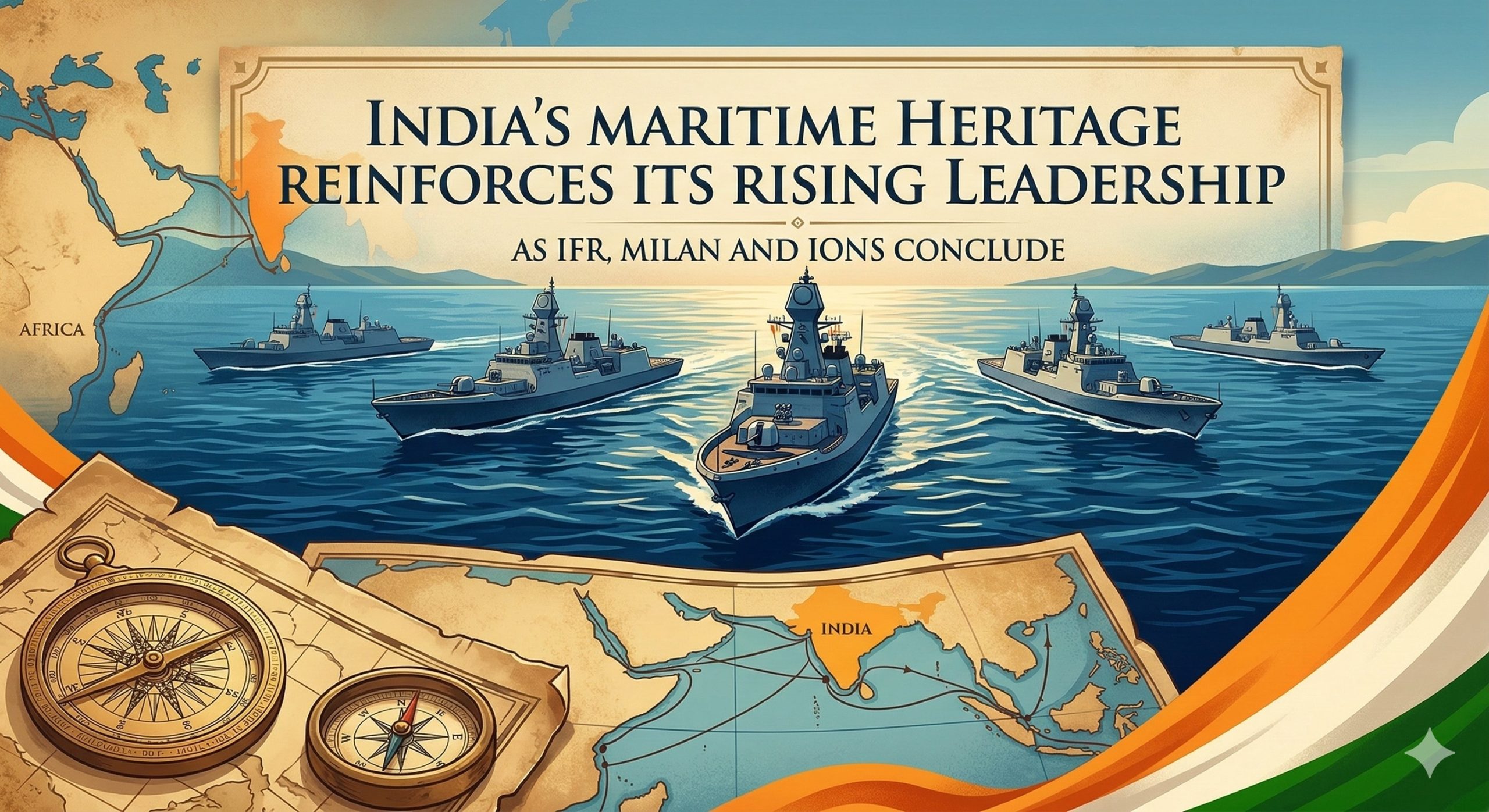
India’s geography, history and strategic position have once again converged to highlight its role as a natural maritime hub. Three major naval engagements—the International Fleet Review (IFR), the multilateral naval exercise MILAN, and meetings associated with the Indian Ocean Naval Symposium (IONS)—concluded successfully this week. Held between 15 and 25 February, these events underlined India’s growing responsibility and influence in maintaining stability across the Indian Ocean and the wider Indo-Pacific region.
India has a coastline of more than 7,500 kilometres, and the subcontinent has historically been connected to distant shores through maritime trade and cultural exchange. Archaeological evidence from sites such as Poompuhar and Arikamedu along the Coromandel Coast indicates active maritime trade networks stretching back many centuries. Literary references, inscriptions and foreign accounts describe Indian merchants and sailors travelling across the Bay of Bengal and the Arabian Sea, reaching Southeast Asia, China, Arabia and East Africa.
For long periods of history, the Bay of Bengal functioned as a corridor of commercial and cultural interaction. Dynasties such as the Satavahanas, Kalingas and later the Cholas maintained maritime connections that linked the Indian subcontinent with regions corresponding to present-day Myanmar, Indonesia, Vietnam and Cambodia. These exchanges helped transmit religious ideas, artistic styles and trading practices across the region. In this sense, the interconnected maritime space now described as the Indo-Pacific had historical precedents in the trading networks of the ancient and medieval Indian Ocean world.
This civilizational maritime background forms the context for India’s contemporary naval outreach. Increasing strategic competition, emerging maritime security challenges and the critical importance of sea lanes have drawn renewed attention to the Indo-Pacific. India’s central location in the northern Indian Ocean gives it a natural stake in promoting stability, cooperation and open sea routes across the region.
The recently concluded International Fleet Review brought together ships and delegations from numerous partner navies along India’s eastern seaboard. The event highlighted the Indian Navy’s operational capabilities, professional standards and expanding technological capacity.
At the same time, MILAN—India’s flagship multilateral naval exercise—witnessed one of its largest editions. From modest beginnings in 1995 as a regional gathering of a handful of navies, MILAN has evolved into a significant Indo-Pacific maritime exercise. This year’s programme included coordinated manoeuvres, maritime security drills, humanitarian assistance simulations and exchanges on common operational challenges.
Meetings held under the framework of the Indian Ocean Naval Symposium (IONS) also brought together naval chiefs and senior officers from across the Indian Ocean region. Discussions focused on issues such as maritime piracy, illegal fishing, climate-related maritime risks and the protection of commercial shipping routes. Participants reaffirmed the importance of cooperation and information sharing among regional navies.
Taken together, IFR, MILAN and IONS reflect India’s evolving maritime identity. From being an ancient connector of cultures and trade routes across the Indian Ocean, India today is emerging as a central strategic actor in shaping the security architecture of the Indo-Pacific. The successful conduct of these engagements illustrates the Indian Navy’s growing diplomatic role and the confidence that regional partners place in India.
Officials emphasised that India’s maritime approach is not centred on power projection alone but on partnership. Its naval diplomacy promotes inclusivity, transparency and cooperative security—principles that resonate with the subcontinent’s long history of maritime exchange.
With a strong heritage behind it and an active diplomatic agenda ahead, India is steadily reinforcing its position as a key maritime hub of the Indo-Pacific—one rooted in history and reaffirmed by the successful conclusion of IFR, MILAN and IONS.