

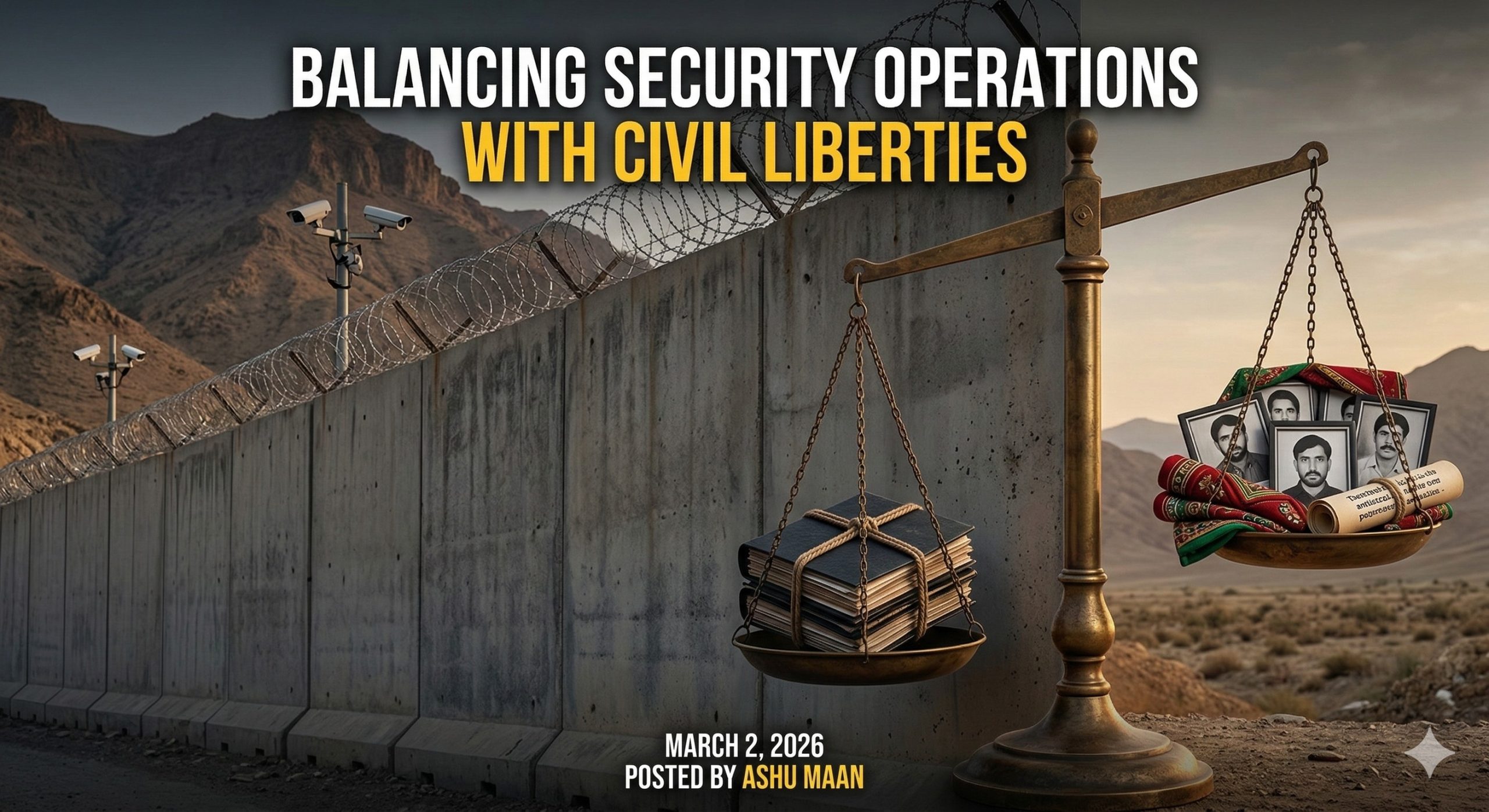
Baloch Culture Day on March 2 is a reminder that identity and dignity do not disappear simply because a state tries to silence them. Yet in Pakistan’s Balochistan province, cultural celebration coexists with enforced disappearances, collective punishment, and a security paradigm that treats an entire population as suspect in the name of counterinsurgency.
A Fractured Security Landscape
Balochistan has been suffering from a low-intensity insurgency, with attacks on security forces, infrastructure, and Chinese-related projects under the China-Pakistan Economic Corridor (CPEC). Militants have been attacking military convoys, police posts, and energy infrastructure, and there have been high-profile attacks on the Gwadar port complex and on the Pakistan Stock Exchange in Karachi to demonstrate reach beyond the province. The Pakistani state uses this violence to justify its extensive security presence, with massive cantonments, intelligence activities, and broad powers for paramilitary forces such as the Frontier Corps.
It is impossible to argue that the state does not have a role to play in safeguarding civilians and vital infrastructure from militant attacks. The issue in Balochistan is that the security paradigm has been constructed almost entirely in a coercive framework, while development and political engagement are left as mere rhetoric. If the aim of counterinsurgency is no longer to build a social contract but to become an objective in itself, then while force may temporarily quell violence, it will never build a foundation for peace.
The human rights deficit
Human rights groups such as Amnesty International and Human Rights Watch have been documenting the patterns of enforced disappearances, extrajudicial killings, and torture in custody in Balochistan. Relatives, usually led by women, have marched from Quetta to Islamabad with pictures of their missing sons and husbands, only to be greeted with indifference, harassment, or further intimidation. The denial of these abuses, much less any effort to correct them, has contributed to the alienation of Baloch society and the militancy that the government of Islamabad is fighting.
The Commission of Inquiry on Enforced Disappearances in Pakistan has itself recorded thousands of cases nationwide, with Balochistan contributing significantly to this number. As of mid-2025, official figures indicate that out of more than 10,000 total cases received since 2011, over 8,800 have been disposed of, leaving approximately 1,700 still pending. However, the prosecution of offenders, especially in the security apparatus, remains negligible, which has emboldened the culture of impunity. The message to the Baloch youth is frighteningly clear: the law will not safeguard you against the state; the state should be feared, not trusted.
Constitutional Promises, Selective Delivery
In theory, the Pakistani constitution enshrines basic rights such as due process, freedom of expression and association, and protection against arbitrary detention, which should protect citizens against the untrammeled actions of the state. In reality, these rights are consistently set aside in Balochistan by comprehensive security laws, the abuse of anti-terrorist legislation, and de facto military domination of the civilian sphere.
The Eighteenth Amendment and the National Finance Commission were intended to enhance federalism and transfer more authority to the provinces regarding their finances, but in Balochistan, the gas, minerals, and seafront are still administered from Islamabad and Rawalpindi. The terms of the revenue-sharing agreement are not transparent, the local government is weak, and nationalist groups are periodically suppressed, such that most Baloch believe that constitutionalism is simply a screen for extraction as before.
Transparency and Accountability as Security Imperatives
It is all the more important to maintain transparency in their operations in Balochistan because of its fragile security environment. Each and every credible complaint of enforced disappearance or extrajudicial execution must set off a time-bound inquiry with the ability to compel security force personnel to testify and to declassify operation files if necessary. Civilian courts, not military courts, must try crimes committed against civilians, and the judgment must be made public to demonstrate that no agency is beyond the law.
International human-rights mechanisms, from UN special procedures to treaty bodies, have repeatedly urged Pakistan to criminalise enforced disappearance in domestic law and to ratify and implement the International Convention for the Protection of All Persons from Enforced Disappearance. Doing so, and actually enforcing those provisions, would not weaken counterinsurgency; it would strengthen the legitimacy of every lawful security operation by drawing a clear line between the state and the militants it claims to oppose.
Recentring dialogue and political representation
Security-orientated policy has contracted, rather than expanded, the role for peaceful politics in Balochistan. Meaningful dialogue must engage not only compliant elites but also nationalists and students who express the grievances of the Balochis about the management of resources, language, and military excesses. Making dissent a crime or labelling all critics as agents of a foreign power may have its uses in propaganda in Islamabad, but it closes the very channels through which a conflict can be diffused.
A serious federal bargain would involve transparent agreements on revenue-sharing from gas, minerals, and ports, with legally enforceable guarantees for provincial and local participation. It would mean empowering elected provincial institutions over cantonment boards on questions of land acquisition, policing priorities, and public order. Above all, it would require the security establishment to accept that durable stability flows from consent, not from perpetual surveillance and coercion.
The challenge of balancing security operations and the protection of civil liberties in Balochistan is not a theoretical exercise for academics; it is a measure of whether Pakistan has the capacity to envision itself as more than a garrison state. A rights-based approach to security would begin with a recognition of past injustices, the establishment of independent oversight, and the subordination of the intelligence and paramilitary agencies to civilian control.
It would also seek to integrate law and order with social policies, education, employment, and infrastructure that meet local needs, not simply serve as a platform for grand announcements, and treat Baloch nationals as partners in security rather than as perpetual suspects. Only then will events such as Baloch Culture Day be more than a testament to cultural vibrancy in the face of oppression; they will be a testament to a political system in which identity, dignity, and security can at last coexist.