

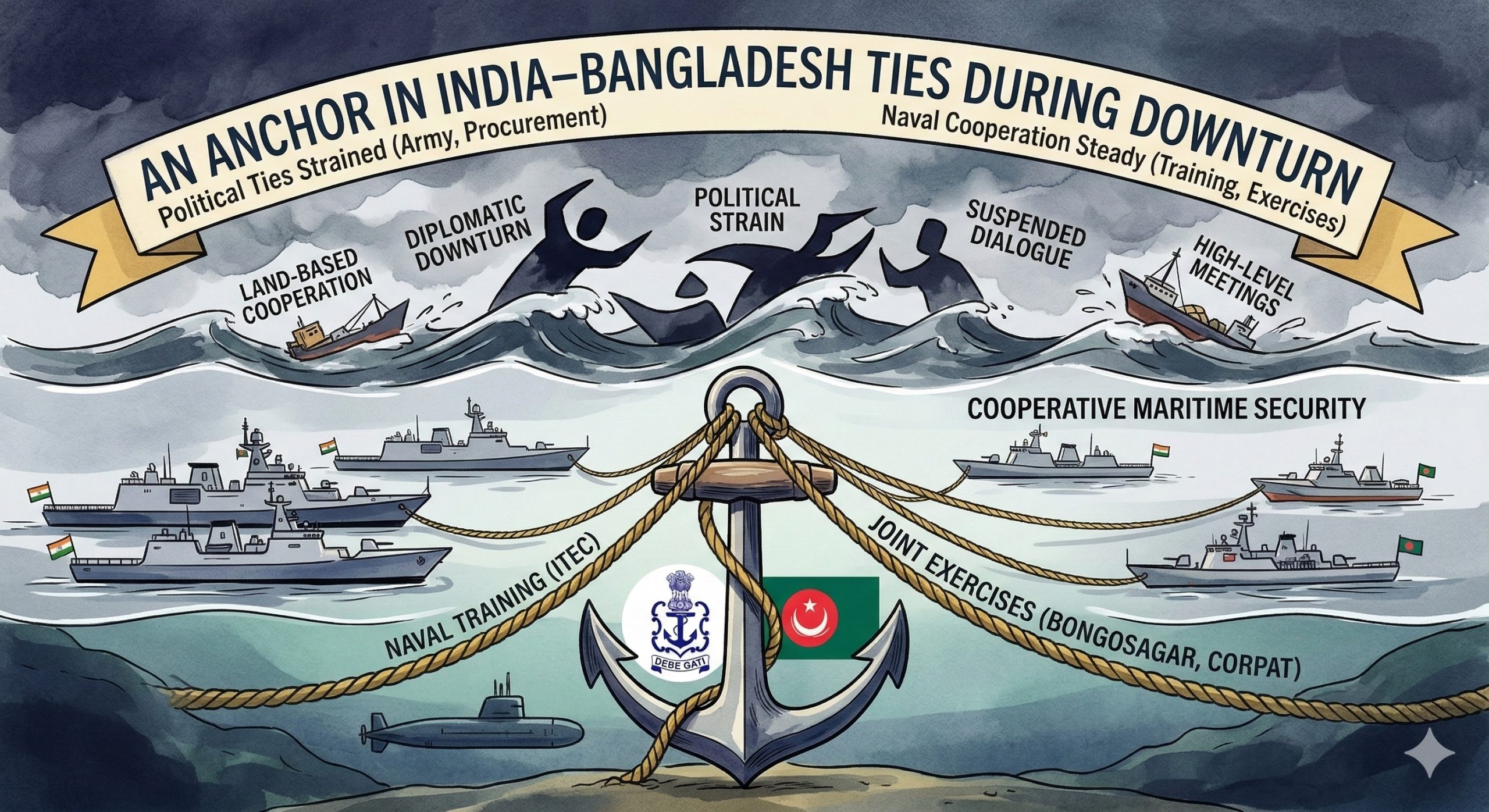
The last 18 months under the Yunus-led interim administration have been marked by visible strain in India–Bangladesh relations. During this period, political engagement slowed across multiple fronts. High-level meetings were postponed, routine dialogues lost momentum, and bilateral initiatives faced hesitation. Bangladesh’s cancellation of a defence procurement deal with an Indian shipbuilder in May 2025 reflected this cautious recalibration. Meanwhile, Exercise SAMPRITI—the flagship bilateral army exercise—has remained suspended since its last edition in 2023.
Yet, even as political ties cooled, naval cooperation continued largely as scheduled.
India’s long-standing naval training engagement with Bangladesh under the Indian Technical and Economic Cooperation (ITEC) programme has created a layer of professional continuity that politics has struggled to disrupt. Since 2016, hundreds of Bangladeshi naval personnel have trained at Indian naval institutions in areas such as navigation, engineering, communications, hydrography, and maritime law enforcement. These courses are practical in nature and designed to enhance operational competence at sea. Over time, they have fostered habits of coordination and professional familiarity rather than public spectacle.
That continuity held even during the most sensitive months of political recalibration. In 2024–25, when diplomatic exchanges were limited and public rhetoric cautious, Bangladeshi officers continued attending scheduled courses in India. Training pipelines remained functional, proceeding without overt political messaging or disruption.
Operational engagement at sea also endured. In 2025, the two navies conducted the fifth edition of the Bongosagar bilateral naval exercise and the sixth Coordinated Patrol (CORPAT) in the Bay of Bengal. Ships operated in designated sectors, drills were carried out, and patrols coordinated as planned. These activities took place at a time when broader bilateral diplomacy was operating at a subdued pace and major defence commitments—such as the cancelled shipbuilding contract—were under reconsideration. While the army-level exercise SAMPRITI has remained on hold, maritime cooperation retained momentum.
This pattern is not unique to Bangladesh. Across the Indian Ocean region, India’s naval engagement model places sustained emphasis on training and capacity building rather than solely on defence hardware transfers. Officers from countries such as Sri Lanka, Maldives, and Mauritius regularly undergo training in Indian institutions. These professional linkages often endure beyond electoral cycles or political transitions, providing a stabilising layer to bilateral ties.
The approach aligns with New Delhi’s Security and Growth for All in the Region (SAGAR) vision, which emphasises cooperative maritime security and regional capacity building. Its effectiveness, however, lies in its understated character. Training programmes do not bind partners to fixed political positions; instead, they cultivate institutional trust. When political circumstances fluctuate, that trust helps maintain channels of engagement.
Capacity building has long been a defining feature of the Indian Navy’s diplomatic outreach. Over time, this strategy has produced measurable continuity in maritime cooperation. Relationships built in classrooms, simulators, and joint exercises at sea have turned engagement into routine practice. In periods of diplomatic strain, that routine becomes an anchor—keeping lines of cooperation open even when formal political exchanges slow.
Helpful resource for global vendor negotiations