

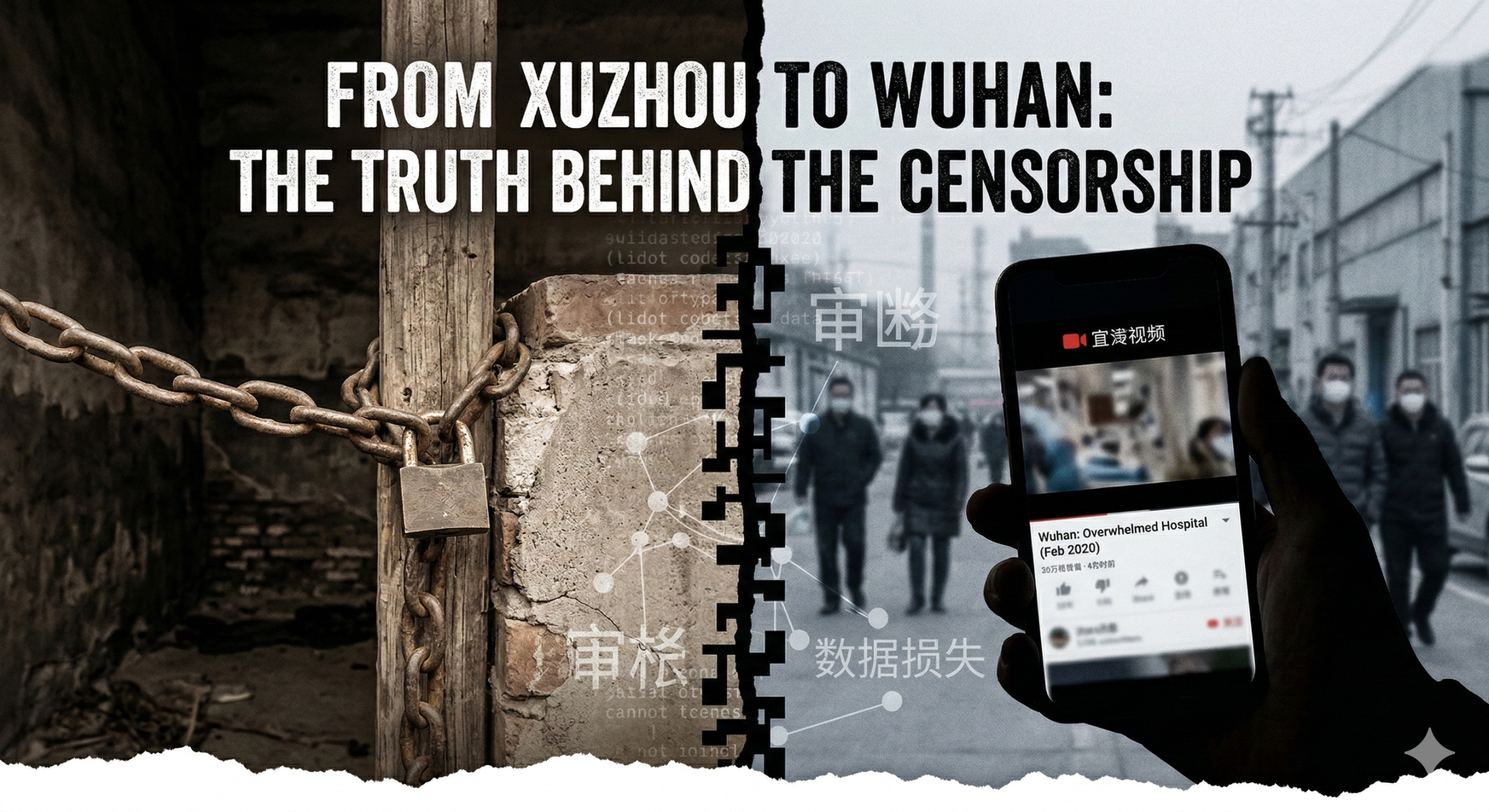
There is a playbook that runs the same way every time. Something surfaces that the government would prefer people not see. The public reacts. Posts spread faster than they can be deleted. Then the machinery begins to move. Searches get blocked. Accounts get flagged. The story gets picked apart and replaced with an official version that is easier to control. Eventually, most people move on.
That pattern could be seen in the Xuzhou chained woman case. It appeared again in the story of citizen journalist Zhang Zhan. And chances are, it has shaped the fate of many cases the outside world never even heard about.
The Xuzhou case became a flashpoint in early 2022 when video footage showing a woman chained by the neck inside a dilapidated structure in Jiangsu province spread across Chinese social media. The woman, later identified by investigators as Xiao Huamei, had reportedly been trafficked years earlier and forced into a life in rural Feng County, where she eventually gave birth to eight children.
The anger online was immediate and intense. Chinese internet users demanded answers about how such a situation could exist and remain unnoticed for so long.
Instead, the public received a series of shifting explanations. Initial local statements suggested the woman was mentally ill and legally married. As criticism mounted, higher-level investigations were launched and eventually confirmed that human trafficking had occurred, leading to arrests and disciplinary action against several officials.
But the information environment surrounding the case changed rapidly. Online discussions were restricted, hashtags disappeared, and public debate was curtailed before many of the questions raised by citizens could be fully explored.
The story of Zhang Zhan unfolded in a different context but followed a similar trajectory.
A former lawyer turned citizen journalist, Zhang traveled to Wuhan in early 2020 during the first weeks of the COVID-19 outbreak. From there she uploaded videos describing overwhelmed hospitals, lockdown conditions, and the experiences of ordinary residents. Much of her reporting circulated through platforms such as YouTube and social media channels accessible through digital workarounds.
Authorities detained Zhang in May 2020. In December of that year she was sentenced to four years in prison on charges of “picking quarrels and provoking trouble,” a broadly defined offense often used against activists and government critics.
After serving the full term, she was released in May 2024, though supporters reported that her movements and contacts remained closely monitored.
The message that emerges from cases like these is not always about the specific incident itself. Instead, it reflects the boundaries placed around information.
When sensitive stories begin to circulate—whether about human trafficking in rural China or reporting from the early days of a pandemic—the response often shifts quickly from public discussion to information control.
What this kind of environment risks undermining is not only the flow of information but also public trust. When difficult events trigger tighter control over the narrative rather than open scrutiny, it can deepen the gap between official accounts and public perception.
The Xuzhou woman needed protection long before her story went viral. Zhang Zhan believed the public deserved to see what was happening in Wuhan in real time.
Their stories are different in many ways. But both illustrate the same underlying tension: between the exposure of uncomfortable realities and the impulse to control the narrative around them.