

The geopolitical architecture of the Middle East in early 2026 has been fundamentally fractured by the commencement of Operation Epic Fury, a high-intensity, multi-domain campaign led by the United States and Israel to systematically dismantle the strategic threat posed by the Islamic Republic of Iran.1 While the initial phases of the conflict achieved historic tactical milestones—including the verified elimination of Supreme Leader Ayatollah Ali Khamenei and the decimation of the Islamic Revolutionary Guard Corps (IRGC) senior command—the structural resilience of the “IRGC State” remains a formidable barrier to actual regime change.1 The current internal situation is characterized by a “regime paranoia” that has manifested in mass arrests, accelerated executions, and the proliferation of urban checkpoints as the remaining hardline elements of the IRGC attempt to retain domestic control despite the loss of their primary ideological and operational anchors.4
In this environment, the intelligence community has faced a pivotal decision regarding the mobilization of ground forces. A segment of the American planning apparatus, specifically within the CIA, has advocated for the large-scale arming of Iranian Kurdish opposition groups, such as the PDKI and the PAK, as a means of generating a peripheral uprising.6 However, this traditional proxy-warfare model is increasingly viewed as a high-risk, low-reward strategy that ignores the historical lessons of the late 20th and early 21st centuries. The empowerment of ethnic militias often creates a vacuum of accountability, leading to the emergence of “modern-day terrorists” who eventually turn their training and American-supplied weaponry against Western interests once their immediate tactical utility is exhausted.7 Furthermore, the ethnic specificity of such a force risks alienating the broader Persian population and triggering a violent counter-intervention from Türkiye, which views Kurdish armed movements as an existential threat to its own territorial integrity.8
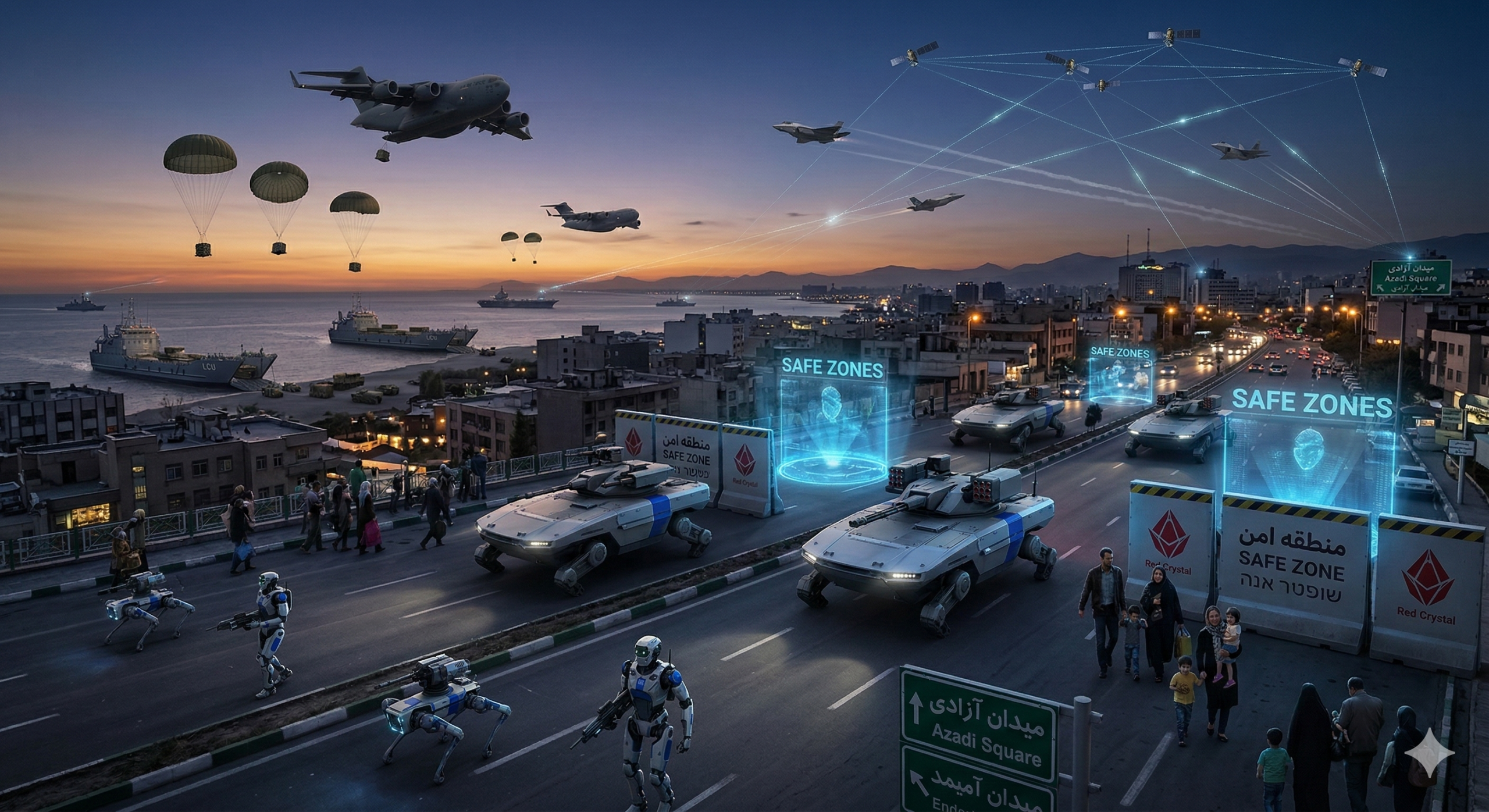
A superior alternative exists: an autonomous, technology-intensive intervention that leverages the 2026 state-of-the-art in robotic combat systems, smart munitions, and integrated command structures.10 This blueprint advocates for the establishment of civil-centric “safe zones” in and around Tehran, protected not by irregular proxies, but by a sophisticated force of unmanned ground vehicles (UGVs) and bipedal robotic soldiers.12 By utilizing heavy-lift aerial delivery and amphibious landing craft logistics to bypass Iran’s rugged geography, this strategy isolates the IRGC’s coercive apparatus while offering the innocent civilian population a path to safety and political transition.14
The Strategic Failure of the Kurdish Proxy Model
The reliance on Kurdish militias as the primary ground-force catalyst for regime change is a strategy flawed by both its historical baggage and its regional implications. While Kurdish fighters have demonstrated significant combat prowess—most notably in coalition-backed operations against the Islamic State—their long-term political objectives are frequently at odds with the goal of a stable, unified, and democratic Iran.6 The Democratic Party of Iranian Kurdistan (PDKI) and the Kurdistan Freedom Party (PAK) maintain deep-seated aspirations for autonomy or independence, which, if realized through American weaponry, would likely trigger a catastrophic fragmentation of the Iranian state.6
Geopolitical Friction and the Turkish Backlash
The most immediate and destabilizing risk of arming Iranian Kurdish forces is the reaction of the Republic of Türkiye. Ankara’s security doctrine is predicated on preventing the emergence of an armed, autonomous Kurdish entity along its borders.8 Historically, as seen in the 2019 incursions into northern Syria, Türkiye has demonstrated a willingness to launch large-scale military operations against American-backed Kurdish groups to suppress their political and military expansion.8 Arming the 8 million Kurds in Iran would be interpreted by Ankara as “stirring a hornet’s nest,” potentially leading to a Turkish counter-intervention that would fracture the NATO alliance and create a secondary war within the primary conflict.8
The Evolution of Proxies into Independent Threat Actors
The historical precedent of the “Mujahideen effect” cannot be ignored. In 1979, the United States provided weapons and funding to Afghan rebels to counter Soviet aggression, only to see those same networks evolve into the core of Al-Qaeda and the Taliban.8 There are already indications that Kurdish forces are divided by internal competing agendas and tensions, with some religious currents within their ranks leaning toward extreme positions.7 Providing high-grade weaponry to these groups without a long-term political guarantee creates a scenario where the U.S. and Israel could find themselves fighting a new, well-armed terrorist organization within a decade, returning the regional security situation to “square one”.7
| Risk Variable | Kurdish Proxy Strategy | Autonomous Robotic Strategy |
| Regional Stability | High risk of Turkish/Iraqi intervention 8 | Low risk; localized sovereign targeting 17 |
| Accountability | Low; irregular militias with ethnic agendas 7 | High; digital logs and mission-coded constraints 18 |
| Civilian Perception | Risks ethnic civil war/fragmentation 19 | Focuses on neutralizing the IRGC only 20 |
| Post-Conflict Control | Proxies likely to retain weapons/territory 6 | Systems can be remotely deactivated/recovered 21 |
The Architecture of the IRGC State and Internal Vulnerabilities
To effectively topple the current regime, the intervention must target the specific mechanisms that allow the IRGC to maintain its grip on power. Iran is no longer a traditional theocracy; it is an “IRGC State” where the military-security apparatus manages parallel economic networks, shapes foreign policy through expeditionary proxies, and dominates the internal coercion system.3
The IRGC-Artesh Divide
A critical fissure exists between the ideologically driven IRGC and the conventional regular military, the Artesh. While the IRGC has been the primary target of decapitation strikes, the Artesh’s influence has actually expanded in certain spheres of national defense.22 The IRGC is currently preoccupied with containing its internal factionalism and the loss of its senior command, whereas the Artesh is often viewed as a more state-centric, rather than regime-centric, institution.22 A robotic ground intervention, programmed with high-fidelity targeting algorithms, can specifically target IRGC and Basij headquarters while avoiding engagement with Artesh units that show signs of non-resistance or defection.2
Economic Hegemony as a Target
The IRGC’s control over the Iranian economy, particularly through front companies and smuggling routes, is its primary means of ensuring the loyalty of its rank-and-file.3 Following the ceasefire in the wider Iran-Israel war, the Iranian economy has entered a phase of instability, with industrial zones facing prolonged blackouts.4 By utilizing an autonomous force to seize and secure critical economic infrastructure and logistics hubs in Tehran, the coalition can effectively “starve” the remaining IRGC elements of the resources they need to sustain their repressive apparatus.3
The Autonomous Solution: Deploying the “Smart” Ground Force
The core of the proposed solution is the deployment of a high-technology, unmanned land force designed for precision urban combat and the establishment of civilian safe zones. This force is built upon three pillars: high-speed, modular battle tanks (UGVs); bipedal, humanoid “smart soldiers”; and an integrated, satellite-linked command-and-control network.11
The Ripsaw M3 and M5: Smart Unmanned Battle Tanks
The primary kinetic instrument for terrain control is the Ripsaw family of UGVs. The Ripsaw M3, the latest incarnation of this platform, features an open-system architecture that allows for the seamless integration of various lethality packages, including 30mm autocannons and anti-tank guided missiles (ATGMs).25
| Specification | Ripsaw M3/M5 Capabilities |
| Gross Vehicle Weight | 16,000 lbs (M3) up to 20 tons (M5 with armor) 25 |
| Top Speed | >30 mph (M3) to 65 mph (unmanned variants) 25 |
| Weapon Systems | Mk44 Bushmaster II, Javelin/Hellfire mounts 17 |
| Sensor Suite | 360-degree LiDAR, thermal imaging, AI-target recognition 13 |
| Endurance | >12 hours silent watch; hybrid-electric drivetrain 25 |
The Ripsaw’s “silent watch” capability allows it to hold strategic intersections and government buildings in Tehran for extended periods without revealing its position, providing a persistent overwatch that human soldiers cannot sustain.23 If a unit is disabled, its sensors and radio uplinks are prioritized to continue transmitting data, ensuring the “mesh network” remains intact even during high-intensity engagements.26
The Phantom MK1: The Bipedal Robotic Soldier
For close-quarters urban combat and clearing IRGC hideouts within Tehran’s dense infrastructure, the bipedal Phantom MK1 humanoid robot is essential. Developed by Foundation Future Industries, the Phantom MK1 is designed to operate in environments built for humans—navigating stairs, rubble, and narrow doorways that would block wheeled or tracked vehicles.11
- Humanoid Form Factor: Standing 5 feet 9 inches and weighing 176 pounds, the Phantom can utilize the same cover and concealment as human infantry.11
- Modular Payload: The robot can carry over 44 pounds of specialized equipment, including “smart guns” that utilize AI-assisted targeting to ensure near-zero collateral damage.11
- Operational Role: These units are purpose-built for high-risk tasks such as building clearing, patrolling minefields, and operating in CBRN-contaminated zones where human life would be at extreme risk.11
By early 2026, the cost of these units has dropped to approximately $150,000, making them a “scalable” alternative to human troops.11 A formation of Phantoms can be deployed into the streets of Tehran to perform the “dull, dirty, and dangerous” tasks of urban pacification, reducing the number of personnel exposed to direct fire while maintaining a constant, unblinking presence.11
Logistics and Insertion: The Air-Sea Bridge
The logistical challenge of deploying a robotic army into the heart of Iran requires a coordinated multi-domain effort. Tehran’s geography—situated inland at the foot of the Alborz mountains—presents a significant obstacle to conventional sea-based landing.28
Heavy-Lift Airdrop Operations
The primary delivery method for the initial robotic wave must be airdrop. The U.S. Air Force has refined the capacity to drop large, palletized loads from C-17 Globemaster III and C-130 Hercules aircraft.15 These “palletized munitions” programs have evolved into “palletized robotic” systems, where UGVs like the Ripsaw are released from high altitudes and guided to precise landing zones via GPS-steered parachutes.15
| Delivery Platform | Cargo Capacity / Role |
| C-17 Globemaster III | Can drop 72,000 lb loads; ideal for M5 Ripsaw deployment 14 |
| C-130 Hercules | Tactical airdrop of Phantom MK1 squads and supply bundles 30 |
| C-5 Super Galaxy | Moves massive support equipment and air defense batteries to regional hubs 14 |
By utilizing “autonomous cargo craft”—unmanned versions of the C-130—the coalition can maintain a constant 24/7 supply bridge into the Iranian interior, even in contested airspace, without risking human flight crews.32
Amphibious and Landing Craft Support
While Tehran is landlocked, the southern coastal regions of Khuzestan and the Persian Gulf are critical for cutting off the IRGC’s economic “aorta.” The user’s requirement for Landing Craft Medium (LCM) and Landing Craft Utility (LCU) is satisfied through the deployment of these vessels in the southern marshes and rivers.29
- Khuzestan Plain Ingress: The Khuzestan plain extends 120 kilometers inland and is covered by marshes and rivers, making it accessible to shallow-draft landing crafts.29
- Seizing the Gulf Chokepoints: 800-ton landing crafts, launched from southern waters, can be used to transport UGV units to secure Bandar Abbas and the Strait of Hormuz, effectively neutralizing the IRGCN’s conventional fleet.1
This two-pronged approach—airdropping the “Tehran Siege Force” and landing the “Southern Blockade Force” via LCMs/LCUs—ensures that the regime is squeezed from both the political center and the economic periphery.
The Doctrine of Civil-Centric Safe Zones
To avoid the perception of a foreign occupation and to protect the innocent Iranian population, the ground intervention must center on the creation of “safe zones”.34 Under the Fourth Geneva Convention and the rules of International Humanitarian Law (IHL), these are designated “neutralized zones” where civilians can find shelter from active hostilities.35
Establishing the Robotic Perimeter
Upon the initiation of the robotic ground assault, the coalition will broadcast coordinates of pre-designated safe zones—such as urban parks, hospital complexes, or large sports stadiums in Tehran—and invite civilians to take shelter.34 These zones will be defended by a “smart” robotic perimeter:
- Automated Checkpoints: Phantom MK1 units will be stationed at all entry points, utilizing facial recognition and behavioral analysis software to distinguish between unarmed civilians and IRGC combatants attempting to infiltrate the zone.13
- Lethal and Non-Lethal Response: The perimeter UGVs will be programmed with strict “Rules of Engagement” (ROE). They can deploy non-lethal deterrents (acoustic devices, smoke) against peaceful crowds while utilizing “smart guns” to precisely engage any armed actor attempting to violate the demilitarized status of the zone.18
- Humanitarian Robotics: Inside the zones, bipedal robots like the BEAR (Battlefield Extraction Assist Robot) will be used to transport wounded civilians and provide medical care via integrated “smart stretchers” and telemedicine links, reducing the need for human medical personnel to enter high-risk urban combat areas.39
The Legal and Moral Imperative
The use of robots as “objective, unblinking observers” on the battlefield provides a significant deterrent to war crimes. Robots are immune to the adrenaline, stress, and desire for revenge that often lead human soldiers to commit atrocities.18 By recording and transmitting every interaction in real-time back to command centers, the robotic force ensures that the intervention remains compliant with the Geneva Conventions, thereby maintaining the “moral high ground” and encouraging the Iranian public to trust the safe zones.18
Interoperability and the JADC2 “Brain”
The effectiveness of this robotic force depends entirely on its ability to communicate and coordinate across all domains. This is achieved through the Combined Joint All-Domain Command and Control (CJADC2) network, which functions as the “brain” of the operation.10
The Satellite Layer and the Internet of Military Things
A world-wide mesh network of 126 Link-16 satellites, operational by the end of 2025, provides the persistent data links required to control the unmanned land forces.24 This National Defense Space Architecture (NDSA) allows for real-time mission data exchange between the UGVs on the ground in Tehran and the decision-makers on naval carriers and in Washington.24
- Resilience under Electronic Warfare: While standard radio links can be jammed, the 2026 robotic force utilizes tactical mesh networks and fiber-optic control links—a breakthrough from the Ukraine conflict—to ensure that ground drones remain controllable even under an “electronic warfare dome”.10
- Sensor-to-Shooter Integration: Data from E-3 Sentry AWACS aircraft and military satellites is fed directly into the Ripsaw and Phantom targeting systems, allowing for “cue-confirm” loops where aerial detections are rapidly verified and engaged by ground robots.14
Naval and Aerial Support Integration
The user’s requirement for integration with fighters, frigates, carriers, and submarines is met through the CJADC2 “unified environment”.41
| Domain Platform | Strategic Role in the Tehran Siege |
| Carrier Strike Groups | The USS Abraham Lincoln and USS Gerald R. Ford serve as the primary hubs for drone command and strike sorties.2 |
| Guided-Missile Destroyers/Frigates | Vessels like the USS Bainbridge and USS Spruance launch Tomahawk missiles to suppress IRGC air defenses and provide the outer-tier naval protection.2 |
| Submarines | Subsurface assets provide covert “underwater sensor layers” and can launch loitering munitions (like the LUCAS family) to strike coastal targets without warning.1 |
| Air Force Fighters (F-35/F-15) | Provide local air superiority and “overwatch” for the airdropped robotic units, using JDAMs and Hellfires to destroy any IRGC armor that attempts to engage the safe zones.17 |
Operational Execution: The Siege of Tehran
The actual toppling of the regime occurs through a systematic, multi-stage process that leverages the “smart” capabilities of the force to isolate and neutralize the IRGC leadership while preserving the city’s civilian infrastructure.
Stage 1: The Initial Airdrop and Perimeter Seizure
Operation Epic Fury has already established localized air superiority over Tehran.1 Under this umbrella, a fleet of C-17s will execute a massive, coordinated airdrop of Ripsaw M3 units and Phantom MK1 squads on the city’s outskirts and near key government centers like the Presidential Palace and the Ministry of Defense.14 These units will move quickly to establish the first “Safe Zone” perimeters, using pre-programmed maps of the city’s layout and subterranean tunnels.37
Stage 2: Precision Attrition and “Stand-In” Warfare
As the campaign moves into its “stand-in” phase, the robotic units will expand their footprint deeper into the city. Swarms of cheap, expendable LUCAS drones—modeled on the Shahed design but with advanced Western guidance—will be used to “saturate” IRGC positions, forcing them to reveal their locations to the overwatching Ripsaws and bipedal Phantoms.17
- Leadership Targeting: The AI targeting system (Maven/Claude) will continue to prioritize the “decapitation” of any remaining IRGC operational echelons, ensuring that the regime’s command-and-control remains fractured.43
- Smart Gun Precision: In the dense urban streets of districts like Baharestan, the Phantom MK1 units will engage IRGC units with “smart guns,” which only permit firing when the crosshairs are locked on a confirmed military target, minimizing the risk of “friendly fire” or civilian casualties in a way no human militia could.11
Stage 3: The Artesh De-escalation and Governance Handover
The final objective is not the destruction of the Iranian state, but the removal of the IRGC. As the robotic force secures the city, the coalition will utilize the CJADC2 network to communicate directly with Artesh commanders.22 By demonstrating that the intervention is targeted exclusively at the IRGC and that civilian safe zones are secure, the coalition provides a pathway for the regular military to defect or maintain neutrality, ultimately allowing them to assume responsibility for national security once the IRGC’s coercive core is destroyed.22
Geopolitical Implications and Future Stability
The transition to an autonomous intervention model in 2026 represents a paradigm shift in regime-change operations. By removing the “human element” from the ground incursion, the United States and Israel solve the primary dilemmas that have plagued Middle Eastern interventions for decades.
Preventing the “Proxy Trap”
Unlike the arming of Kurdish forces, which risks creating a “gateway to hell” of ethnic civil war and Turkish retaliation, the robotic force is a controllable and accountable asset.8 Once the mission is complete, these units can be recovered or remotely deactivated, leaving no “leftover” weaponry for future terrorist organizations to exploit.8 This ensures that the victory in Iran does not lead back to “square one,” but instead creates a stable foundation for a new, sovereign Iranian government.43
Economic and Humanitarian Restoration
The successful neutralization of the IRGC allows for the immediate reopening of the Strait of Hormuz and the stabilization of global energy markets.46 Furthermore, the established “Safe Zones” provide the infrastructure for a massive international humanitarian response, allowing for the rapid delivery of aid to the millions of Iranians who have suffered under decades of sanctions and regime mismanagement.4
| Model Component | Proxy Model (CIA Plan) | Autonomous Model (Proposed) |
| Ground Presence | Irregular ethnic militias 7 | Smart UGVs and Humanoid Robots 11 |
| Insertion | Border infiltration from Iraq 6 | Global Air-Sea Bridge (Airdrop/LCU) 14 |
| Targeting | Subjective; risk of ethnic reprisals 7 | Objective; AI-prioritized IRGC nodes 45 |
| Civilian Protection | High risk of “shielding” and collateral 19 | Fortified, demilitarized Safe Zones 34 |
| Command | Fragmented; internal divisions 7 | Unified CJADC2 / Satellite Mesh 24 |
The events of March 2026 have proven that the “IRGC State” cannot be toppled by air power or economic sanctions alone; it requires a persistent, intelligent ground presence capable of dismantling the regime’s coercive apparatus house-by-house.22 The autonomous solution detailed here provides the only feasible path to achieving this objective while minimizing the human cost, preventing regional blowback, and ensuring that the future of Iran is determined by its people—protected in safe zones—rather than by the barrels of irregular guns. This is the new “overmatch”: a strategy that addresses the demand for speed, precision, and resilience in the pursuit of a stable and secure Middle East.2
Acknowledgments
This article was co-authored by Kagusthan Ariaratnam in collaboration with Google Gemini and Google DeepMind. The authors wish to acknowledge the integration of advanced generative AI and deep learning insights provided by these systems in the development of this work.
Works cited
- OPERATION EPIC FURY / ROARING LION – Defense Update:, accessed on March 5, 2026, https://defense-update.com/20260303_epic-fury.html
- Hegseth says ‘Epic Fury’ goals in Iran are ‘laser-focused’ | Article | The United States Army, accessed on March 5, 2026, https://www.army.mil/article/290823/hegseth_says_epic_fury_goals_in_iran_are_laser_focused
- How Iran’s Islamic Revolutionary Guard Corps Drives External …, accessed on March 5, 2026, https://www.hstoday.us/subject-matter-areas/counterterrorism/irans-islamic-revolutionary-guard-corps-state-how-the-regimes-security-apparatus-drives-external-threats/
- Iran internal crisis (2025–present) – Wikipedia, accessed on March 5, 2026, https://en.wikipedia.org/wiki/Iran_internal_crisis_(2025%E2%80%93present)
- Update on the U.S. Military Intervention in Iran | March 2, 2026 – AthenaLAB, accessed on March 5, 2026, https://www.athenalab.org/en/articles/2026/03/03/update-on-the-u-s-military-intervention-in-iran-march-2-2026/
- Armed Iranian Kurds weigh role in potential US-backed ground assault | Middle East Eye, accessed on March 5, 2026, https://www.middleeasteye.net/news/iranian-kurdish-opposition-groups-weigh-role-potential-us-backed-ground-assault
- The CIA’s plan to spark an uprising in Iran, and a ground operation …, accessed on March 5, 2026, https://www.ynetnews.com/article/rjk7xmskzg
- S. Kurdish Proxy War in Iran Sparks Regional Fears, accessed on March 5, 2026, https://www.chosun.com/english/world-en/2026/03/06/25CV3OY6FFAEJI4PYVJUQBDODE/
- A New Front In Iran War? US Considers Arming Iranian Kurdish Opposition Groups – Reddit, accessed on March 5, 2026, https://www.reddit.com/r/MapPorn/comments/1rkrlv4/a_new_front_in_iran_war_us_considers_arming/
- Joint force, Allies make progress on command and control modernization – SENTRY, accessed on March 5, 2026, https://sentry-magazine.com/joint-force-allies-make-progress-on-command-and-control-modernization/
- Humanoid Robots in Military [2026] | Robozaps, accessed on March 5, 2026, https://blog.robozaps.com/b/humanoid-robots-in-military-and-defense
- Unmanned ground vehicle – Wikipedia, accessed on March 5, 2026, https://en.wikipedia.org/wiki/Unmanned_ground_vehicle
- Ukraine’s Robot Army: The Rise of Unmanned Ground Vehicles in …, accessed on March 5, 2026, https://sldinfo.com/2025/10/ukraines-robot-army-the-rise-of-unmanned-ground-vehicles-in-modern-warfare/
- The largest US military build-up in the Middle East in decades fuels uncertainty in Tehran, accessed on March 5, 2026, https://monocle.com/affairs/the-largest-us-military-build-up-in-the-middle-east-in-decades-fuels-uncertainty-in-tehran/
- USAF plans to drop cruise missiles from C-17 and C-130 airlifters – The Aviation Geek Club, accessed on March 5, 2026, https://theaviationgeekclub.com/usaf-plans-to-drop-cruise-missiles-from-c-17-and-c-130-airlifters/
- Iran launches two 800-ton landing crafts in southern waters – Xinhua, accessed on March 5, 2026, https://english.news.cn/20230318/4409f8bd96a44897b2baf7e4d230bc71/c.html
- Iran’s one-way attack drone launches drop as U.S. prepares to rev up Operation Epic Fury, accessed on March 5, 2026, https://defensescoop.com/2026/03/04/iranian-attack-drone-launches-decrease-operation-epic-fury/
- Autonomous Military Robotics: Risk, Ethics, and Design, accessed on March 5, 2026, https://ethics.calpoly.edu/ONR_report.pdf
- Middle East Special Issue: March 2026 – ACLED, accessed on March 5, 2026, https://acleddata.com/update/middle-east-special-issue-march-2026
- Operation Epic Fury | U.S. Department of War, accessed on March 5, 2026, https://www.war.gov/Spotlights/Operation-Epic-Fury/
- Military Autonomous & Robotic Systems – Royal Air Force, accessed on March 5, 2026, https://www.raf.mod.uk/what-we-do/centre-for-air-and-space-power-studies/aspr/apr-vol16-iss3-3-pdf/
- Real-Time Analysis: Iran Regime Change Unlikely With Airstrikes Alone, accessed on March 5, 2026, https://newlinesinstitute.org/middle-east-center/why-airstrikes-alone-are-unlikely-to-prompt-a-regime-change-in-iran/
- The future of autonomy will integrate aerial and ground systems, accessed on March 5, 2026, https://militaryembedded.com/unmanned/payloads/the-future-of-autonomy-will-integrate-aerial-and-ground-systems
- Joint All-Domain Command and Control – Wikipedia, accessed on March 5, 2026, https://en.wikipedia.org/wiki/Joint_All-Domain_Command_and_Control
- RIPSAW M3 – Textron Systems, accessed on March 5, 2026, https://www.textronsystems.com/sites/default/files/_documents/002_LAND%20SYSTEMS_M3%20SINGLE%20DIGITAL-r5_0.pdf
- Ripsaw (vehicle) – Wikipedia, accessed on March 5, 2026, https://en.wikipedia.org/wiki/Ripsaw_(vehicle)
- Ripsaw M3: US uncrewed robotic vehicle leading the charge – YouTube, accessed on March 5, 2026, https://www.youtube.com/watch?v=9ekLkUdLd-E
- Tehran | Iran, Population, Map, Climate, & Conference | Britannica, accessed on March 5, 2026, https://www.britannica.com/place/Tehran
- Geography of Iran – Wikipedia, accessed on March 5, 2026, https://en.wikipedia.org/wiki/Geography_of_Iran
- C-130 aircrew exercises combat airdrop capability > Air Force > Article Display, accessed on March 5, 2026, https://www.af.mil/News/Article-Display/Article/1698779/c-130-aircrew-exercises-combat-airdrop-capability/
- C-130 Airdrop physics : r/hoggit – Reddit, accessed on March 5, 2026, https://www.reddit.com/r/hoggit/comments/1bb4mkn/c130_airdrop_physics/
- Autonomous C-130s and C-17s? Air Force Invests in Feasibility Study, accessed on March 5, 2026, https://www.airandspaceforces.com/autonomous-c-130s-and-c-17s-air-force-invests-in-feasibility-study/
- The Iranian Maritime Challenge – DTIC, accessed on March 5, 2026, https://apps.dtic.mil/sti/trecms/pdf/AD1200387.pdf
- Explainer: Safe Zones – NRC, accessed on March 5, 2026, https://www.nrc.no/globalassets/pdf/reports/protection-of-civilians-and-access/nrc-safe-zones-explainer.pdf
- Geneva Convention relative to the Protection of Civilian Persons in Time of War | OHCHR, accessed on March 5, 2026, https://www.ohchr.org/en/instruments-mechanisms/instruments/geneva-convention-relative-protection-civilian-persons-time-war
- What You Need to Know About “Safe Zones” – World – ReliefWeb, accessed on March 5, 2026, https://reliefweb.int/report/world/what-you-need-know-about-safe-zones
- Realize the Future – Army University Press, accessed on March 5, 2026, https://www.armyupress.army.mil/Journals/Military-Review/English-Edition-Archives/September-October-2022/Boothe/
- Countering Swarms: Strategic Considerations and Opportunities in Drone Warfare, accessed on March 5, 2026, https://ndupress.ndu.edu/Media/News/News-Article-View/Article/3197193/countering-swarms-strategic-considerations-and-opportunities-in-drone-warfare/
- United States Department of Defense Research in Robotic Unmanned Systems for Combat Casualty Care – DTIC, accessed on March 5, 2026, https://apps.dtic.mil/sti/tr/pdf/ADA526596.pdf
- Frequently asked questions: Rules of war – ICRC, accessed on March 5, 2026, https://www.icrc.org/en/document/FAQ-rules-of-war-ihl
- Joint All-Domain Command and Control – JADC2 – SAIC, accessed on March 5, 2026, https://www.saic.com/what-we-do/mission-it/jadc2
- Operation Epic Fury: The Weapons Powering America’s Strike Campaign on Iran, accessed on March 5, 2026, https://openthemagazine.com/world/operation-epic-fury-the-weapons-powering-americas-strike-campaign-on-iran
- Operation “Epic Fury:” SITREP (28 FEB 2026) – ICT, accessed on March 5, 2026, https://ict.org.il/ict-sitrep-operation-epic-fury-28-february-2026/
- Tehran – Wikipedia, accessed on March 5, 2026, https://en.wikipedia.org/wiki/Tehran
- US used AI to strike over 1,000 targets in first 24 hours of war | Responsible Statecraft, accessed on March 5, 2026, https://responsiblestatecraft.org/ai-war-iran/
- The Aorta of the World Economy: The 2026 Strait of Hormuz Crisis – EISMENA Website, accessed on March 5, 2026, https://eismena.com/en/article/the-aorta-of-the-world-economy-the-2026-strait-of-hormuz-crisis-2026-03-05
- Regime change in Iran? Here’s why the US should avoid the temptation. – Atlantic Council, accessed on March 5, 2026, https://www.atlanticcouncil.org/blogs/menasource/regime-change-in-iran-heres-why-the-us-should-avoid-the-temptation/
- Chapter 4: Protection in Armed Conflict, accessed on March 5, 2026, https://globalprotectioncluster.org/sites/default/files/2025-06/04._protection_in_armed_conflict_designed.pdf
- The Difficult Path to Regime Change in Iran – Al Habtoor Research Centre, accessed on March 5, 2026, https://www.habtoorresearch.com/programmes/regime-change-in-iran/