

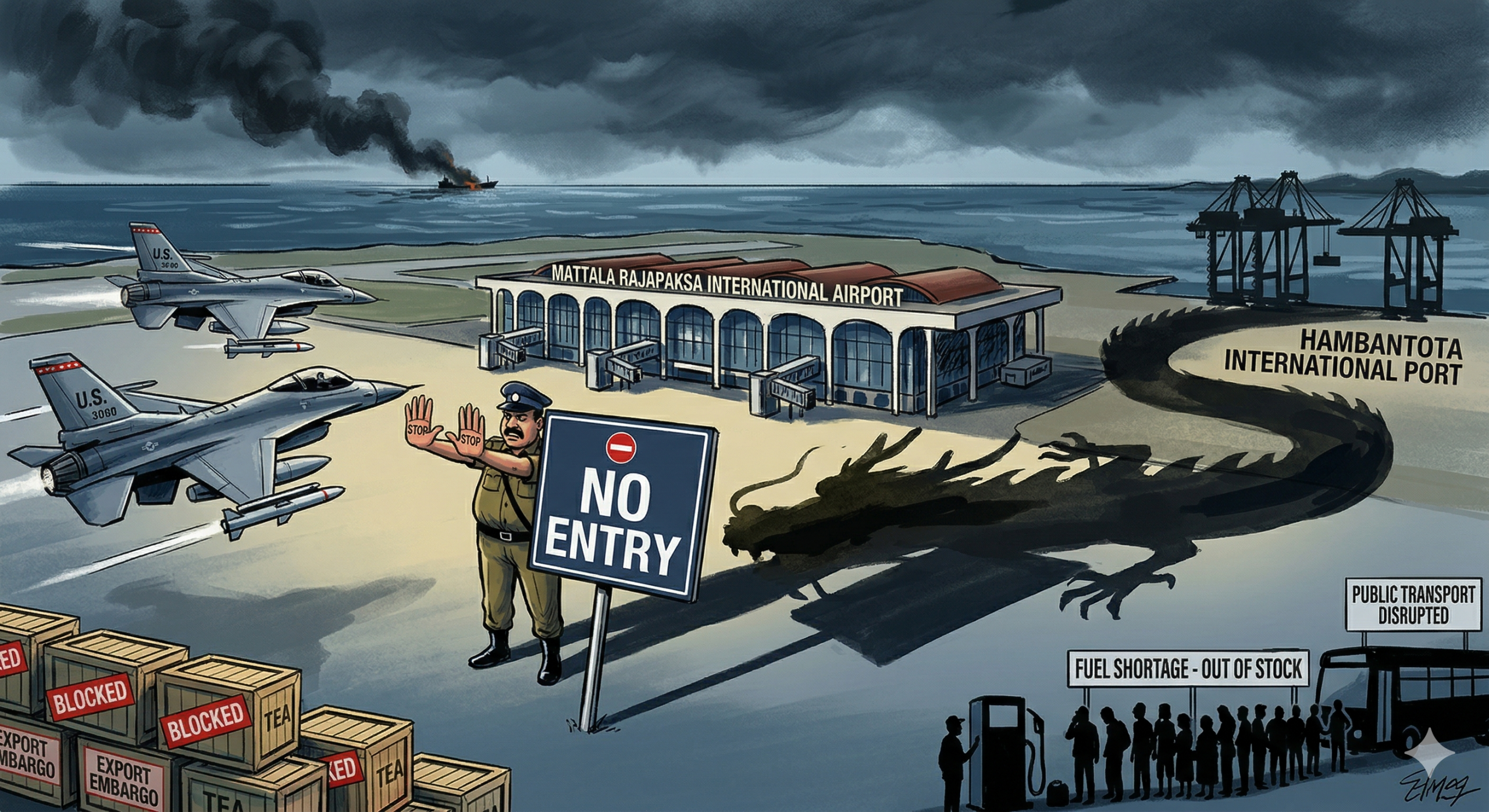
The decision by the administration of President Anura Kumara Dissanayake to deny the United States military access to the Mattala Rajapaksa International Airport in March 2026 represents a critical inflection point in the maritime security of the Indian Ocean Region. While the Colombo government maintains that this refusal was a calculated act of “strict neutrality” designed to insulate the island from the escalating conflict between the United States, Israel, and the Islamic Republic of Iran, a deeper analysis suggests a more complex reality.1 The strategic denial, issued only days before the commencement of Operation Epic Fury, provides substantial evidence that despite official claims of an equidistant foreign policy, Sri Lanka remains firmly tethered to a Chinese orbit—a position that carries the risk of severe geoeconomic and diplomatic consequences.4
The Crucible of Conflict: Operation Epic Fury and the Indian Ocean Theater
The broader context of the March 2026 crisis began on February 28, when a massive joint military offensive by the United States and Israel was launched against the Iranian regime.4 This campaign, dubbed Operation Epic Fury, aimed to dismantle Iran’s nuclear infrastructure and degrade its conventional military capabilities following years of rising tension.4 The opening salvo involved nearly 900 strikes in just twelve hours, resulting in the assassination of Supreme Leader Ali Khamenei and several other top-tier officials.4 Iran’s retaliation was swift and geographically expansive, utilizing its drone and ballistic missile arsenal to strike at regional U.S. allies and vital shipping corridors.7
As the conflict spilled over from the Persian Gulf into the wider Indian Ocean, the strategic value of Sri Lanka’s southern coastline increased exponentially. The importance of the region was underscored when Iran launched intermediate-range ballistic missiles (IRBMs) toward the joint U.S.-UK base at Diego Garcia, located in the central Indian Ocean.10 This strike, described by Iranian state media as a “significant step” demonstrating that Tehran’s reach exceeded previous Western estimations, forced the United States to seek additional logistical depth and “strategic spots” for the deployment of anti-ship and surveillance assets.10
| Strategic Event Log: Indian Ocean Escalation (March 2026) | Date | Significance | Primary Source |
| US-Israel launches Operation Epic Fury | Feb 28, 2026 | Surprise strikes on Tehran; death of Ali Khamenei | 4 |
| Sinking of the IRIS Dena | March 4, 2026 | US submarine torpedoes Iranian frigate off Galle, Sri Lanka | 13 |
| Strait of Hormuz effectively closed | March 4, 2026 | Iran shutters waterway, causing global oil price surge | 15 |
| Iranian missile strike on Diego Garcia | March 17, 2026 | Demonstrates Iranian IRBM capability in the IOR | 10 |
| Dissanayake reveals denial of US aircraft | March 20, 2026 | Public declaration of neutrality in Parliament | 1 |
The most direct engagement in Sri Lanka’s vicinity occurred on March 4, 2026, when the USS Charlotte, a Los Angeles-class submarine, torpedoed the Iranian frigate IRIS Dena approximately 19 nautical miles off the coast of Galle.13 The Dena, returning from a naval exercise in India, was sunk with the loss of at least 84 sailors, while 32 were rescued by the Sri Lankan Navy.13 This event not only brought the war to Sri Lanka’s territorial doorstep but also placed the Dissanayake government in a diplomatic vice, forced to manage the humanitarian fallout while under intense pressure from Washington to limit cooperation with Tehran.13
The Anatomy of the Denial: The Mattala Airport Request
Against this backdrop of kinetic warfare, the United States made a formal request on February 26, 2026, to station two combat aircraft at the Mattala Rajapaksa International Airport (MRIA) between March 4 and March 8.1 These aircraft, described as fighter jets armed with eight anti-ship missiles, were to be relocated from a U.S. base in Djibouti.1 The positioning of missile-armed warplanes at Mattala would have provided the U.S. Navy with a critical platform for monitoring the southern shipping lanes and potentially intercepting Iranian naval assets returning from the Bay of Bengal.2
The “Double Denial” Strategy and the Neutrality Defense
President Anura Kumara Dissanayake’s response to the U.S. request was framed through a narrative of strict, non-aligned neutrality. In a high-profile address to Parliament on March 20, the President disclosed that his government had simultaneously received a request from Iran for three of its naval vessels to make a “goodwill visit” to Sri Lankan ports between March 9 and March 13.1 By rejecting both requests, Dissanayake argued that the government was maintaining an equidistant stance.3 “With two requests before us, the decision was clear,” the President stated, adding that granting access to one side would have inevitably obligated the state to assist the other, thereby drawing Sri Lanka into a conflict far beyond its regional interests.2
This policy of “refusal to all” is seen by the Dissanayake administration as a survival mechanism for a small, import-dependent state.25 However, analysts note that the refusal of U.S. combat aircraft—which are part of an established security partnership including the Acquisition and Cross-Servicing Agreement (ACSA)—represents a significant setback for the U.S. Indo-Pacific strategy.5 Critics argue that the neutrality defense is a convenient shield for a government that is increasingly prioritizing its relationship with Beijing and Tehran over its traditional ties with the West.5
The Significance of Mattala Rajapaksa International Airport
The choice of Mattala as the requested landing site is historically and strategically significant. Often dubbed the “world’s emptiest international airport,” the facility was built using $209 million in loans from the EXIM Bank of China during the administration of Mahinda Rajapaksa.26 Its development is frequently cited as a prime example of China’s “debt trap” diplomacy, as the airport’s chronic lack of commercial viability left Sri Lanka burdened with massive debt servicing obligations.26
In April 2024, in an effort to revitalize the facility and reduce fiscal deficits under the terms of an IMF bailout, the Sri Lankan government handed the management of Mattala to a joint venture between India’s Shaurya Aeronautics and Russia’s Airports of Regions.27 While this move was intended to diversify the airport’s operational control, the infrastructure itself remains a Chinese-funded asset located adjacent to the Chinese-leased Hambantota Port.6 The U.S. request to use a Chinese-built facility for combat operations during a war with an Iranian regime that is increasingly aligned with Beijing represents a profound irony of modern geopolitical competition.5
| Mattala Airport (MRIA) Key Data | Detail | Source |
| Construction Funding | $209 Million Loan (EXIM Bank of China) | 27 |
| Current Management (2024-2054) | Shaurya Aeronautics (India) & Airports of Regions (Russia) | 27 |
| Strategic Assets | 3,500m Runway; Large Aircraft Capability (A380/An-225) | 26 |
| Revenue to Debt Ratio | $300,000 Revenue vs. $23.6 Million Repayment (Historical) | 26 |
| 2026 Proposed Use | US Combat Aircraft Base (Denied) | 1 |
The “Chinese Orbit” and the Erosion of Equidistance
The contention that Sri Lanka’s current trajectory is moving away from true equidistance and into a “Chinese Orbit” is supported by several second-order insights regarding the Dissanayake government’s internal and external pressures.6 Since the NPP (National People’s Power) government assumed power in 2024, there has been a notable shift in the rhetoric concerning foreign intelligence and security cooperation.1
Espionage Narratives and the Shadow of the MSS
According to analysis from the Eurasia Review, the Sri Lankan political discourse remains fixated on outdated conspiracy theories involving the CIA and India’s RAW, while largely ignoring the massive expansion of Chinese espionage operations.1 Citing the 2025 Global Threat Report, the ministry of State Security (MSS) of China has surpassed the CIA as the most active espionage agency worldwide.1 In 2024, Chinese cyber operations expanded by 150%, targeting critical infrastructure and financial sectors globally.1
In Sri Lanka, this influence is manifest not just in the “strategic trap” of leased infrastructure like Hambantota, but in the “reciprocal arrangement” of diplomatic and security assistance.6 The Dissanayake regime has consistently defended China’s record on human rights in Xinjiang in international forums, a move seen as a trade-off for Chinese assistance in defending Sri Lanka’s own human rights record at the UN.6 Furthermore, the January 2025 Joint Statement between China and Sri Lanka reaffirmed that Colombo will “never allow its territory to be used for any anti-China activities,” a commitment that significantly limits the scope for U.S. military cooperation on the island.30
The Rejection of US Strategic Initiatives
The refusal of the Mattala landing rights is the latest in a series of decisions that have prioritized Chinese sensitivities over Western security offers. The rejection of the $480 million Millennium Challenge Corporation (MCC) grant by the previous administration, which the current NPP leadership supported, was officially attributed to “people’s power” and sovereignty concerns, yet analysts argue it was a clear sign of the “China hand” preventing U.S. strategic expansion in the region.6
While Sri Lanka has signed an Acquisition and Cross-Servicing Agreement (ACSA) and has a non-binding State Partnership Program (SPP) with the U.S., these are limited to humanitarian and disaster relief operations.12 The proposed Status of Forces Agreement (SOFA), which would have granted broader legal immunities to U.S. personnel and facilitated more robust military engagement, remains stalled due to intense domestic political opposition led by nationalist and left-leaning factions.12 In contrast, the high-quality “Belt and Road” cooperation plan signed in 2025 emphasizes “multi-sectoral practical cooperation,” including maritime domain awareness and personnel training with Chinese forces.30
Economic Vulnerabilities: The Toll of Geopolitical Friction
The decision to deny the U.S. while navigating the fallout of the sinking of the IRIS Dena has exposed the profound fragility of the Sri Lankan economy.25 Sri Lanka is a “peripheral” import-dependent economy, where external shocks from global energy markets and shipping routes quickly cascade into domestic crises.25
The Tea-for-Oil Crisis and the Iranian Market
Iran is a critical economic partner for Sri Lanka, serving as the seventh-largest destination for tea exports and a major buyer of low-grown “Ceylon Tea”.35 This relationship is underpinned by a unique “Tea-for-Oil” barter mechanism, where tea is supplied to settle a $251 million debt to the Iran Oil Company.36
The ongoing war has decimated this trade. With the closure of the Strait of Hormuz and the suspension of services by major shipping lines due to “war risk,” tea exports to the Gulf have come to a near standstill.36 The Sri Lankan tea industry is reportedly facing revenue losses of $10 million per week.36 Furthermore, the dramatic collapse of the Iranian rial against the Sri Lankan rupee has eroded the purchasing power of Iranian buyers, leading to a cumulative decline in auction prices in Colombo.35
| Tea Export Impact (March 2026) | Statistic | Primary Source |
| Weekly Revenue Loss | $10 Million | 36 |
| Gulf Market Share | ~52% of Total SL Tea Exports | 36 |
| Barter Deal Volume | 11 Million kg per Annum | 36 |
| Price Depreciation | 6% decline in low-grown prices over 4 weeks | 35 |
| Logistics Disruption | 50% of exports blocked by Hormuz/Suez uncertainty | 37 |
Energy Insecurity and Inflation
The energy sector presents an even more immediate threat to national stability. Sri Lanka’s Sapugaskanda refinery relies heavily on West Asian crude imports.25 The de facto blockade of the Strait of Hormuz has sent North Sea Brent crude prices soaring above $112 per barrel, a 48% increase since the start of the conflict.8 This has led to the reintroduction of petrol rationing and the “odd-even” plate system for fuel distribution in Sri Lanka, as of March 18, 2026.37 Rising fuel costs are expected to translate into higher electricity and food distribution prices, undermining the fragile economic recovery.25
The Remittance Pillar Under Threat
The conflict also poses a catastrophic risk to worker remittances, one of Sri Lanka’s largest sources of foreign exchange.25 There are over 1.5 million Sri Lankans working in the Gulf, contributing over $8 billion annually (as of 2025).25 A prolonged war, involving Iranian strikes on energy hubs in Qatar, Saudi Arabia, and the UAE, could lead to labor displacement or large-scale evacuations, which would drain Sri Lanka’s foreign exchange reserves and trigger a currency collapse.15
US-Sri Lanka Relations and the Spectre of “Severe Consequences”
The refusal of the Mattala request has significantly strained relations with the United States at a time when Washington is increasingly transactional in its approach to regional security.5 President Donald Trump’s branding of NATO allies as “cowards” for their reluctance to support the war in Iran suggests that smaller nations like Sri Lanka may face harsh diplomatic and economic responses if they are perceived as obstructionist.3
The Sergio Gor Mission and the Repatriation Conflict
The “diplomatic bombshell” regarding the Mattala refusal was dropped during the visit of U.S. Special Envoy Sergio Gor to Colombo.41 Gor’s mission was focused on securing maritime cooperation and promoting the “free and open Indo-Pacific”.13 However, the meeting was reportedly marred by a fundamental disagreement over the survivors of the IRIS Dena and the crew of the IRIS Bushehr.13
Internal State Department cables revealed that Washington pressured Sri Lanka not to repatriate the 251 Iranian sailors currently in its custody.13 The U.S. argued that the sailors should be held to prevent them from being used for Iranian state propaganda and even suggested the Israeli ambassador was exploring whether they could be encouraged to “defect”.13 Dissanayake’s firm rejection of this demand, citing “humanitarian responsibility,” was a clear assertion of sovereignty that directly countered U.S. wartime policy.12
Geoeconomic Retaliation and Secondary Sanctions
The “severe consequences” for Sri Lanka are likely to manifest through economic channels. The Trump administration has already announced plans to increase global tariffs to 15%.43 For Sri Lanka, whose largest export market is the United States (particularly for the apparel sector), any targeted trade retaliation or the removal of GSP+ preferences would be devastating.5
Furthermore, as the U.S. Treasury continues to sanction networks involved in funding regional proxies like Hezbollah, there is a rising risk that Sri Lankan entities involved in the “Tea-for-Oil” barter with sanctioned Iranian oil firms could face secondary sanctions.44 This would effectively isolate Sri Lanka from the Western financial system, a price of “neutrality” that the island cannot afford to pay.25
Conclusion: The Perils of Peripheral Neutrality
The refusal of U.S. combat aircraft access to Mattala Airport in March 2026 is a definitive moment for Sri Lanka’s foreign policy.2 While President Dissanayake’s “Double Denial” of both American and Iranian requests was presented as a triumph of non-alignment, the strategic reality suggests a nation whose choices are increasingly constrained by its obligations to Beijing and its economic ties to a destabilized Middle East.5
The assertion of neutrality, though popular domestically and legally sound under international law, has placed Sri Lanka on a collision course with a United States administration that views the Indian Ocean as a vital theater for its survivalist struggle against Iran.12 The economic fallout—manifesting through the collapse of the tea trade, the energy crisis, and the threat to remittances—indicates that neutrality is not a cost-free posture.25 As the 2026 Iran war continues to reshape the global order, Sri Lanka’s proximity to the “Chinese Orbit” may provide short-term diplomatic cover, but it risks a long-term isolation that could derail its post-crisis recovery and expose the island to the very “severe consequences” it sought to avoid.5
The geopolitical risk for Colombo remains high: if it cannot demonstrate the “equidistance” it claims, it will find itself a pawn in a great power rivalry where its strategic locations, like Mattala and Galle, are no longer viewed as sovereign territory, but as military objectives for the dominant powers of the 21st century.5
This article was co-authored by Kagusthan Ariaratnam, Gemini, and Google DeepMind.
About the Authors
-
Kagusthan Ariaratnam is a seasoned professional at the intersection of technology and innovation, bringing deep industry expertise and strategic vision to the exploration of complex digital landscapes.
-
Gemini is a state-of-the-art multimodal AI model from Google. Designed to process and reason across various types of information—including text, code, audio, image, and video—it serves as an adaptive collaborator in research, creativity, and problem-solving.
-
Google DeepMind is a world-leading AI research laboratory committed to solving intelligence to advance science and benefit humanity. By developing increasingly capable and general-purpose AI systems, DeepMind continues to push the boundaries of what is possible in the digital age.
Works cited
- Overlooking China’s MSS In Sri Lanka’s Spy Narratives – Op-ed – Eurasia Review, accessed on March 22, 2026, https://www.eurasiareview.com/23032026-overlooking-chinas-mss-in-sri-lankas-spy-narratives-oped/
- Sri Lanka’s Strategic Neutrality: Denying U.S. Request for Combat …, accessed on March 22, 2026, https://niice.org.np/archives/12368
- Sri Lanka says it denied US request to land two aircraft at Mattala airport, accessed on March 22, 2026, https://www.aljazeera.com/amp/news/2026/3/20/sri-lanka-says-it-denied-us-request-to-land-two-aircraft-at-mattala-airport
- 2026 Iran War | Explained, United States, Israel, Strait of Hormuz, Map, & Conflict | Britannica, accessed on March 22, 2026, https://www.britannica.com/event/2026-Iran-Conflict
- Sri Lanka Denies U.S. Request to Base 2 Warplanes at Mattala Airport in March 2026, accessed on March 22, 2026, https://currentaffairsai.com/daily-current-affairs/sri-lanka-refused-ground-access-us-warplanes-article3741
- AUKUS, the Quad, China in Sri Lanka, and India’s Security Concerns | South Asia Journal, accessed on March 22, 2026, https://southasiajournal.net/post/commentary/31560/aukus-the-quad-china-in-sri-lanka-and-indias-security-concerns
- 2026 Iran war – Wikipedia, accessed on March 22, 2026, https://en.wikipedia.org/wiki/2026_Iran_war
- Live Updates: Iran military says Strait of Hormuz will be “completely closed” if U.S. delivers on Trump threat, accessed on March 22, 2026, https://www.cbsnews.com/live-updates/iran-war-us-israel-gas-and-oil-prices-trump-netanyahu-strait-hormuz/
- Timeline of the 2026 Iran war – Wikipedia, accessed on March 22, 2026, https://en.wikipedia.org/wiki/Timeline_of_the_2026_Iran_war
- Iran launches missiles in ‘failed bid’ to hit Diego Garcia in India’s backyard, Indian Ocean base key to US power projection, accessed on March 22, 2026, https://timesofindia.indiatimes.com/world/middle-east/iran-launches-missiles-in-failed-bid-to-hit-diego-garcia-in-indias-backyard-indian-ocean-base-key-to-us-power-projection/articleshow/129727094.cms
- Iran-Israel war updates on March 20, 2026: Trump rules out ceasefire in Iran, accessed on March 22, 2026, https://www.thehindu.com/news/international/iran-israel-war-usa-west-asia-trump-netanyahu-live-updates-march-20-2026/article70764069.ece
- Sri Lanka And India Dodge US Dragnet With Mix Of Firmness And Tact – Analysis, accessed on March 22, 2026, https://www.eurasiareview.com/22032026-sri-lanka-and-india-dodge-us-dragnet-with-mix-of-firmness-and-tact-analysis/
- Sri Lanka Refused To Bow To US Demands On Iranian Vessels Showing It Has A Mind Of Its Own – OpEd, accessed on March 22, 2026, https://www.eurasiareview.com/20032026-sri-lanka-refused-to-bow-to-us-demands-on-iranian-vessels-showing-it-has-a-mind-of-its-own-oped/
- US presses Sri Lanka not to repatriate Iranian sailors after warship …, accessed on March 22, 2026, https://www.iranintl.com/en/202603084077
- Iran War Shipping Update—March 19, 2026, accessed on March 22, 2026, https://www.unitedagainstnucleariran.com/blog/iran-war-shipping-update-march-19-2026
- Economic impact of the 2026 Iran war – Wikipedia, accessed on March 22, 2026, https://en.wikipedia.org/wiki/Economic_impact_of_the_2026_Iran_war
- Sri Lanka repatriates remains of 84 Iranian sailors – World – DAWN.COM, accessed on March 22, 2026, https://www.dawn.com/news/1981870
- Sri Lanka to repatriate remains of 84 Iranians killed in US attack – SpaceWar.com, accessed on March 22, 2026, https://www.spacewar.com/afp/260313082615.k2lyziso.html
- Sri Lanka refused US request to land warplanes: Dissanayake – Daily Pioneer, accessed on March 22, 2026, https://dailypioneer.com/news/sri-lanka-refused-us-request-to-land-warplanes-dissanayake
- President explains Sri Lanka’s decision to reject Iranian Naval and US aircraft requests, accessed on March 22, 2026, http://www.adaderana.lk/news/119986/president-explains-sri-lankas-decision-to-reject-iranian-naval-and-us-aircraft-requests
- Sri Lanka refused ground access to US warplanes | International | Bangladesh Sangbad Sangstha (BSS), accessed on March 22, 2026, https://www.bssnews.net/international/370423
- Sri Lanka refused US request to land two fighter jets in Mattala: President, accessed on March 22, 2026, https://www.dailymirror.lk/breaking-news/Sri-Lanka-refused-US-request-to-land-two-fighter-jets-in-Mattala-President/108-335892
- Sri Lanka refused ground access to US warplanes, accessed on March 22, 2026, https://www.spacewar.com/afp/260320074349.tycudkuk.html
- Sri Lanka denies US warplanes landing at Mattala airport amid Middle East conflict tensions, says Anura Kumara Dissanayake – India Today, accessed on March 22, 2026, https://www.indiatoday.in/world/story/sri-lanka-denies-us-warplanes-landing-mattala-airport-middle-east-conflict-tensions-president-anura-kumara-dissanayake-2884902-2026-03-20
- Factum Perspective: Shockwaves from the Strait: The Implications of a US–Iran Conflict for Sri Lanka, accessed on March 22, 2026, https://factum.lk/regional-geopolitics/factum-perspective-shockwaves-from-the-strait-the-implications-of-a-us-iran-conflict-for-sri-lanka/
- Mattala Airport: Evaluations Today, 2026 | Thuppahi’s Blog, accessed on March 22, 2026, https://thuppahis.com/2026/03/21/mattala-airport-evaluations-today-2026/
- Indian, Russian Firms Manage Sri Lanka’s Hambantota Airport – Utkarsh Classes, accessed on March 22, 2026, https://utkarsh.com/current-affairs/international/travel-transport/indian-russian-companies-to-manage-china-built-airport-in-sri-lanka
- Sri Lanka denied US request to land armed fighter jets, says President Dissanayake, accessed on March 22, 2026, https://m.economictimes.com/news/defence/sri-lanka-denied-permission-to-us-to-land-its-fighter-jets-dissanayake/articleshow/129707322.cms
- Mattala Airport in spotlight as Gulf aviation crisis pushes Emirates and Qatar to seek new hub – MYind.net, accessed on March 22, 2026, https://myind.net/Home/viewArticle/mattala-airport-in-spotlight-as-gulf-aviation-crisis-pushes-emirates-and-qatar-to-seek-new-hub
- Joint Statement between the People’s Republic of China and The Democratic Socialist Republic of Sri Lanka, accessed on March 22, 2026, https://mfa.gov.lk/en/joint-statement-between-china-sri-lanka/
- Joint Statement between the People’s Republic of China and The Democratic Socialist Republic of Sri Lanka Ministry of Foreign Affairs of the People’s Republic of China, accessed on March 22, 2026, https://www.mfa.gov.cn/eng/xw/zyxw/202501/t20250116_11536637.html
- Geopolitical Implications Of China-Sri Lanka Joint Communique – Analysis, accessed on March 22, 2026, https://www.eurasiareview.com/19012025-geopolitical-implications-of-china-sri-lanka-joint-communique-analysis/
- Singapore rejects Sri Lanka President’s allegation on wanted ex-CB Governor, accessed on March 22, 2026, https://economynext.com/singapore-rejects-sri-lanka-presidents-allegation-on-wanted-ex-cb-governor-13421/
- ECONOMIC OUTLOOK AMID THE IRAN CONFLICT | First Capital, accessed on March 22, 2026, https://firstcapital.lk/wp-content/uploads/2026/03/Flash-Note-Economic-Outlook-Amid-The-Iran-Conflict-03.03.26.pdf
- Iran’s Currency Collapse Hits Sri Lanka’s Tea Exports – Echelon.lk, accessed on March 22, 2026, https://echelon.lk/irans-currency-collapse-hits-sri-lankas-tea-exports/
- Iran war: Sri Lanka tea industry faces 10 million USD loss per week – The Siasat Daily, accessed on March 22, 2026, https://www.siasat.com/iran-war-sri-lanka-tea-industry-faces-10-million-usd-loss-per-week-3433718/
- Middle East conflict threatens SL tea exports – DailyNews, accessed on March 22, 2026, https://dailynews.lk/2026/03/05/local/961582/middle-east-conflict-threatens-sl-tea-exports/
- Trump says considering ‘winding down’ Iran war, US eases oil sanctions, accessed on March 22, 2026, https://www.abs-cbn.com/news/world/2026/3/21/trump-says-considering-winding-down-iran-war-us-eases-oil-sanctions-1128
- Sri Lankan president blames Iran, not the US, for global fuel crisis, accessed on March 22, 2026, https://www.wsws.org/en/articles/2026/03/19/sqyg-m19.html
- Trump calls NATO allies ‘cowards’ over Iran | ABS-CBN News, accessed on March 22, 2026, https://www.abs-cbn.com/news/world/2026/3/21/trump-calls-nato-allies-cowards-over-iran-0002
- QR code and West Asian war: Govt beset by growing woes, accessed on March 22, 2026, https://www.sundaytimes.lk/260322/columns/qr-code-and-west-asian-war-govt-beset-by-growing-woes-635245.html
- Bodies of 84 Iranian sailors to be flown home from Sri Lanka – Arab News, accessed on March 22, 2026, https://www.arabnews.com/node/2636294/%7B%7B
- Timeline of the second Trump presidency (2026 Q1) – Wikipedia, accessed on March 22, 2026, https://en.wikipedia.org/wiki/Timeline_of_the_second_Trump_presidency_(2026_Q1)
- Washington | International Crisis Group, accessed on March 22, 2026, https://www.crisisgroup.org/trigger-list/iran-usisrael-trigger-list/flashpoints/washington
- (PDF) China’s Strategic Ambitions in the Indian Ocean Region, India’s Anxiety and the United States’ concerns – ResearchGate, accessed on March 22, 2026, https://www.researchgate.net/publication/329122765_China’s_Strategic_Ambitions_in_the_Indian_Ocean_Region_India’s_Anxiety_and_the_United_States’_concerns