

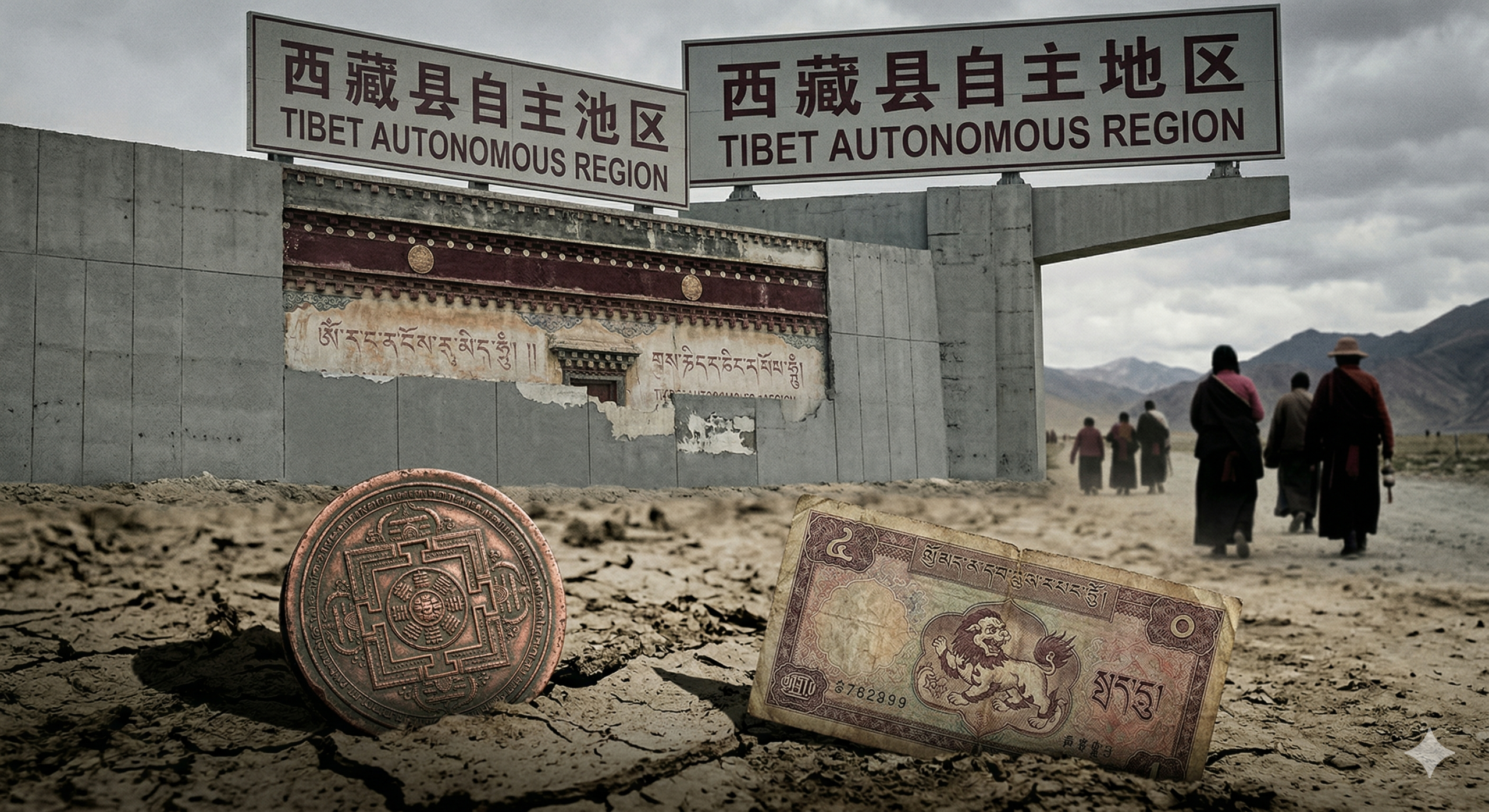
Tibet’s capital, Lhasa, fell to the Chinese army in March 1959. It was more than merely an end to a failed Tibetan uprising. It was the collapse of Tibet’s independence and the start of a prolonged struggle for sovereignty, identity, and international law.
The People’s Liberation Army (PLA) takeover of Lhasa by force and the suppression of the Tibetan Uprising also marked the forced exile of the 14th Dalai Lama, Tenzin Gyatso. The events of March 1959 transformed Tibet into the world’s most enduring geopolitical dispute.
Tibet had been a self-governing polity for decades before the PLA entered and occupied it in 1950. After the Qing dynasty’s fall in 1911, Tibet expelled the Chinese officials and functioned as an independent government, with its own currency and diplomatic functions.
Though not universally recognised as a sovereign state, Tibet always exhibited the core attributes of statehood under international law. It had its own geographical territory, population, administration, and diplomacy.
Despite the ambiguity, Tibet had functional independence. This is central to the contemporary arguments that Tibet’s occupation and takeover by Communist China were neither voluntary nor legitimate.
The occupation of Tibet was incontrovertibly established through the 17-point agreement in 1951, signed by Tibetans under duress after the PLA occupation of eastern Tibet.
The agreement, ostensibly, guaranteed autonomy and religious freedom while affirming Chinese sovereignty.
Tibetans, though later, repudiated the 17-point treaty, arguing justifiably that it was coerced and hence invalid under international law.
The principle that treaties and agreements signed under coercion lack legitimacy is widely accepted internationally. This has raised a serious question mark over the legal basis for Communist China’s claims over Tibet.
Communist China’s promises under the 17-point treaty in 1951 were fragile from the beginning. This was established by the events of March 1959.
Thousands of Tibetans rose in rebellion against Communist China’s forcible occupation of their land, even as tensions escalated in Lhasa over the likely abduction and incarceration of the Dalai Lama.
The subsequent military crackdown in Lhasa not only crushed the Tibetan Uprising but also dismantled Tibet’s traditional political and religious institutions.
The PLA destroyed the monasteries, criminalised local dissent, and brought Tibet under a central administrative structure put in place by Beijing. This replaced the indigenous governance systems.
The daring escape from Lhasa of the young Tenzin Gyatso, disguised as a young soldier, ended the Tibetan autonomy in practice.
Despite the magnitude of the March 1959 events in Tibet, the international community remained muted. Not a word came from the global powers, who were making strategic calculations instead of considering the human cost of Tibet’s military occupation.
Because the Cold War between the US-led Western bloc and the erstwhile USSR-led Socialist bloc was at its peak, Tibet became a peripheral issue, overshadowed by the global geopolitical considerations.
Without discounting the United Nations resolutions on Tibet in 1959, 1961, and 1965 that expressed concern over the human rights violations by Communist China, these international efforts stopped short of recognising Tibet as an independent state or condemning the PLA’s occupation and outrightly rejecting Beijing’s claims of sovereignty.
Notably, though, none of the UN resolutions has ever formally endorsed Communist China’s claim over Tibet, leaving the legal status of the territory contested.
In the decades that followed, the economic interests of global powers took precedence over political advocacy for occupied Tibet. They deepened their trade with Beijing, totally avoiding substantive engagement over Tibet’s status.
This reluctance effectively marginalised the Tibet question, allowing a free run to Communist China to consolidate its iron grip over the territory, framing the issue as an internal matter.
The Tibetan government-in-exile, established by the Dalai Lama in Dharamshala, India, as the Central Tibetan Administration, continues to advocate for genuine autonomy or independence, keeping the Tibet self-determination question alive in the world’s memory.
Scholars of international law, however, are divided over the status of Tibet. Some argue that Tibet’s history establishes its independent functioning for the most part, and the forced occupation by the PLA is a clear case for self-determination. Others justify the occupation, citing decades of PLA control.
This divided opinion among legal scholars, reflecting the broader tensions between legal principles and political realities of the global system, has only helped solidify Communist China’s continued persecution, oppression, and destruction of Tibetans.
Tibet’s conversion into an “autonomous region” from a self-governing polity clearly illustrates how power and trade have trumped principles of international law, shaping outcomes.
Bringing back Tibet into the global diplomatic consciousness requires more than just symbolic gestures. This demands a reassessment of the legal norms that dictate diplomacy, a desire to confront geopolitical compromises, and a renewed commitment to the principle of justice.
Until then, Tibet and its occupation would continue to starkly remind the world that once sovereignty is lost, it is rarely restored without a sustained global will.