

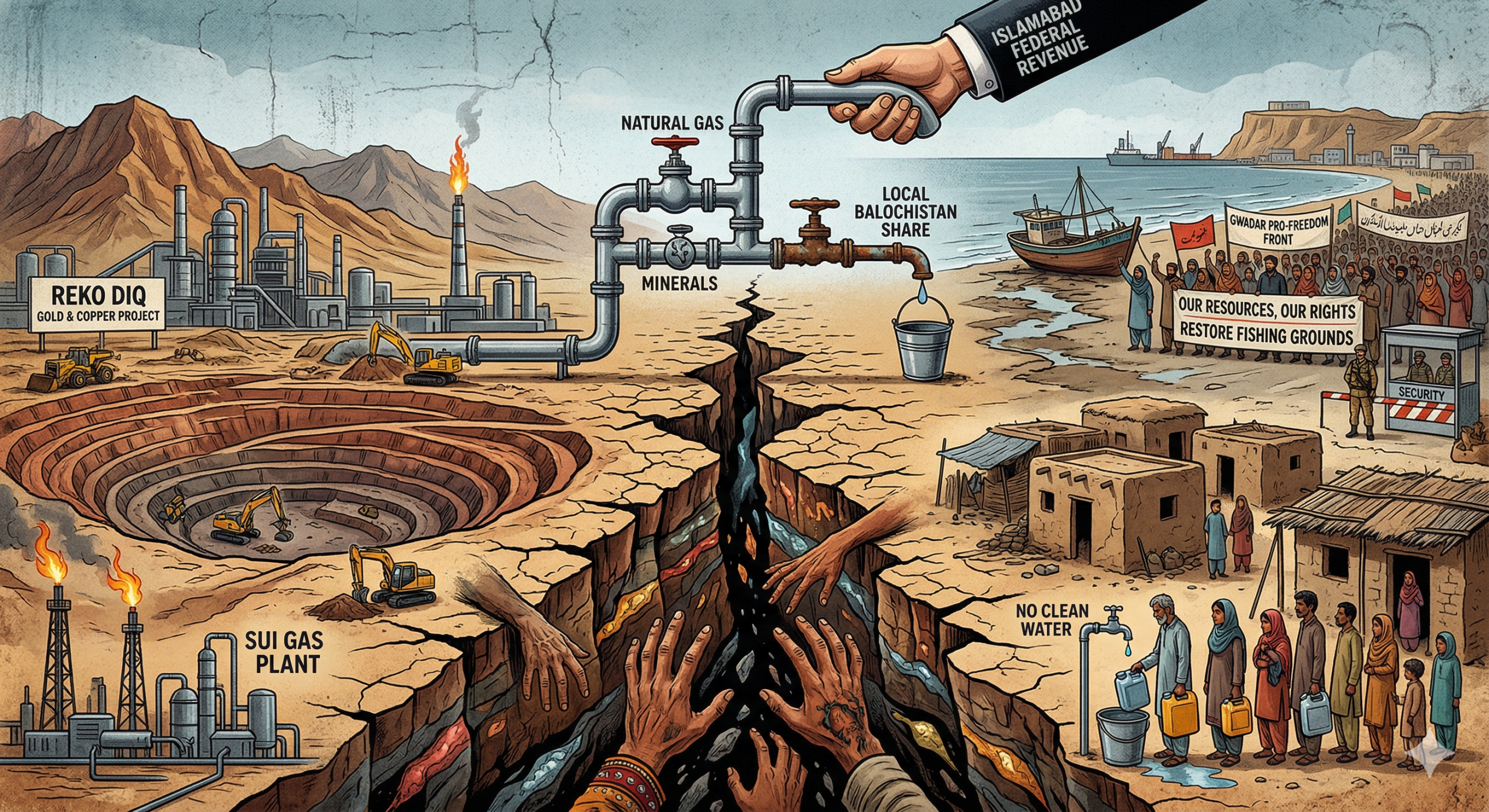
Balochistan has historically accounted for a significant share of Pakistan’s domestic natural gas production—at its peak, over half—though its share has declined substantially in recent decades as production from other provinces has grown. The Reko Diq copper and gold deposit in Chagai district holds billions of tonnes of ore, placing it among the largest undeveloped mineral reserves in the world. The Saindak copper-gold project, also in Chagai, has operated under lease to a Chinese state enterprise since 2002. Pakistan’s Planning Commission estimates the province’s poverty rate at approximately 71%, the highest in the country.
Those figures appear in official documents without explaining the distance between them. The province supplying more than a third of Pakistan’s gas, holding its most valuable undeveloped mineral deposits, and hosting the deep-water port anchoring a multi-billion dollar regional trade corridor also records the lowest rates of access to clean water, electricity, and secondary education in the country.
The revenue structure connecting those two realities runs through federal allocation mechanisms that Baloch political leaders have described as systematically disadvantageous for decades. Pakistan’s National Finance Commission distributes federal revenues to provinces weighted primarily by population. Balochistan, with roughly 15 million people and under 6% of the national total, receives a proportionally limited federal allocation relative to Punjab or Sindh. Gas royalty payments are governed by federal rates that Baloch legislators have repeatedly argued undervalue the province’s production share. Disputes over royalty arrears have recurred in negotiations with Islamabad across multiple governments without comprehensive resolution.
The Reko Diq case traces the pattern through a single transaction. The Balochistan government cancelled a mining contract with Tethyan Copper Company, a joint venture of Barrick Gold and Antofagasta, in 2011. An international arbitration panel issued a $5.97 billion damages award against Pakistan in 2019, one of the largest such rulings against a state on record. A renegotiated agreement in 2022 brought Barrick Gold back under a restructured arrangement that allocates equity stakes to the provincial government and Pakistan’s sovereign wealth fund. The mine remains in development. Whether residents of Chagai district see material returns from the revised structure is a question the project’s timeline has not yet answered.
Gwadar concentrates these tensions in a single location. Pakistan’s government has positioned the port and its special economic zone as the anchor of CPEC’s regional connectivity benefits, with employment and trade advantages projected for Balochistan’s population. Residents of the city, which has a population of roughly 90,000, have described a different set of consequences.
The Gwadar Pro-Freedom Front, a civic organization with no armed affiliation, organized sustained protests through 2021 and 2022 that drew tens of thousands of participants. Their demands were not ideological. They asked for fishing grounds affected by port construction to be restored, for security checkpoints restricting daily movement in their own city to be removed, and for access to clean drinking water. The government made public commitments in response. Local civil society organizations monitoring those commitments documented incomplete follow-through.
Sameer Mengal, a Baloch civic activist whose family has been involved in the province’s political life for two generations, described the economic situation to Pakistani media as a system in which Balochistan’s resources are extracted and the revenues leave with them, returning nothing to the province but the security apparatus managing the extraction. Pakistani officials dispute that characterization. The poverty and development data are not in dispute.
Armed groups operating in Balochistan have cited the resource revenue gap in their public justifications for violence across multiple insurgency cycles. The argument draws on conditions that are measurable rather than asserted. Security operations have addressed the violence those conditions produce. The allocation structure producing them has remained unchanged across five insurgency cycles, four constitutional revisions, and dozens of federal governments in Islamabad.