

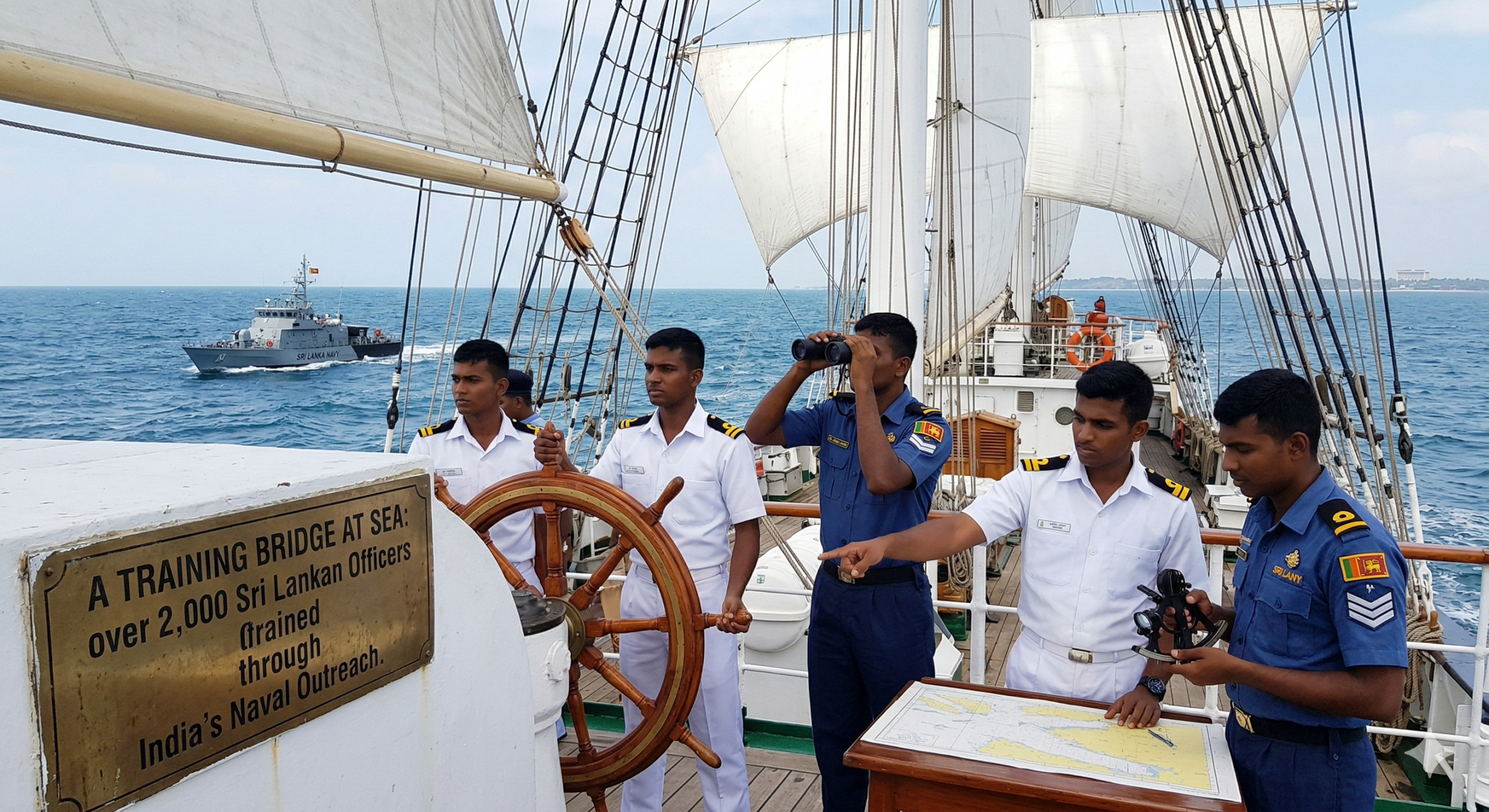
The arrival of a tall sailing ship in a Sri Lankan harbour was usually viewed as little more than a ceremonial gesture — a moment of pageantry, colourful flags and goodwill. Yet the visit by INS Tarangini was far more than a symbolic port call. It represented a long and steady investment in human capital that had come to define the maritime relationship between the two neighbouring countries. Over nine years, 2,214 officers trained was an extraordinary scale of cooperation that few defence partnerships in the region could match.
The deployment, which brought INS Tarangini to Sri Lanka, focused on giving Sri Lankan trainee officers hands-on exposure to ocean sailing. Such visits typically included harbour-based instruction, navigation briefings, safety drills and a sea phase in which mixed crews undertook basic seamanship routines. While not as dramatic as a joint naval exercise or a high-level defence delegation, the impact of such engagements was enduring. Skills acquired early in an officer’s career — bridge management, watchkeeping, sail handling and teamwork — tended to stick for life.
Indian officials had long maintained that training, rather than hardware, was the real foundation of regional maritime ties. The numbers supported that claim. Between 2016–17 and 2024–25, Sri Lanka, under India’s various military education programmes, sent 2,214 officers for training. These officers were exposed to a wide range of disciplines: officer cadet courses, hydrography, engineering, communications, diving, maritime law, staff college curricula and even specialised submarine familiarisation modules.
This consistent engagement had created what naval planners often called a “shared professional language”. Young Sri Lankan officers who trained alongside their Indian counterparts became accustomed to similar navigation standards, safety protocols and operational procedures. Over time, this familiarity translated into smoother coordination at sea — whether during joint patrols, search-and-rescue missions or humanitarian operations. In a region as disaster-prone and strategically contested as the Indian Ocean, such alignment was invaluable.
INS Tarangini’s visit fitted seamlessly into that long-standing pattern. For the officers on board, the deployment was as much about personal bonds as it was about training. Days spent on deck — handling lines, adjusting course and navigating choppy seas — tended to break down barriers far faster than official meetings could. Veteran instructors argued that cooperation forged under such conditions was more durable precisely because it was built on shared challenges rather than formal agreements.
Beyond the training sphere, the broader defence relationship between the two countries had matured considerably. India’s support included institutional capacity-building, such as the establishment of the Maritime Rescue Coordination Centre in 2022, which gave Sri Lanka a modern mechanism for managing maritime safety and coordinating emergency responses. The two sides also signed their first defence cooperation memorandum in 2025, giving structure to areas like joint exercises and coordinated patrols.
However, even with these high-profile developments, training remained the most visible and measurable pillar of bilateral cooperation. A total of 2,214 officers trained over nine years was not a number achieved casually. It reflected sustained prioritisation on both sides: India’s willingness to dedicate slots in its defence academies and Sri Lanka’s confidence in India’s training ecosystem.
As INS Tarangini completed its time in Sri Lanka, it reinforced a message that had guided regional cooperation for years — that the most reliable partnerships were built not on grand gestures but on sustained, person-to-person engagement. For the next generation of Sri Lankan naval officers, the experience gained would be one more step in a professional journey shaped, in no small part, by the ones who had trained before them.