

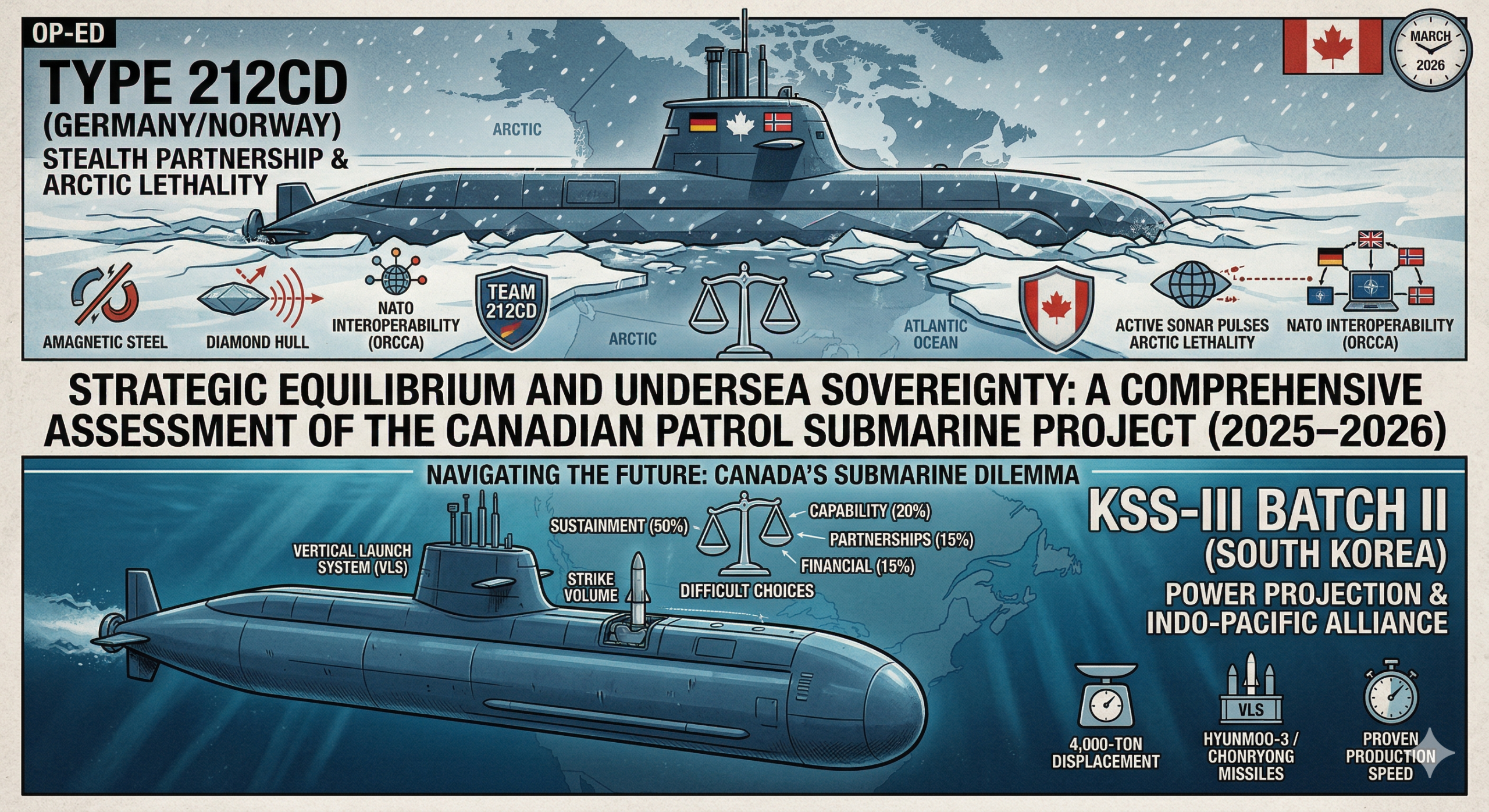
The Canadian Patrol Submarine Project (CPSP) represents a generational pivot in North American defense policy, shifting the Royal Canadian Navy (RCN) from a legacy coastal defense posture toward a credible, multi-ocean power projection capability.1 As of March 2026, the procurement process has reached its most critical juncture, with the federal government under Prime Minister Mark Carney and the newly established Defence Investment Agency (DIA) evaluating final formal proposals from two shortlisted contenders: ThyssenKrupp Marine Systems (TKMS) of Germany and Hanwha Ocean of South Korea.4 While the South Korean KSS-III Batch II offers a formidable “heavyweight” platform optimized for blue-water endurance and vertical strike volume, a growing consensus among NATO-aligned analysts and Canadian defense officials suggests that the German-built Type 212CD (Common Design) presents a superior solution tailored to Canada’s specific strategic reality: the defense of the Arctic, deep integration with European allies, and the deployment of “extreme stealth” technologies.7
The selection process is governed by a rigorous evaluation matrix that prioritizes sustainment, which accounts for 50% of the total score, followed by platform capability at 20%, and financial and strategic partnerships at 15% each.9 Within this framework, the Type 212CD emerges not merely as a submarine but as the center of a “Team 212CD” trilateral framework involving Germany and Norway, designed to mitigate the “orphan fleet” risks that plagued the previous Victoria-class acquisition.11
Technical Architecture and the Stealth Paradigm
The Type 212CD is an evolutionary but significant leap from the proven Type 212A class, which has served with distinction in the German and Italian navies.7 At its core, the 212CD is designed to thrive in high-threat, sensor-dense environments where detection equals destruction.11 TKMS has engineered the vessel to operate under a philosophy of “acoustic and electromagnetic invisibility,” leveraging materials and hull geometries that are fundamentally different from those of the South Korean competitor.16
The Diamond-Shaped Hull and Active Sonar Deflection
The most distinctive feature of the Type 212CD is its faceted, “diamond-shaped” outer hull.14 Traditional submarine design relies on a circular cross-section to maximize pressure resistance; however, this shape provides a strong, predictable return for active sonar pulses.14 The Type 212CD replaces these curves with flat, sloped surfaces designed to reflect incoming active sonar energy away from the emitter, similar to the stealth shaping of the F-35 fighter.1
This design choice is particularly critical in the 2025–2026 operational environment, where adversaries have deployed sophisticated multi-static sonar nets that can “detect” traditional quiet submarines by the absence of sound.1 By reducing the target echo strength (TES), the Type 212CD can “disappear” from active pings, a capability described by TKMS CEO Oliver Burkhard as making the submarine “quieter than Canadian snowfall”.10 The KSS-III, while exceptionally quiet for its size, maintains a more traditional hull form that relies on anechoic coatings rather than geometric deflection, potentially leaving it more vulnerable to the latest generation of active sonar hunters.1
Amagnetic Steel and the MAD Evasion Advantage
Beyond its acoustic profile, the Type 212CD utilizes high-tensile amagnetic (non-magnetic) steel for its pressure hull, a material hallmark of German naval engineering.15 Most conventional and nuclear submarines are built from magnetic steel, which creates a detectable magnetic anomaly as the massive hull moves through the Earth’s magnetic field.22 Anti-submarine warfare (ASW) aircraft, such as the Russian Il-38 or the Chinese Y-8Q, use Magnetic Anomaly Detectors (MAD) to pinpoint a submarine’s location once it has been roughly located via sonar.22
The amagnetic properties of the 212CD effectively neutralize this search tactic.22 Trials with similar German-built hulls have shown MAD localization failure rates exceeding 90% at operational depths.22 For the RCN, this offers an unparalleled level of survivability in the shallow waters of the Canadian Arctic Archipelago, where the seabed and the ice canopy create a “metallic clutter” that makes magnetic stealth even more effective.1 The South Korean KSS-III, due to its massive 4,000-ton displacement, creates a significantly larger magnetic and acoustic footprint that is inherently harder to mask.1
Arctic Specialization and Under-Ice Capabilities
The Government of Canada’s 2024 defense policy update, “Our North, Strong and Free,” explicitly identified the Arctic as a primary theater for the RCN’s future submarine fleet.3 Submarines are Canada’s only covert strategic assets capable of year-round surveillance beneath the ice.29 The selection of the Type 212CD is increasingly framed as a choice for specialized cold-water lethality.7
Optimized Cold-Water Performance
The German design is tailored for the harsh environments of the North Atlantic and the Barents Sea, areas that share the extreme thermal gradients and high-latitude challenges of the Canadian Arctic.11 The 212CD features advanced air-independent propulsion (AIP) using hydrogen fuel cells, which generate electricity silently and without the thermal signature associated with nuclear reactors or even advanced lithium-ion discharge at high power.14
The AIP system allows the 212CD to remain submerged for over three weeks at a time, making it ideal for patrolling the “choke points” of the Arctic Archipelago where surfacing to snorkel is often impossible due to ice cover.1 While the South Korean KSS-III also features AIP and a longer overall range, its larger hull and greater draft make it less maneuverable in the shallow, ice-cluttered sills of the Northwest Passage.1 Proponents of the German bid, including analysts who highlight the 212CD’s “ambush” capabilities, argue that the compact size of the German vessel is a tactical necessity for navigating Canada’s northern approaches.7
The Arctic Protection Partnership
In a significant diplomatic move in March 2026, Norway and Germany submitted a joint government-to-government offer to Canada, centering on an “Arctic Protection Partnership”.14 This proposal extends beyond the physical submarine to include shared training, intelligence sharing on Russian and Chinese movements in the High North, and a common logistics network.19 Joining this partnership would place Canada at the center of a specialized undersea alliance designed to secure the Greenland-Iceland-United Kingdom (GIUK) Gap and the Arctic Basin—a key strategic objective of the Carney government.12
NATO Standardization and the ORCCA Ecosystem
One of the most compelling arguments for the German bid is the immediate and deep integration it offers within the NATO undersea ecosystem.11 Since 1960, TKMS has provided over 70% of the conventional submarine capacity for NATO allies, creating a massive base of interoperable systems and shared operational doctrine.12
The ORCCA Combat Management System
The Type 212CD is equipped with the ORCCA combat management system, developed by KTA Naval Systems (a joint venture between TKMS, Atlas Elektronik, and Norway’s Kongsberg).14 ORCCA is described as the most advanced combat system for non-nuclear submarines, designed specifically to fuse massive amounts of sensor data—from sonar and optronics to electronic support measures (ESM) and navigation—into a single, unified interface.31
For the RCN, ORCCA represents a “mature NATO sensor and combat-system ecosystem”.16 It allows Canadian crews to share a “Common Operating Picture” with German, Norwegian, and potentially Dutch and Polish allies in real-time.1 This level of digital interoperability ensures that a Canadian submarine on patrol in the North Atlantic can seamlessly integrate its sensor data into a wider NATO theater command, a capability that would be far more difficult and expensive to achieve with the bespoke systems of the KSS-III.11
Avoiding the “Orphan Fleet” Trap
The 50% weighting given to sustainment in the CPSP evaluation is a direct reaction to Canada’s experience with the Victoria-class.9 Those submarines were an “orphan fleet” with no other operators, meaning that every spare part and software update had to be custom-built for Canada at a high cost.9 By joining the Type 212CD program alongside Germany and Norway, Canada becomes part of a large, long-term user group.12
This “Team 212CD” approach ensures that the cost of through-life upgrades, maintenance infrastructure, and spare-parts inventories is shared across three nations.12 Germany’s expansion of its order to six boats and Norway’s recent decision to increase its fleet to six means that even if Canada only purchases six submarines, the total production run of 12 or more vessels creates significant economies of scale.14
Strategic Alliances and Geopolitical Alignment
The CPSP decision is as much a geopolitical statement as it is a military procurement.35 Prime Minister Carney’s foreign policy, often characterized as “values-based realism,” seeks to rebuild Canada’s hard power while strengthening ties with like-minded liberal democracies.35
The European Tilt vs. the Indo-Pacific Pivot
Choosing Germany and Norway represents a strategic tilt toward Europe and the traditional NATO heartland.11 This choice is viewed as a response to the intensifying security challenges in the North Atlantic and a resurgent Russia.11 It also serves as a hedge against potential shifts in U.S. foreign policy, reducing Canada’s reliance on American defense suppliers by building a transatlantic “production and sustainment alliance” with European partners.13
Conversely, the South Korean bid is seen through the lens of Canada’s Indo-Pacific Strategy.3 Hanwha Ocean has argued that a Canadian purchase of the KSS-III would create a durable defense-industrial link between an Arctic NATO member and a key Indo-Pacific security actor.3 While this has strategic merit, critics argue that Canada’s primary sovereign responsibility remains its own Arctic and Atlantic coasts—environments where the German design’s specialization and NATO-native integration are most advantageous.7
The Trade-Offs of Vertical Launch Systems (VLS)
A major point of contention between the two bids is the inclusion of a Vertical Launch System (VLS). The South Korean KSS-III Batch II features a 10-cell VLS capable of launching cruise missiles and non-nuclear ballistic missiles.16 Former intelligence officer Michael J. Lalonde has highlighted this as a foundational requirement for “blue-water” power projection and land-attack missions.1
The Type 212CD, in its current configuration, does not include a VLS, opting instead to maximize torpedo tube space for heavyweight weapons and special forces deployment.1 However, TKMS has noted that the 212CD can fire the Naval Strike Missile (NSM-SL) and the IDAS air-defense missile through its torpedo tubes, providing a multi-mission capability without the displacement penalty of a VLS module.14 For many RCN planners, the stealth advantages of the smaller 212CD hull outweigh the strike volume of the larger, potentially louder KSS-III.7
Economic Offsets and Local Manufacturing
The CPSP represents an estimated investment over its lifetime, and the federal government is demanding “sizable economic offsets” to support the domestic defense industry. The “Team 212CD” bid has responded with a comprehensive package designed to anchor high-skilled jobs in Canada for decades.12
The Team 212CD Industrial Coalition
TKMS has built an unusually broad coalition of Canadian partners, positioning the bid as a “Strategic Partnership of Generational Importance”.12 Key elements of the German industrial offer include:
- Sovereign Sustainment: A teaming agreement with Seaspan Shipyards to establish a sovereign capability for the through-life support of naval ships, ensuring that all maintenance, refits, and repairs are performed in Canadian yards.14
- Heavyweight Torpedo Production: A partnership with Magellan Aerospace to explore the production of heavyweight torpedoes in Canada, creating a new high-tech manufacturing capability.14
- Training and Simulation: A March 2026 agreement with CAE—Canada’s largest defense company—to develop a digital training ecosystem, including simulators and virtual reality trainers, produced and maintained in Canada.9
- Localized Manufacturing: German officials have stated that if requested, TKMS is open to establishing a production facility in Canada to build certain segments or even entire batches of the 12-submarine fleet.
- Artificial Intelligence and Automation: Agreements with Canadian firms like Gastops and CORSphere to integrate Canadian AI solutions into the 212CD’s automation and condition-monitoring systems.5
The “German Space” and “Bombardier” Quid-Pro-Quo
In a unique strategic trade-off, German Defense Minister Boris Pistorius suggested that as part of the submarine deal, the German government would purchase Canadian technology.13 This includes the potential purchase of at least 18 Bombardier Global aircraft to be used as electronic warfare and airborne early-warning platforms for the Bundeswehr.13 Furthermore, Germany has expressed interest in adopting the Canadian-built CMS 330 combat management system from Lockheed Martin Canada for its own future surface ships—a move that would significantly boost Canadian exports in the naval sector.13
| Economic Benefit | TKMS (Germany) Proposal | Hanwha (South Korea) Proposal |
| Projected Jobs | Not publicly disclosed (Supply chain focus) | annually (average) |
| Major Steel Partner | Algoma Steel (Global supply chain integration) | Algoma Steel ( investment) |
| Training Lead | CAE / Domestic Training Ecosystem | Babcock Canada / Jinhae Facility |
| Technology Transfer | Amagnetic material knowledge / Digital Twin | Submarine construction / R&D |
| Strategic Quid-Pro-Quo | Bombardier aircraft / CMS 330 Adoption | Hydrogen Hub / Rocket Launch |
| Shipyard Partner | Seaspan Shipyards / Vancouver | Ontario Shipyards / Hamilton |
The “Split Contract” Debate: Operational Complexity vs. Industrial Gain
In early 2026, media reports suggested that the Canadian government was reviewing a “6+6” split procurement: six German Type 212CDs for the Atlantic and six South Korean KSS-IIIs for the Pacific.44 While this option might allow Canada to attract industrial investment from both nations and potentially address the different requirements of the two oceans, it has been widely panned by military officials and analysts alike.5
Operational and Financial Pitfalls
Vice-Admiral Angus Topshee, Commander of the RCN, has explicitly stated that a single-class fleet is the most efficient and effective model.45 Running two different submarine classes would double the requirements for spare-parts inventories, training programs, maintenance facilities, and specialized shore infrastructure.5 It would erode the “economies of scale” that the CPSP is designed to achieve and potentially push the lifecycle cost significantly higher—a difficult sell in a sensitive political environment.5
Furthermore, South Korean officials have warned that their industrial cooperation offers, including the massive job numbers and steel plant investments, would have to be “reconsidered from scratch” if the contract were split.27 Secretary of State Stephen Fuhr has emphasized that the government is seeking “one partner” to ensure the project moves at the speed required to replace the Victoria-class before they become completely non-operational.45
The Decision-Making Framework: Risk Management and Timelines
The procurement is being managed by the DIA, which Prime Minister Carney launched to “rebuild, rearm, and reinvest in the CAF faster”.2 The Agency’s goal is to move from proposal submission (March 2, 2026) to a preferred bidder selection by late June 2026—a “lightning fast” pace for a program of this magnitude.
Delivery Timelines and Capability Gaps
A critical factor in the evaluation is the “capability gap” risk. The Victoria-class is scheduled for retirement in the early-to-mid 2030s. Hanwha Ocean has emphasized its “proven production speed,” promising to deliver the first KSS-III by 2032 and four units by 2035.1 Hanwha’s CEO, Glenn Copeland, argues that their “whole-of-nation” approach can hit these deadlines with high cost-predictability.
TKMS has countered that its timeline is “much closer than the Koreans think,” indicating it can also deliver a boat by 2032 with a steady ramp-up thereafter.20 The Germans argue that because their production line in Kiel and Wismar is already operational and building boats for Norway and Germany, the technical and schedule risk for Canada is lower than starting a new, bespoke build in Korea or Canada.14
| Milestone | Target Date (Expected) |
| Final Proposal Submission | March 2, 2026 |
| Clarifying Question Period | March – April 2026 |
| Preferred Bidder Selection | Late June 2026 |
| Contract Award | 2028 |
| First Submarine Delivery | No later than 2035 (Aims for 2032) |
| Full Operational Capability | Mid-to-late 2040s |
Conclusion: The German Advantage in the Canadian Context
As the CPSP evaluation enters its final stages, the Type 212CD stands as the most strategically aligned option for the Royal Canadian Navy’s core missions.7 While the KSS-III is an ingenious “heavyweight” that offers greater strike volume and blue-water range, the German-built vessel provides a combination of specialized Arctic stealth and NATO-native integration that the RCN cannot find elsewhere.11
The “extreme stealth” of the diamond hull and magnetic steel addresses the specific challenges of surviving in the contested northern waters of the future.14 The ORCCA combat management system and the “Arctic Protection Partnership” provide a level of alliance-based security and sustainment that mitigates the risks of operating a sophisticated submarine fleet.14 Furthermore, the broad industrial coalition under “Team 212CD” ensures that the economic benefits of the procurement are anchored in Canada through high-value partnerships with firms like CAE, Seaspan, and Magellan.9
Ultimately, the choice of the Type 212CD would signal a Canadian commitment to NATO’s northern flank and a prioritization of “under-ice sovereignty” as the ultimate guarantor of national security in the 21st century.12 By March 2026, the data and the geopolitical winds increasingly point toward a German-led future for the Royal Canadian Navy’s undersea fleet.1
This article was co-authored by Kagusthan Ariaratnam, Gemini, and Google DeepMind.
About the Authors
-
Kagusthan Ariaratnam is a seasoned professional at the intersection of technology and innovation, bringing deep industry expertise and strategic vision to the exploration of complex digital landscapes.
-
Gemini is a state-of-the-art multimodal AI model from Google. Designed to process and reason across various types of information—including text, code, audio, image, and video—it serves as an adaptive collaborator in research, creativity, and problem-solving.
-
Google DeepMind is a world-leading AI research laboratory committed to solving intelligence to advance science and benefit humanity. By developing increasingly capable and general-purpose AI systems, DeepMind continues to push the boundaries of what is possible in the digital age.
Works cited
-
- Which Submarine Should Canada Buy? Type 212CD vs KSS-III – Michael J. Lalonde, accessed on March 28, 2026, https://www.michaeljlalonde.com/2025/09/15/which-submarine-should-canada-buy/
- Canada’s 2025 Defence Budget Signals Return to Hard Power – Michael J. Lalonde, accessed on March 28, 2026, https://www.michaeljlalonde.com/2025/11/06/budget-2025-signals-return-to-hard-power/
- Features – espritdecorps, accessed on March 28, 2026, https://www.espritdecorps.ca/feature
- Deadline day: $20B submarine showdown puts Korean and German bids in spotlight – CBC, accessed on March 28, 2026, https://www.cbc.ca/news/politics/submarines-canada-korea-germany-jobs-9.7108627
- Canada unlikely to split $40B submarine contract between Korea and Germany – aju press, accessed on March 28, 2026, https://m.ajupress.com/amp/20260312163352760
- Deadline day_ $20B submarine showdown puts Korean and German bids in spotlight _ CBC News.pdf
- Canada Needs a New Submarine. Which Kind Should It Choose? – The National Interest, accessed on March 28, 2026, https://nationalinterest.org/blog/buzz/canada-needs-new-submarine-which-kind-should-it-choose-bw-090425
- Germany and Norway offer Canada early access to new submarines in pitch to join project, accessed on March 28, 2026, https://www.reddit.com/r/CanadaPolitics/comments/1irtvxa/germany_and_norway_offer_canada_early_access_to/
- TKMS CAE Submarine Agreement: Germany’s Final Move – Fliegerfaust, accessed on March 28, 2026, https://www.fliegerfaust.com/tkms-cae-submarine-agreement-canada-cpsp/
- High-Stakes Competition: South Korea and Germany Vie for Canada’s Multi-Billion Dollar Submarine Contract – ReadyAyeReady.com, accessed on March 28, 2026, https://readyayeready.com/high-stakes-competition-south-korea-and-germany-vie-for-canadas-multi-billion-dollar-submarine-contract/
- Germany’s Submarine Gambit: TKMS Takes the Fight for Canada’s Arctic Fleet, accessed on March 28, 2026, https://defencematters.eu/germanys-submarine-gambit-tkms-takes-the-fight-for-canadas-arctic-fleet/
- TKMS TEAM 212CD – Canada’s Future Submarine Partnership, accessed on March 28, 2026, https://team212cd.ca/
- Canada’s Submarine Program: Germany and Norway Propose Partnership in the Type 212CD Project – Großwald, accessed on March 28, 2026, https://www.grosswald.org/canadas-submarine-choice-germany-and-norway-seek-a-third-partner-in-the-212-cd-programme/
- Type 212CD submarine – Wikipedia, accessed on March 28, 2026, https://en.wikipedia.org/wiki/Type_212CD_submarine
- Germany’s Type 212 ‘AIP’ Stealth Submarine Is One of the Best on Earth, accessed on March 28, 2026, https://nationalsecurityjournal.org/germanys-type-212-aip-stealth-submarine-is-one-of-the-best-on-earth/
- South Korea Goes All In in Canada’s High-Stakes Arctic Submarine Race. – Global Tenders, accessed on March 28, 2026, https://global.tendernews.com/newsdetails.aspx?s=7272&t=South-Korea-Goes-All-In-in-Canada%E2%80%99s-High-Stakes-Arctic-Submarine-Race.
- TKMS – Producing Advanced Submarines for NATO – Canadian Defence Review, accessed on March 28, 2026, https://canadiandefencereview.com/tkms-producing-advanced-submarines-for-nato/
- HDW Class 212 CD – TKMS Group, accessed on March 28, 2026, https://www.tkmsgroup.com/submarines/submarine-classes/hdw-class-212-cd
- Norway orders two more German Type 212CD submarines To Counter Russian Arctic Navy., accessed on March 28, 2026, https://global.tendernews.com/newsdetails.aspx?s=7593&t=Norway-orders-two-more-German-Type-212CD-submarines-To-Counter-Russian-Arctic-Navy.
- Your World Tonight – The Prime Minister looks to expand Canadian ports, Israel’s ‘Day of disruption’ for Gaza deal, a rare case of a flesh-eating parasite in the U.S., and more Transcript and Discussion – PodScripts, accessed on March 28, 2026, https://podscripts.co/podcasts/your-world-tonight/the-prime-minister-looks-to-expand-canadian-ports-israels-day-of-disruption-for-gaza-deal-a-rare-case-of-a-flesh-eating-parasite-in-the-us-and-more
- German sub bid can do ‘a lot more’ to benefit Canada than South Korea’s: CEO | Power & Politics : r/CanadianForces – Reddit, accessed on March 28, 2026, https://www.reddit.com/r/CanadianForces/comments/1rkeg4i/german_sub_bid_can_do_a_lot_more_to_benefit/
- How German Facet Stealth on Indian Type 214 Subs Promises Ghost-Like Invisibility Against China-Pak ASW Hunters | Defence News India, accessed on March 28, 2026, https://defence.in/threads/how-german-facet-stealth-on-indian-type-214-subs-promises-ghost-like-invisibility-against-china-pak-asw-hunters.16079/
- TKMS: we want Poland to join the underwater power of Europe – Portal Stoczniowy, accessed on March 28, 2026, https://portalstoczniowy.pl/en/tkms-okrety-podwodne-dla-polski-program-orka/
- A Deep Dive Into Germany’s Submarine Force – The War Zone, accessed on March 28, 2026, https://www.twz.com/a-deep-dive-into-germanys-submarine-force
- Type 206A Submarine Overview | PDF | Naval Warfare | Shipping – Scribd, accessed on March 28, 2026, https://www.scribd.com/document/705576343/Type-206-submarine
- Farewell, Victoria! On Hanwha Ocean’s Bid for the Canadian Patrol Submarine Project – MIR, accessed on March 28, 2026, https://www.mironline.ca/farewell-victoria-on-hanwha-oceans-bid-for-the-canadian-patrol-submarine-project/
- Korea to cut investments if Canada splits submarine contract, accessed on March 28, 2026, https://www.koreatimes.co.kr/business/companies/20260305/korea-to-cut-investments-if-canada-splits-submarine-contract
- Department of National Defence and the Canadian Armed Forces 2026-27 Departmental Plan – Canada.ca, accessed on March 28, 2026, https://www.canada.ca/en/department-national-defence/corporate/reports-publications/departmental-plans/departmental-plan-2026-27.html
- Defence Investment Agency seeks input from Canadian industry on future submarine fleet sustainment – Canada.ca, accessed on March 28, 2026, https://www.canada.ca/en/defence-investment-agency/news/2026/03/defence-investment-agency-seeks-input-from-canadian-industry-on-future-submarine-fleet-sustainment.html
- Submarine Partnership Pitched By Germany And Norway To Canada – The War Zone, accessed on March 28, 2026, https://www.twz.com/sea/submarine-partnership-pitched-by-germany-and-norway-to-canada
- Type 212CD Submarines, Germany – Naval Technology, accessed on March 28, 2026, https://www.naval-technology.com/projects/type-212cd-submarines-germany/
- Next-Generation Electronic Warfare Systems for Type 212CD Submarines, accessed on March 28, 2026, https://www.defenseadvancement.com/news/next-generation-electronic-warfare-systems-for-type-212cd-submarines/
- Submarines for Canada – Canadian Naval Review, accessed on March 28, 2026, https://www.navalreview.ca/2025/10/submarines-for-canada/
- [Album] Type 212CD (Common Design) diesel-electric/AIP attack submarine renders – Reddit, accessed on March 28, 2026, https://www.reddit.com/r/submarines/comments/1qa0zbv/album_type_212cd_common_design_dieselelectricaip/
- Mark Carney and Canada’s Quest for Hard Power, accessed on March 28, 2026, https://www.policymagazine.ca/mark-carney-and-canadas-quest-for-hard-power/
- Prime Minister Carney announces Canada has achieved the NATO 2% defence spending target, accessed on March 28, 2026, https://www.pm.gc.ca/en/news/news-releases/2026/03/26/prime-minister-carney-announces-canada-has-achieved-nato-2-defence
- Indo-Pacific Outlook 2026 | APF Canada, accessed on March 28, 2026, https://www.asiapacific.ca/publication/indo-pacific-outlook-2026
- TKMS and CAE Sign Teaming Agreement to Support CPSP – Canadian Defence Review, accessed on March 28, 2026, https://canadiandefencereview.com/tkms-and-cae-sign-teaming-agreement-to-support-cpsp/
- Partners – TKMS – Team 212CD, accessed on March 28, 2026, https://team212cd.ca/partners
- Gastops and TKMS Sign Teaming Agreement for CPSP – Canadian Defence Review, accessed on March 28, 2026, https://canadiandefencereview.com/gastops-and-tkms-sign-teaming-agreement-to-establish-canadian-center-of-excellence-for-cpsp/
- Active Conflicts & News Megathread October 22, 2025 : r/CredibleDefense – Reddit, accessed on March 28, 2026, https://www.reddit.com/r/CredibleDefense/comments/1od3m4q/active_conflicts_news_megathread_october_22_2025/
- TKMS would expand its proposal to equip the Canadian Navy with twelve new Type 212CD submarines – Zona Militar, accessed on March 28, 2026, https://www.zona-militar.com/en/2026/01/23/tkms-would-expand-its-proposal-to-equip-the-canadian-navy-with-twelve-new-type-212cd-submarines/
- Canada submarines: What Germany, South Korea are offering, accessed on March 28, 2026, https://www.bnnbloomberg.ca/business/politics/2026/03/02/no-new-auto-plants-but-heres-what-else-germany-and-south-korea-are-offering-in-their-submarine-bids/
- Canada Weighs Split Submarine Order, accessed on March 28, 2026, https://www.chosun.com/english/industry-en/2026/03/03/HSBL73FD4NBW3OIHAC4KW22KNQ/
- Secretary of state says Canada not looking to split submarine contract – CTV News, accessed on March 28, 2026, https://www.ctvnews.ca/business/article/secretary-of-state-says-canada-not-looking-to-split-submarine-contract/
- Secretary of state says Canada not looking to split submarine contract – iPolitics, accessed on March 28, 2026, https://www.ipolitics.ca/2026/03/05/secretary-of-state-says-canada-not-looking-to-split-submarine-contract/
- Michael J. Lalonde (u/MichaelJLalonde) – Reddit, accessed on March 28, 2026, https://www.reddit.com/user/MichaelJLalonde/comments/
- Secretary of state says Canada not looking to split submarine contract – Bowen Island Undercurrent, accessed on March 28, 2026, https://www.bowenislandundercurrent.com/national-news/secretary-of-state-says-canada-not-looking-to-split-submarine-contract-11960793
- First Procurements in the Defence Investment Agency Announced, accessed on March 28, 2026, https://canadiandefencereview.com/first-procurements-in-defence-investment-agency-announced/
- Localization Battle Heats Up in $45 Billion Canadian Submarine Deal, accessed on March 28, 2026, https://www.thelec.net/news/articleView.html?idxno=6036
- Outcomes Tracker – Build Canada, accessed on March 28, 2026, https://www.buildcanada.com/tracker/commitments/2392