

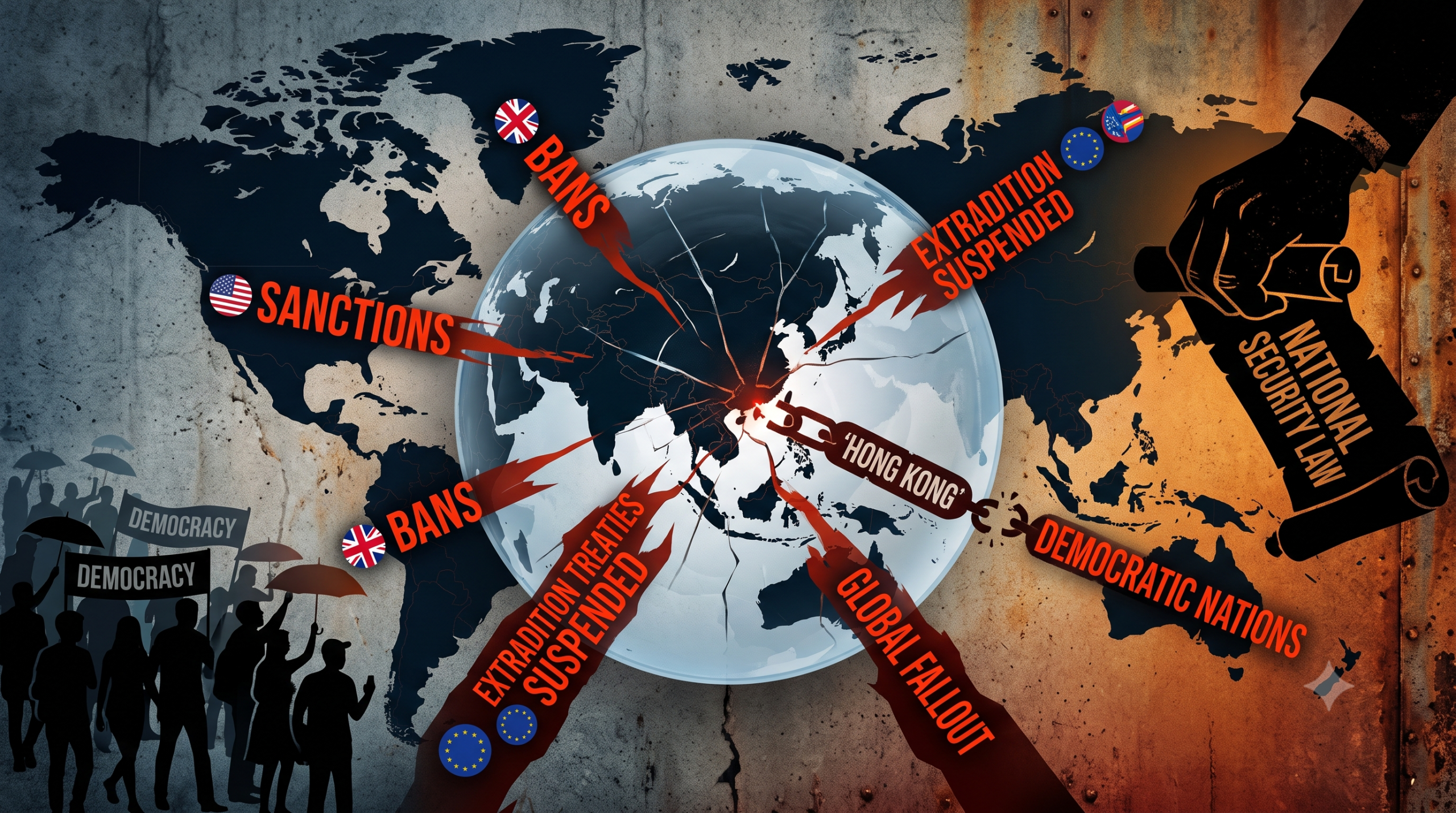
China’s National People’s Congress Standing Committee passed the Hong Kong National Security Law on 30 June 2020, and the law took effect in the territory the same night. Within weeks, the United States, the United Kingdom, the European Union, Canada, Australia, and several other governments condemned the legislation, imposed targeted sanctions on Chinese and Hong Kong officials, and suspended bilateral extradition treaties with the city. The UK also introduced a new immigration scheme giving British National (Overseas) status holders and their families a path to British citizenship.
US sanctions and Executive Order 13936
On 14 July 2020, then-President Donald Trump signed both the Hong Kong Autonomy Act and Executive Order 13936, which determined that Hong Kong was no longer sufficiently autonomous to justify treatment different from mainland China. The order authorised visa restrictions and economic sanctions against officials found responsible for undermining the city’s autonomy and democratic institutions.
The Treasury Department’s Office of Foreign Assets Control (OFAC) made its first designations under the order on 7 August 2020, sanctioning 11 Hong Kong and Chinese officials, including then-Chief Executive Carrie Lam and then-Secretary for Security John Lee, for undermining Hong Kong’s freedom and autonomy. By February 2023, the cumulative number of people added to the Specially Designated Nationals list under the order had grown to 42, by which point John Lee — sanctioned in 2020 in his earlier security role — had since become Chief Executive, according to the US Congressional Research Service.
EU and broader sanctions pressure
The European Parliament called for targeted measures against Hong Kong and Chinese officials under the EU’s Global Human Rights Sanctions Regime, a position it reaffirmed in a resolution adopted on 16 September 2021, as documented by the human rights organisation Safeguard Defenders.
Extradition treaties suspended
Several governments moved quickly to cut extradition ties with Hong Kong once the law took effect:
- Canada suspended its extradition treaty on 3 July 2020.
- Australia suspended its treaty on 9 July 2020.
- Germany suspended its treaty on 31 July 2020.
- France announced on 3 August 2020 that it would not ratify its pending treaty.
The United States, United Kingdom, and New Zealand also suspended their treaties around the same period. In total, ten democratic nations suspended or halted ratification of extradition arrangements with Hong Kong following the law’s imposition, according to Safeguard Defenders.
Beijing and Hong Kong responded in kind, suspending the city’s extradition treaties with Canada, Australia, the UK, New Zealand, and Germany, and later the United States, while shelving the pending treaty with France.
The UK’s BN(O) visa scheme
The UK’s Foreign, Commonwealth and Development Office announced details of a new visa scheme on 22 October 2020, with applications opening on 31 January 2021. The route allows British National (Overseas) status holders and their eligible family members to live, work, and study in the UK.
Under the scheme, holders can apply for settled status after five years of UK residence, and for British citizenship after a further year. The UK government has estimated that around 5.4 million Hong Kong residents — roughly 2.9 million BN(O) status holders plus an estimated 2.5 million family members — are eligible, according to the University of Oxford’s Migration Observatory.
The House of Commons Library has confirmed that the scheme was created in direct response to the national security law, which the UK considers a breach of the commitments China made under the 1984 Sino-British Joint Declaration signed at the time of the Hong Kong handover.