

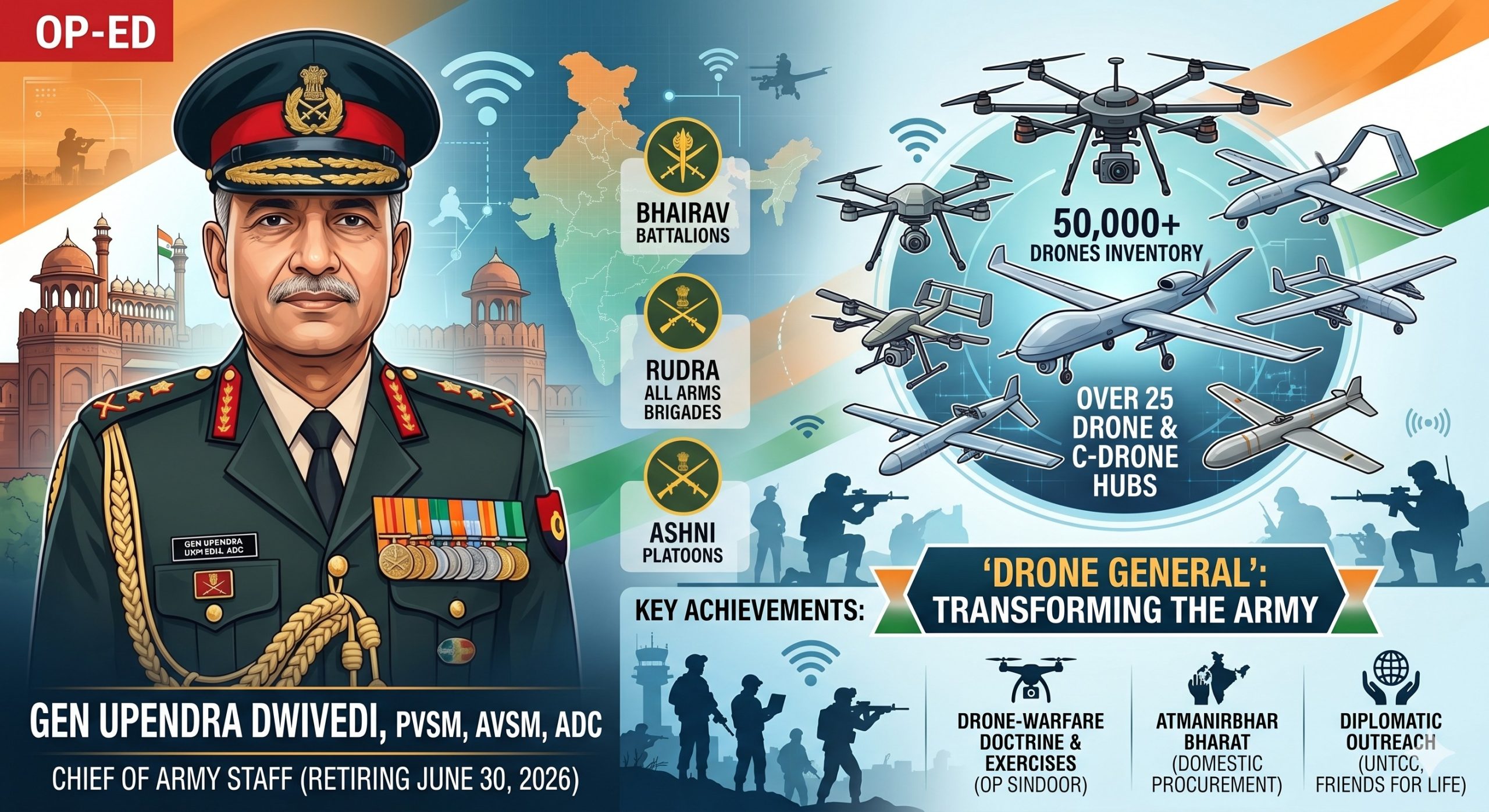
General Upendra Dwivedi will retire as Chief of Army Staff on June 30, 2026, concluding a tenure that saw the Indian Army’s drone inventory grow from a few hundred to more than 50,000 — a figure expected to double again within two to three years, according to defence sources.
More than 25 Drone and Counter-Drone Hubs have been established across military stations during his tenure, officials said, providing the infrastructure for large-scale induction, training and operational employment of unmanned systems. Precision engagement and surveillance capabilities have also been extended, with systems now capable of operating at distances approaching 500 kilometres.
General Dwivedi has come to be known within military circles as the “Drone General,” a title reflecting the scale of the transformation overseen during his tenure. New formations including Bhairav Battalions, Ashni Platoons, Rudra All Arms Brigades, Shaktibaan Regiments and Divyastra Batteries were created during this period, alongside the continued evolution of Integrated Battle Groups.
The transformation was tested operationally during Operation Sindoor, which involved the coordinated use of drones, loitering munitions, electronic warfare and real-time intelligence fusion. The operation is increasingly cited within strategic circles as a template for India’s future approach to warfare.
Officials also pointed to progress on self-reliance during the tenure. Nearly all special clothing requirements and a substantial proportion of ammunition needs are now sourced domestically, the result of partnerships between the Army, DRDO, private industry, start-ups and academic institutions aimed at developing indigenous drones, counter-drone systems and AI-enabled battlefield technologies.
Nearly 25 doctrines, strategic guidelines and policy documents were issued during General Dwivedi’s tenure, covering land warfare, strategic security, red teaming and emerging domains such as space, according to defence officials.
On the diplomatic front, the Army hosted the UNTCC Chiefs Conclave, attended by chiefs and representatives from 32 countries, and launched the “Friends for Life” digital platform, which has connected nearly 100,000 alumni of Indian military training institutions worldwide.
Nearly 100 dual-use infrastructure projects were also launched in collaboration with various ministries during the tenure, officials said, aimed at improving both military preparedness and civilian connectivity. Outreach programmes were conducted across border states, and the National Cadet Corps was expanded by nearly 20 per cent.
General Dwivedi’s successor is expected to be announced shortly. Defence analysts say the new Chief will inherit an institution substantially restructured around drone and multi-domain capabilities, with the scale of transformation expected to shape Army doctrine and procurement priorities for years to come.