

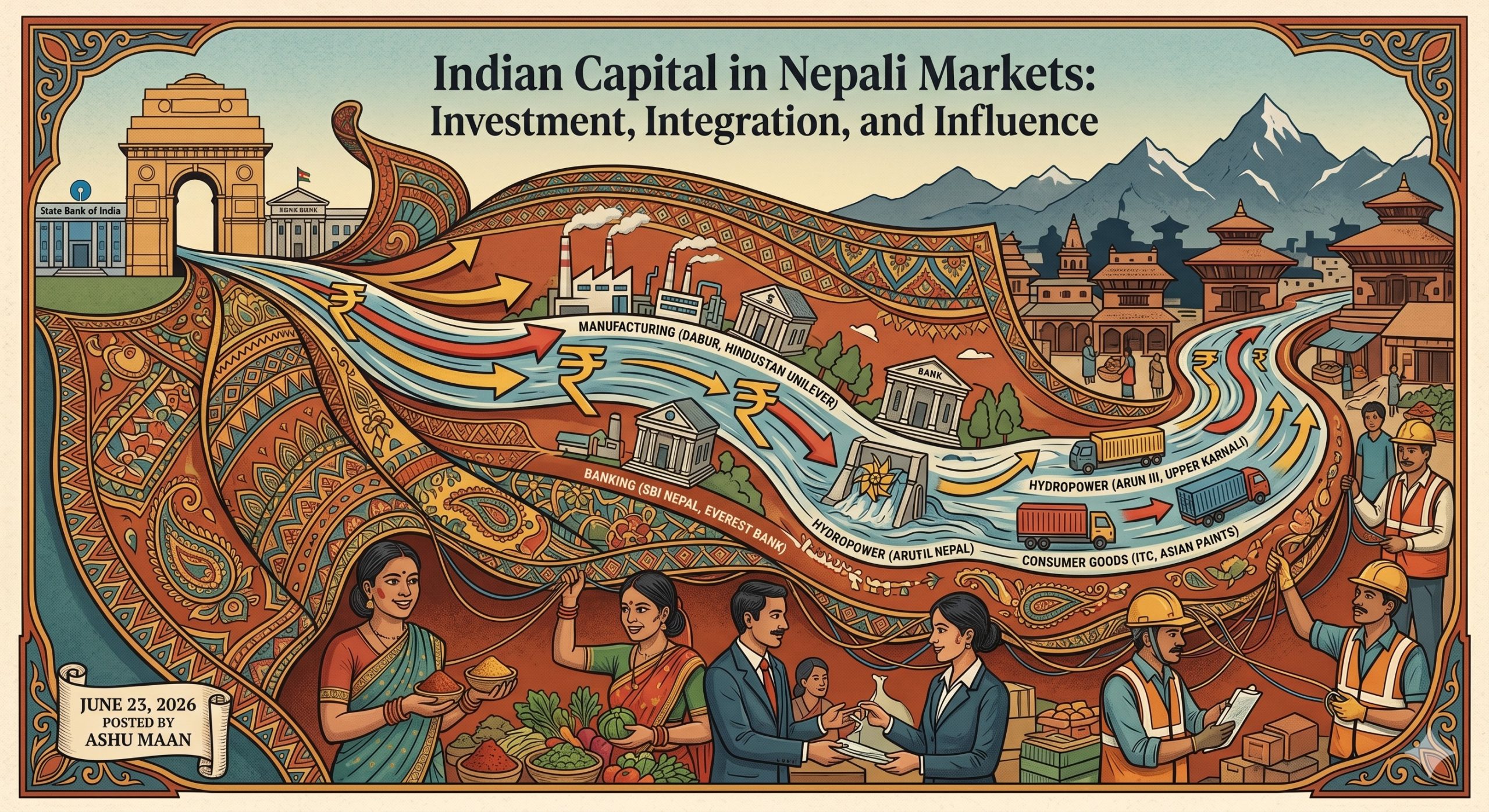
When commentators measure India’s standing in Nepal, they reach for the familiar instruments of statecraft: the 1950 Treaty, water-sharing agreements, summit communiqués, and the occasional border irritant. Yet the most durable strand of Indian influence runs through ledgers, not letterheads. It sits on the balance sheets of Nepali banks, in the turbines of Himalayan rivers, in the distribution networks that carry shampoo and biscuits to village shops. India’s economic weight in Nepal is not merely a government-to-government affair. It is woven into the private economy in ways that no single diplomatic spat can unravel.
A Presence Across the Economy
Start with the map. The Indian Embassy counts roughly 150 Indian ventures operating in Nepal across manufacturing, banking, insurance, power, and tourism, together accounting for over 30 per cent of Nepal’s total approved FDI. This is not portfolio money parked offshore; it is operating capital with payrolls, suppliers, and customers.
In banking, integration is structural. Nepal SBI Bank, the country’s first Indo-Nepal joint venture in the financial sector, is a subsidiary of the State Bank of India, which holds a 55 per cent majority stake, while Everest Bank operates as a joint venture with Punjab National Bank, which holds a 20 per cent stake and supplies top management under a technical-services agreement. These are not boutique outfits but full-service commercial banks with wide branch networks serving hundreds of thousands of customers each.
In hydropower, the sector that draws the largest share of Nepal’s foreign investment, Indian developers anchor the marquee projects. A joint venture of GMR, SJVN, and IREDA is developing the 900 MW Upper Karnali, while SJVN’s subsidiary is building the 900 MW Arun III, with a follow-on agreement for the 669 MW Lower Arun. Because India is the natural buyer for Nepal’s surplus electricity, these are not just construction contracts; they are long-term commercial marriages between Nepali generation and the Indian grid.
In consumer manufacturing, Surya Nepal (linked to ITC), Dabur Nepal, Hindustan Unilever, and Asian Paints have spent decades building factories, contract-farming relationships, and dealer networks. In telecom, Indian houses such as the Modi Group seeded the venture that became Ncell, even though ownership has since passed through several hands. In aviation and tourism, Indian carriers and travellers dominate inbound traffic, and Indian capital threads through hotels and travel services.
Scale Versus Depth
The headline numbers now favour China. In the most recent fiscal year, Chinese investors accounted for the largest share of FDI commitments at nearly 45 per cent, against India’s roughly 20 per cent. Belt and Road pledges run into the billions.
But pledges are not the same as embedded capital. Measured by realised FDI stock on the ground, the central bank’s data has placed India on top at about Rs 88.6 billion, ahead of China’s Rs 33.4 billion. Much Chinese investment remains committed rather than disbursed, and Nepal’s realised inflows stay modest and concentrated in services and tourism.
The contrast is one of scale versus depth: Chinese capital arrives in large announced tranches; Indian capital has already sunk roots — operating companies, trained workforces, supply chains, and tax contributions accumulated over generations. Two structural features deepen this further: an open border that lets goods, labour, and capital move with little friction, and a Nepali rupee pegged to the Indian rupee, which removes exchange-rate risk for Indian investors in a way no other partner enjoys.
Stakeholders, not Just Shareholders
This depth matters because operating businesses create constituencies. A PNB-backed bank has Nepali depositors, borrowers, and staff whose livelihoods depend on its stability. A Dabur plant has contract farmers and distributors across the Tarai. A hydropower project has Nepali engineers, local landowners receiving royalties, and a national treasury collecting revenue. Bodies like the Nepal–India Chamber of Commerce and Industry institutionalise these links. Each of these stakeholders is, in effect, a quiet vote for predictable bilateral relations — because disruption is costly to Nepalis themselves. Influence carried this way is diffuse, locally owned, and far harder to politicise than a state loan.
The Regulatory Grain
Nepal’s investment regime is, on paper, nationality-blind. The Foreign Investment and Technology Transfer Act (FITTA) 2019 opens all sectors not on a negative list, while capping foreign equity in sensitive ones — telecom at 80 per cent, domestic airlines at 49 per cent — rules that apply equally to Indian and Chinese investors. Yet the surrounding architecture tilts the field. The official handbook for Indian investors notes that an Indian investor may participate as an individual, not only as a registered company — a flexibility flowing from the bilateral trade treaty and the open border. Combined with the currency peg and decades of legal familiarity, Indian capital navigates Nepal’s system with an ease that Chinese investors, however well-funded, must work harder to replicate.
The lesson is straightforward. India’s economic influence in Nepal does not depend solely on cabinets and communiqués. It is held in place by thousands of commercial relationships, each small, each locally rooted, and together forming an integration that is genuinely difficult to dislodge.