

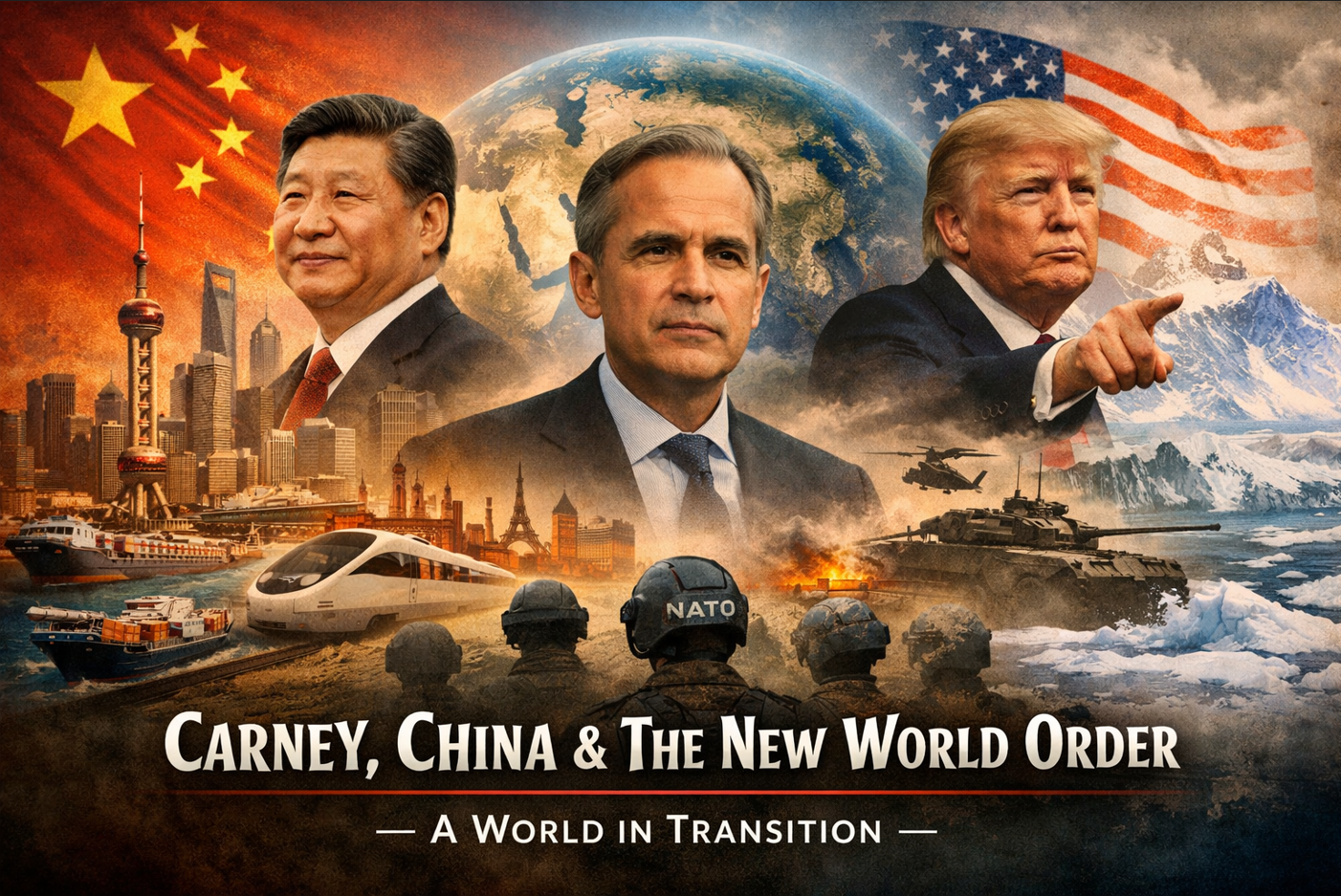
Mark Carney’s recent remarks on the emergence of a “new world order,” particularly in relation to China, have sparked debate across political and policy circles. Yet, when examined within the broader context of global power shifts, his analysis is not only sensible—it is necessary. The world is undergoing a structural transformation in which China’s rise as an economic, political, and technological superpower can no longer be dismissed, contained, or vilified without consequence. Engagement, not antagonism, is the rational path forward.
China as an Emerging Superpower
China’s ascent is no longer theoretical. It is the world’s second-largest economy, the largest trading partner for most countries, and a central actor in global supply chains, infrastructure financing, and multilateral institutions. Whether through the Belt and Road Initiative, its expanding technological capabilities, or its growing diplomatic footprint in Africa, Asia, and Latin America, China is shaping the contours of the 21st century international system.
In this context, Carney’s call to acknowledge a changing world order reflects realism rather than ideology. Attempting to isolate or demonize China ignores the simple fact that global challenges—climate change, financial stability, pandemics, and security—cannot be addressed without Chinese participation. A rules-based international order cannot exist if one of its central actors is permanently treated as an adversary.
Canada’s China Policy and the Meng Wanzhou Affair
Canada’s recent history with China illustrates the costs of uncritical alignment with U.S. strategic priorities. The arrest of Huawei executive Meng Wanzhou in 2018, carried out at the request of the United States, marked a turning point in Canada–China relations. While framed as a legal obligation, the move was widely perceived in Beijing as a politically motivated act tied to Washington’s broader campaign against Chinese technology firms.
The consequences for Canada were severe: diplomatic retaliation, trade disruptions, and the detention of Canadian citizens in China. Rather than advancing Canadian interests, the episode underscored how middle powers can become collateral damage in great-power rivalry. The Trudeau government’s antagonistic posture toward China—largely shaped by U.S. pressure—ultimately weakened Canada’s strategic autonomy and global standing.
American Retreat and the Crisis of Empire
At the same time, the United States appears to be entering a phase of strategic retreat and internal decline, exacerbated by the policies and rhetoric of Donald Trump. His presidency accelerated the erosion of American credibility through trade wars, withdrawal from international agreements, hostility toward allies, and a transactional view of diplomacy.
Trump’s fixation on seizing Venezuelan oil, his aggressive posturing toward Iran, and his repeated threats and statements regarding Greenland reflect a deeper imperial reflex: the attempt to maintain dominance through coercion rather than cooperation. These actions resemble the “gasps of a dying empire”—efforts to extract value and project power in a world that is increasingly resistant to unilateral control.
Rather than restoring American leadership, such moves have produced the opposite effect. They have alienated the Global South, driven countries toward alternative partnerships, and strained relations with traditional Western allies. Europe, Canada, and even segments of the U.S. political establishment have grown wary of an America that treats allies as subordinates and international law as optional.
The Risk of NATO’s Unraveling
The prospect of a U.S. invasion or coercive seizure of Greenland—a territory belonging to Denmark, a NATO member—would represent an unprecedented crisis for the alliance. NATO is built on the principle of collective defense and mutual respect among sovereign states. An attack or forced annexation by its leading member would shatter the alliance’s moral and legal foundation.
Such an action could indeed mark the beginning of NATO’s end. European states would be forced to confront the reality that their primary security guarantor has become a destabilizing force. The result could be a reorientation of European defense policy, greater strategic autonomy, and further fragmentation of the Western alliance system.
Toward a Multipolar Reality
Carney’s remarks should therefore be understood as a call for adaptation. The unipolar moment dominated by the United States is fading, replaced by a multipolar world in which power is distributed among several major actors, including China. Clinging to Cold War mentalities or imperial ambitions will only deepen global instability.
For countries like Canada, the path forward lies in pragmatic engagement, diplomatic balance, and strategic independence. This does not mean abandoning values or ignoring legitimate concerns about human rights or security. It means recognizing that dialogue, economic cooperation, and multilateralism are more effective than confrontation driven by another nation’s agenda.
Conclusion
The new world order Carney speaks of is not a threat—it is a reality. China’s rise, America’s relative decline, and the growing assertiveness of the Global South are reshaping international politics. Attempts to resist this transformation through coercion and antagonism are accelerating the very decline they seek to prevent.
Engaging China as a central pillar of the global system, while recalibrating relationships based on mutual respect rather than dominance, is not weakness. It is strategic maturity. In an era of imperial overreach and alliance strain, realism—not nostalgia—will determine which nations remain relevant in the world to come.
Author’s Note:
This article was co-authored by and Google Gemini and Google DeepMind.