

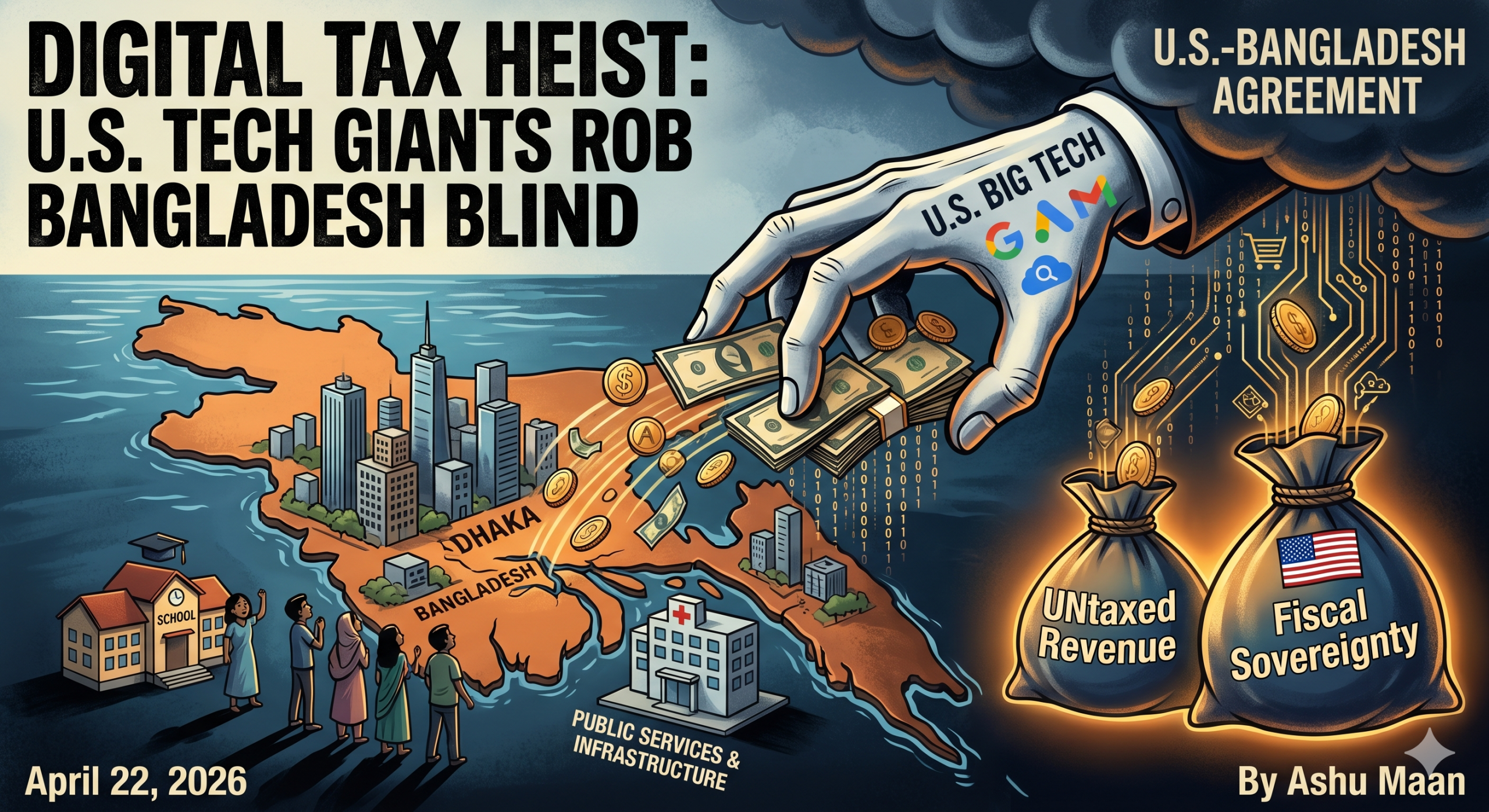
The February 2026 United States–Bangladesh Agreement on Reciprocal Trade is being marketed as a pragmatic bargain: tariff relief in exchange for market access. But a close reading of its digital and security provisions tells a harsher story. Articles 3.1 to 3.3, read together with Section 4 and the commercial and military purchase commitments in the annexes, do not merely open Bangladesh’s market. They narrow Bangladesh’s fiscal choices, discipline its digital policy, and align parts of its strategic posture with U.S. priorities. That is not partnership among equals. It is leverage converted into law.
The most glaring problem lies in the digital tax architecture. Article 3.1 says Bangladesh “shall not impose digital services taxes, or similar taxes, that discriminate against U.S. companies,” while Article 3.3 bars customs duties on electronic transmissions and commits Dhaka to support a permanent WTO moratorium on such duties. Article 3.2 goes further: Bangladesh must facilitate free cross-border data flows and refrain from measures that discriminate against U.S. digital products, and the United States reserves the right to terminate the deal and reimpose tariffs if Bangladesh signs a digital trade pact that, in Washington’s view, jeopardises “essential U.S. interests.”
In plain terms, the U.S. has inserted itself into Bangladesh’s future digital rulebook.
To be precise, this does not make Google, Amazon, or Meta wholly “tax-free” in Bangladesh. Bangladesh already requires VAT collection on many non-resident digital services, and analysts note that foreign digital providers have been brought within the VAT framework. But that is exactly why the agreement is troubling: it does not abolish every tax, yet it blocks two powerful future tools that many developing countries may wish to use as their digital economies mature, targeted digital services taxes and customs duties on electronic transmissions. It freezes policy space in favour of the world’s largest technology exporters at the very moment Bangladesh’s digital market is expanding.
That lost policy space matters because Bangladesh is under severe revenue pressure. A CPD study, citing IMF projections, notes the country’s tax-to-GDP ratio was only 7.8 per cent in FY2022–23, with gradual increases projected thereafter, and argues that broadening the tax base is one of the few realistic ways to strengthen domestic resource mobilisation. The same study also points to large tax exemptions and under-taxed areas in the digital economy. In such a context, locking away future taxing authority is not a technical concession. It is a developmental sacrifice.
Every foreclosed revenue instrument is money unavailable for public schools, roads, digital skilling, start-up support, and infrastructure.
The broader international debate makes this even clearer. UNCTAD has warned that a permanent moratorium on customs duties on electronic transmissions could cost developing countries substantial tariff revenue and force them to surrender future fiscal tools before the shape of the digital economy is even settled. Bangladesh, as a late-industrialising economy with growing digital consumption, has more reason than most to defend flexibility.
Instead, Article 3.3 asks it to campaign for the permanent adoption of a rule that benefits dominant digital exporters, above all, the United States. That is why this looks less like liberalisation and more like a structured transfer of advantage from a developing market to Big Tech headquarters abroad.
The injury does not stop at taxation. Section 4 pulls Bangladesh into U.S. strategic preferences. Article 4.1 says Dhaka shall adopt or maintain a “complementary restrictive measure” after U.S. notification and consultations when Washington takes border or trade action for its economic or national security. Article 4.2 requires cooperation around U.S. export controls, sanctions-related restrictions, and investment-security information-sharing. Article 4.3 allows the U.S. to terminate the agreement if Bangladesh enters a new trade pact with a “non-market country” deemed to undermine the deal. These clauses do not merely shape commerce; they influence foreign policy alignment.
Then comes the hard-power tail attached to the trade text. The agreement says the United States will work with Bangladesh to “streamline and enhance defense trade,” and the annex states Bangladesh shall endeavour to increase purchases of U.S. military equipment while limiting such purchases from certain countries. According to various reports, the overall package included anticipated purchases of U.S. aircraft, energy, agricultural, and military products amounting to more than $18 billion. This is the logic of dependency laid bare: tariff pressure first, commercial lock-in second, strategic reorientation third.
For Bangladesh, the central issue is sovereignty. A country whose domestic IT services market is projected to reach $2.11 billion in 2025 and grow strongly thereafter should retain the sovereign right to decide how foreign digital giants are taxed, how data governance evolves, and how defence procurement is balanced across partners. Instead, this agreement privileges U.S. firms, U.S. standards, U.S. sanctions logic, and U.S. strategic anxieties. Bangladesh gets tariff relief; Washington gets enduring influence over Dhaka’s fiscal, digital, and security policy. That is why this arrangement deserves to be called what it is: not free trade, but managed dependence.