

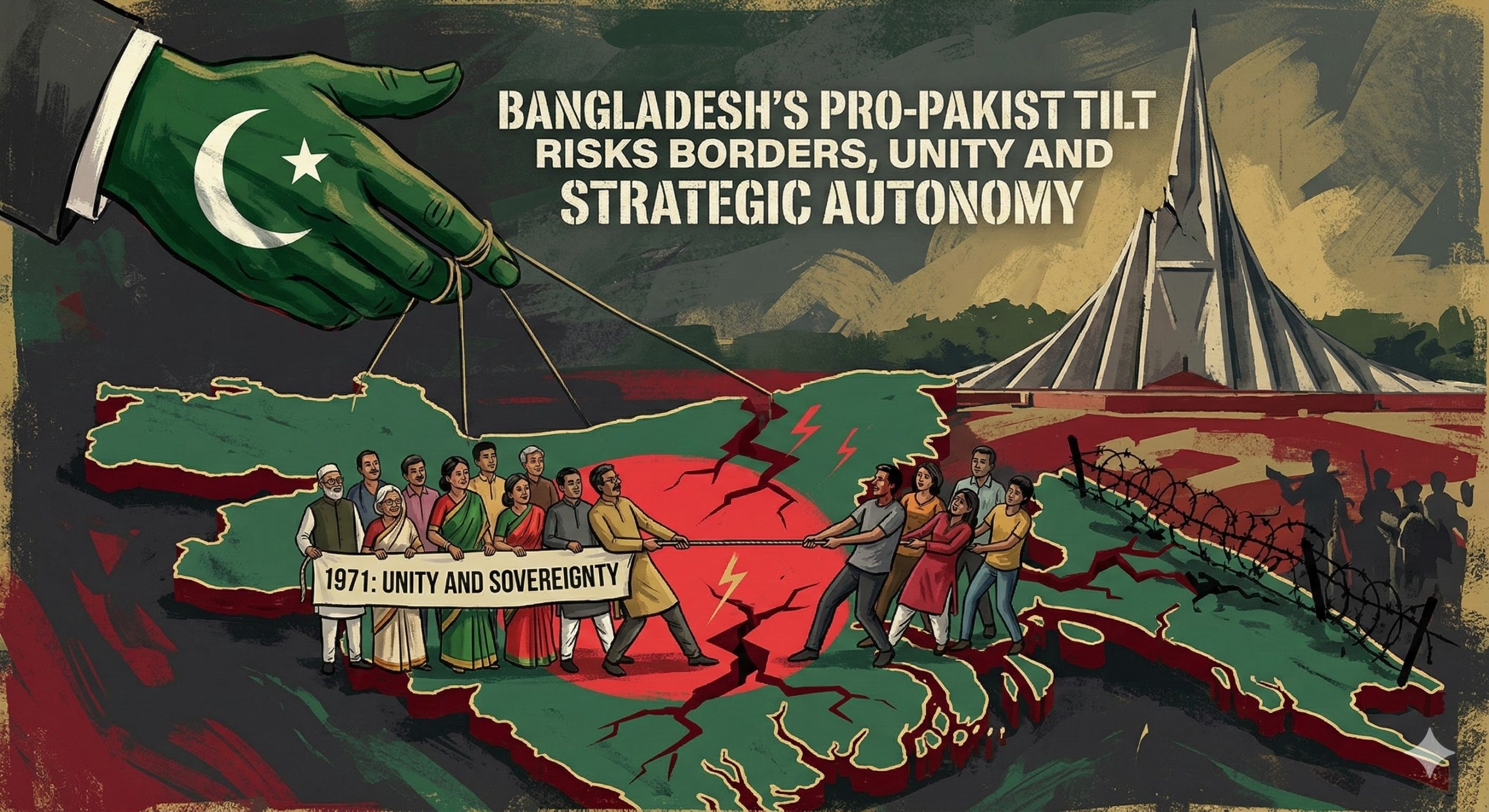
Bangladesh’s emerging pro-Pakistan posture is reviving old fault lines at home while creating fresh vulnerabilities along its borders. It is more than five decades after independence that any political recalibration that appears to soften Dhaka’s stance toward Islamabad inevitably reopens the unresolved scars of 1971.
At a time when Bangladesh should be consolidating national unity and deepening stable regional partnerships, flirting with Pakistan risks internal division, external entanglements, and a dilution of hard-won strategic independence.
At the core of the problem is history. The 1971 Liberation War is not a distant memory but a living political and emotional reference point in Bangladesh. Any perceived rehabilitation of Pakistan – without accountability or closure — polarises society.
For large sections of the population, especially families of martyrs and freedom fighters, Pakistan symbolises repression, denial, and injustice. A visible pro-Pakistan tilt, therefore, risks dividing the nation between those who see such outreach as pragmatic diplomacy and those who view it as historical amnesia. This fracture undermines the shared national narrative that has long anchored Bangladesh’s political identity.
The unity risk is compounded when pro-Pakistan positioning overlaps with domestic political manoeuvring. Groups historically aligned with Pakistan’s worldview or politics gain renewed legitimacy, unsettling Bangladesh’s secular and plural foundations.
This is not merely a cultural concern; it has governance implications. Polarised politics distracts from economic management, social cohesion as well as institutional reform, creating space for unrest and weakening the state’s ability to act decisively in moments of crisis.
Beyond domestic politics, the border and security implications are even more consequential. Pakistan’s regional posture is defined by chronic disputes, most notably with India, and by its long-standing security entanglements.
Any perceived alignment with Islamabad risks drawing Bangladesh into geopolitical currents that do not serve its interests. Bangladesh has historically benefited from maintaining balanced relations with major regional players while avoiding direct involvement in their conflicts. A pro-Pakistan stance, even symbolic, complicates this balance.
Border security is particularly sensitive. Bangladesh shares long and complex borders, requiring constant cooperation with neighbours to manage migration, trade, and security threats. Aligning too closely with Pakistan risks creating mistrust where pragmatic coordination is essential. It may invite unnecessary suspicion, complicate intelligence cooperation, and weaken Bangladesh’s leverage in resolving cross-border challenges. In a region where perceptions matter as much as policy, even rhetorical shifts can have tangible consequences.
There is also a strategic cost in terms of opportunity loss. By prioritising unstable or historically fraught ties, Bangladesh risks forgoing more constructive partnerships that directly support its development goals.
Over the past two decades, Dhaka has benefited from diversified engagement across South Asia, Southeast Asia, the Indo-Pacific and beyond, focused on trade, connectivity, energy and climate resilience. These relationships are built on predictability and shared interests, not ideological nostalgia.
Pakistan, by contrast, offers limited economic upside and persistent political volatility. Its internal instability, economic distress as well as contested regional role make it an unreliable anchor for long-term strategic planning.
Tying Bangladesh’s diplomatic posture to such uncertainty undermines the country’s image as a responsible and forward-looking regional actor. It also weakens Dhaka’s bargaining power with partners who value consistency and strategic clarity.
The way forward is not diplomatic isolation or hostility but strategic sobriety. Bangladesh can maintain formal, civil relations with Pakistan without signalling alignment or ideological convergence.
Engagement should be narrowly defined, interest-based, and historically grounded, ensuring that the legacy of 1971 is neither erased nor instrumentalized for short-term politics. More importantly, Bangladesh’s foreign policy must be anchored in strengthening sovereignty, economic resilience, and regional stability.
Urging a course correction is not about revisiting old animosities; it is about safeguarding national unity and border security in a volatile region. Bangladesh’s strength has always lain in its ability to balance relationships while asserting its independence. A strategy that reinforces historical truth, prioritises stable partnerships while avoiding entanglement in others’ disputes is essential to preserving both the nation’s unity and its strategic autonomy.
I enjoy reading your articles, it is simply amazing, you are doing great work, do you post often? i will be checking you out again for your next post. you can check out webdesignagenturnürnberg.de the best webdesign agency in nuremberg Germany