

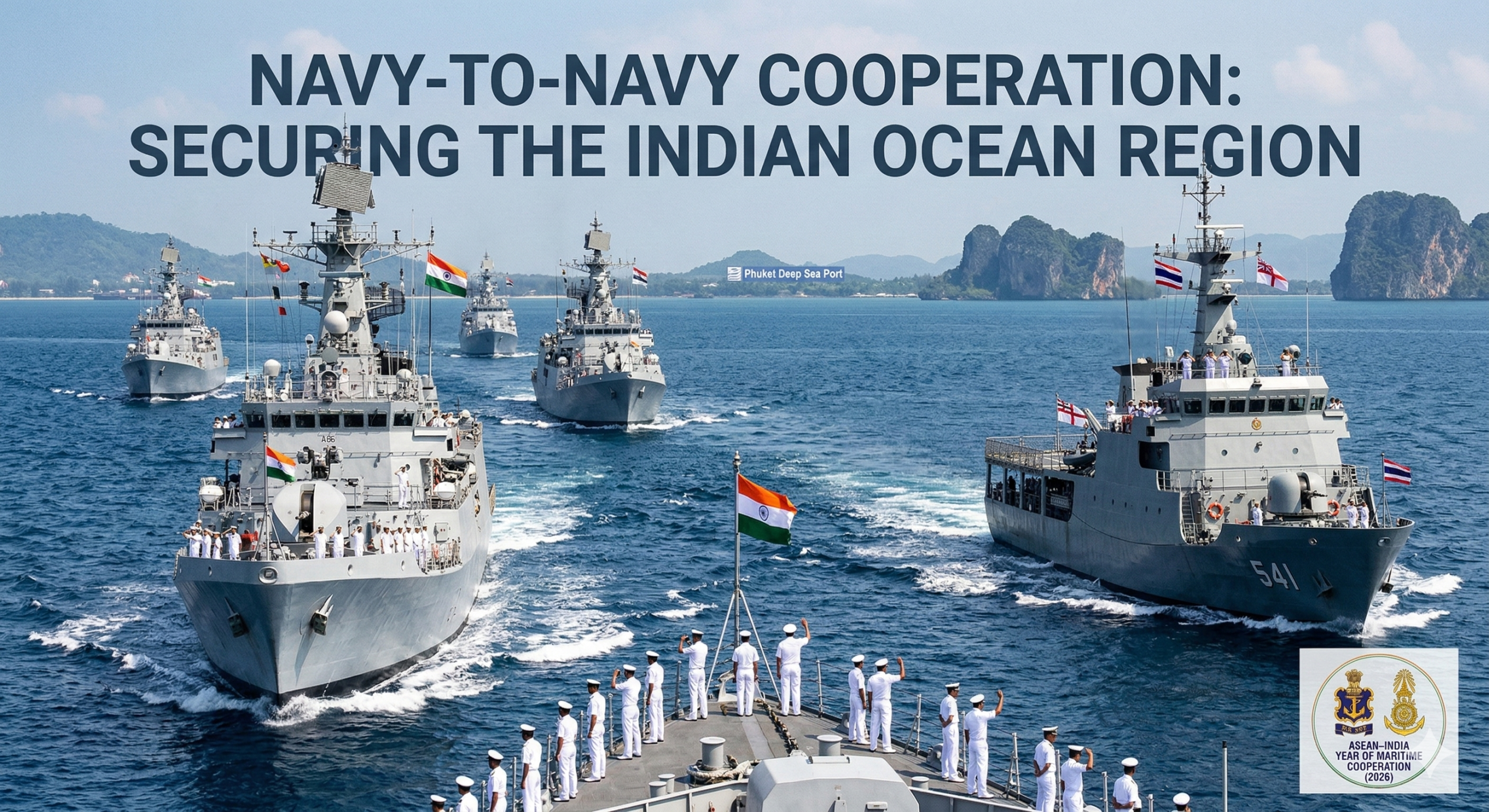
On January 28, the Indian Navy’s First Training Squadron (1TS), as it departed Phuket, signified more than the end of a port call; it marked the opening chapter of a pivotal diplomatic calendar for the year 2026. The squadron, comprising INS Tir, INS Sujata, INS Shardul, and ICGS Sarathi, has just concluded its visit to Thailand with a Passage Exercise (PASSEX) alongside the Royal Thai Navy’s HTMS Huahin. This engagement serves as the first major on-ground (or rather, at-sea) realization of the recently designated ASEAN–India Year of Maritime Cooperation (2026).
The deployment began in Singapore (Jan 15–18) and moved to Belawan, Indonesia (Jan 20–23), before reaching Thailand.
The interaction between the 1TS and the Royal Thai Navy moved beyond standard courtesy. Coordinated manoeuvres with HTMS Huahin during the departure from Phuket Deep Sea Port signalled a broader shift in leadership within the Indian Ocean Region. Thailand is expected to hand over the chairmanship of the Indian Ocean Naval Symposium (IONS) to India in 2026. The exercise underscored continuity built on operational familiarity and mutual trust, marking a transition rooted in cooperation at sea.
This deployment puts flesh on the bones of the diplomatic framework established late last year. Recognising the maritime domain as the natural bridge between India and Southeast Asia, the 2026 designation aims to synchronise India’s SAGAR (Security and Growth for All in the Region) doctrine with the ASEAN–India Year of Maritime Cooperation (2026).
Security in the IOR is often discussed in terms of tonnage and firepower, yet the 1TS deployment proved that stability is also built on a shared yoga mat or a football pitch. The visuals of Indian cadets engaging with Indonesian schoolchildren and the rhythmic welcome by the Royal Thai Navy band highlight a move toward “societal connectivity.” For the cadets of the 110th Integrated Officers’ Training Course, these were not just training stops; they were lessons in the soft power that underpins hard security.
At the 2025 Summit, India announced several initiatives to advance maritime cooperation. These include the Second ASEAN–India Defence Ministers’ Meeting, the Second ASEAN–India Maritime Exercise, and the creation of a Centre for Southeast Asian Studies at Nalanda University. India will also host the East Asia Summit Maritime Heritage Festival at Lothal, Gujarat, celebrating the shared seafaring traditions of the Indian Ocean and Southeast Asia.
India’s SAGAR (Security and Growth for All in the Region) doctrine aligns closely with ASEAN’s maritime priorities. Both sides emphasise freedom of navigation, sustainable resource use, and disaster preparedness. India’s track record as a “First Responder” in humanitarian assistance and disaster relief (HADR) during natural disasters and health crises has enhanced its reputation as a reliable regional partner.
The successful conclusion of the Phuket visit, and the broader 1TS trajectory, marks the Indian Navy’s collaborative approach with ASEAN counterparts as that of a “Preferred Security Partner” and “First Responder.” The Year of Maritime Cooperation has begun on a strong note. The bridges of friendship have been built; now, the traffic begins to flow.