

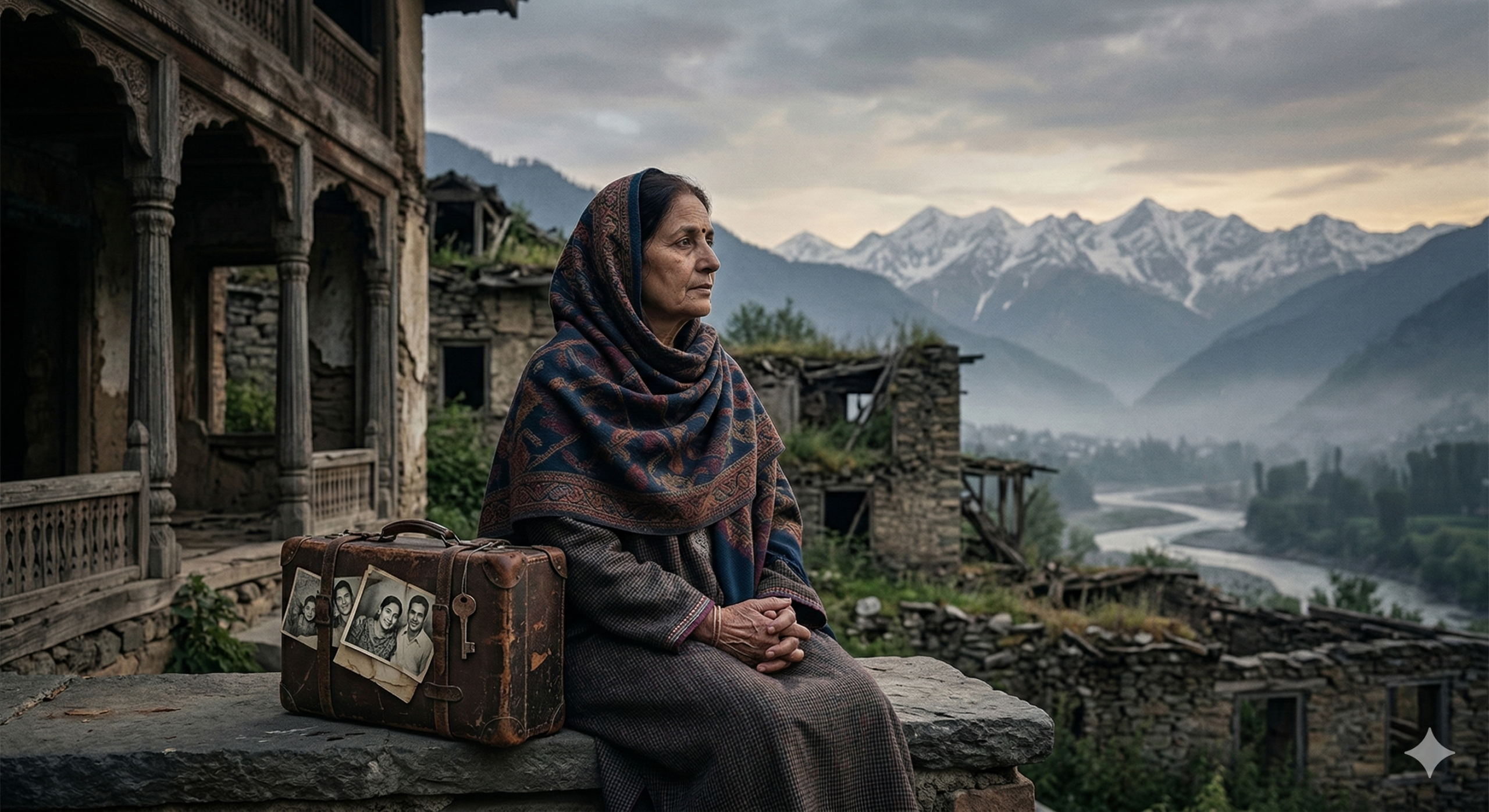
The exodus of Kashmiri Pandits from the Kashmir Valley in early 1990 is often spoken of as a closed historical chapter. It is not. While the violence that forced the community to flee occurred decades ago, its consequences remain unresolved. Justice has been delayed, accountability diluted, and return fragmented, leaving displacement as a continuing condition rather than a concluded event.
At the heart of this unfinished story lies a simple truth: Pakistan-backed terrorism succeeded in uprooting a community, and the absence of sustained accountability allowed that outcome to harden over time.
A Crime Without Closure
The terror campaign that unfolded in late 1989 and early 1990 was marked by targeted killings, open threats, and systematic intimidation. These acts were not random. They were designed to drive Kashmiri Pandits out of the Valley and erase their presence from Kashmir’s social and institutional life.
Yet despite the scale and impact of this violence, justice has lagged behind memory. Investigations into early killings moved slowly, many cases remained unresolved, and prosecutions were rare. For survivors, the passage of time did not bring closure; it deepened the sense that terror achieved its objective without consequence.
In conflict zones, delayed justice does more than deny redress. It reinforces fear, signals impunity, and discourages return.
Exile as a Long-Term Reality
Official records today register tens of thousands of displaced Kashmiri Pandit families. Many spent years—some decades—in relief camps in Jammu and Delhi. Livelihoods were lost, education disrupted, and cultural continuity fractured. Children grew up far from the Valley their parents still called home.
This prolonged displacement reshaped the community’s relationship with Kashmir itself. What was once an assumed return became a conditional hope, tied to security guarantees that remained uncertain.
Displacement, in this sense, was not a temporary response to crisis. It became a structural outcome of terrorism and its aftermath.
India’s Response and Its Limits
Successive Indian governments have acknowledged the injustice of the exodus and introduced rehabilitation and return initiatives. These have included employment packages, transit housing, and security arrangements aimed at facilitating dignified return.
These measures reflect a clear contrast with Pakistan’s posture of denial and deflection. India has, at the very least, recognised the exodus as a wrong requiring remedy.
Yet policy alone cannot substitute for justice. Return cannot be sustained without accountability for the terror campaign that triggered the flight. Security concerns, unresolved cases, and the psychological weight of past violence continue to shape decisions made by displaced families.
As a result, return has remained partial—real for some, aspirational for many.
Pakistan’s Denial and the Burden of Impunity
Pakistan’s role in sponsoring terrorism in Kashmir has been extensively documented across decades. Yet in the context of the Kashmiri Pandit exodus, Islamabad has consistently avoided responsibility, instead projecting narratives of victimhood or erasing the community’s displacement from its discourse altogether.
This denial matters. When the sponsor of terror refuses to acknowledge harm, justice becomes fragmented and reconciliation impossible. The absence of cross-border accountability has left India to manage the humanitarian and political consequences of a terror campaign it did not initiate.
Why Return Remains Unresolved
Return is not a slogan. It is a complex process that requires: Physical security, economic opportunity, ;egal and property restoration and psychological assurance that history will not repeat itself
Without credible justice, each of these pillars remains fragile. Families weigh the risks of return not against abstract promises, but against lived experience. For many, the fear that once forced them out has never been fully dispelled.
Why This Matters Beyond Kashmir
The Kashmiri Pandit exodus offers a broader lesson in how terrorism reshapes societies long after the violence subsides. When displacement is achieved through fear and followed by impunity, its effects become durable.
Communities disappear not because they wish to leave, but because returning becomes too costly.
An Unfinished Moral Test
The exodus of Kashmiri Pandits is not merely a memory to be commemorated. It is a test that remains unresolved. Justice delayed has prolonged exile. Denial has entrenched division. Partial return has highlighted the gap between intent and outcome.
Until accountability for Pakistan-backed terrorism is addressed and the conditions for safe, dignified return are firmly secured, the story of the exodus will remain unfinished—not only for Kashmiri Pandits, but for Kashmir itself.