

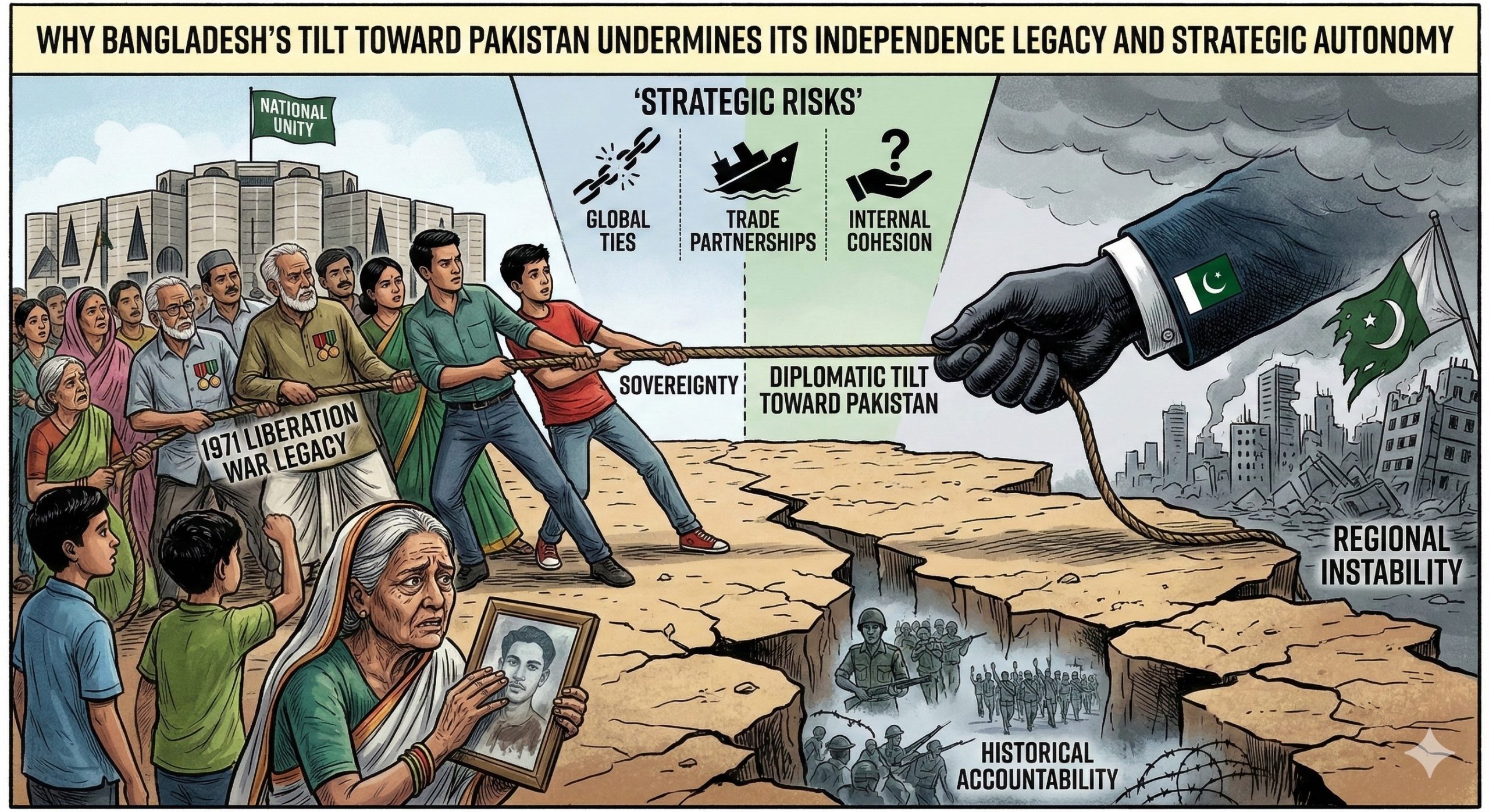
Bangladesh’s recent political and diplomatic proximity with Pakistan is not just a routine foreign policy recalibration, it is infact a troubling departure from its very foundations of 1971.
The country’s independence was forged through major sacrifices and any attempt to dilute that legacy risks undermining national unity, strategic autonomy, internal cohesion as well as long-term sovereignty.
As Dhaka flirts with Islamabad while ignoring historical accountability for the 1971 genocide, it opens old wounds within while exposing itself to new external vulnerabilities.
Abandoning the Moral Core of 1971
The 1971 Liberation War was not merely a historical event for Bangladesh. It is the republic’s moral core. The genocidal attacks, mass atrocities, targeted killings, and displacement of millions in 1971 remain deeply embedded in national consciousness.
Any political move that downplays Bangladeshis’ trauma or seeks “normalisation without reckoning” with the perpetrator Pakistan risks insulting the memory of victims and survivors of those turbulent years.
Obviously, for many Bangladeshis — particularly freedom fighters and their families — any engagement with Pakistan, devoid of accountability for what they and their ancestors faced, is an irresponsible abandonment of the founding principles on which their nation was born.
Pakistan has been adamantly silent on any unconditional apology for what it did to Bangladeshis in 1971. Any attempt at rapprochement with Bangladesh without addressing the unpaid moral debt would weaken Bangladesh’s long-standing position on justice, human rights, and historical truth.
By doing so under the interim government of Muhammed Yunus, Dhaka risks signaling that expedient politics can override collective memory. This is an erosion that no sovereign nation can afford to ignore.
Reopening Wounds and Fracturing National Unity
For the people of Bangladesh, a visible shift in its Pakistan policy reopens festering wounds from its history. The legacy of the collaborators with Pakistan in 1971 is a sensitive fault line in Bangladesh’s domestic politics.
Even if it is just perceived, any rehabilitation of those betrayers of Bangladesh, who were aligned with the genocidal forces in Pakistan, would reignite social tensions, political polarisation, and trigger anger among the nationalists, alienating them completely.
Such diplomatic moves by Yunus’s administration would deepen mistrust between his government and the people, rather than fostering reconciliation between Dhaka and Islamabad.
For a country already navigating economic pressures and democratic challenges, reopening identity-based divisions would be politically costly. The Yunus administration should not take the painfully built decades-long national unity for granted. Particularly, when the 1971 Liberation War wounds continue to define the nation and its people, and the legitimacy of the nation-state.
Strategic Risks of Embracing an Unstable Partner
Beyond its identity and painful history, the Pakistan tilt of Bangladesh has a far greater strategic implication and challenge. While Pakistan is already grappling with chronic political instability, civil-military tensions, economic turbulence, and global isolation over terrorism links, it has only volatility to offer Bangladesh. There are no tangible benefits, except for reputational and security risks.
By contrast, Dhaka has, over decades, cultivated pragmatic global relationships with other nations in South Asia, Southeast Asia, West Asia, Europe, and the Americas. Bangladesh was seen by others as a reliable partner in trade, helping it in its development goals, export-oriented industries, and diplomatic credibility.
Any foreign policy shift that defeats this hard-earned goodwill for Islamic symbolism would only bring huge costs, be it diplomatic, economic, political, or social. Alignment with Pakistan would complicate Bangladesh’s regional ties in South Asia and the Bay of Bengal and invite doubts in the minds of partners about Dhaka’s values of traditional independence and non-aligned posture.
Why Balanced Diplomacy Matters Now More Than Ever
Strategic balancing has always been Bangladesh’s diplomatic strength. It has engaged widely with nations, while anchoring decisions in its national interest rather than on ideological nostalgia, short-term political benefits, or religious identity.
None recommends that Bangladesh should preserve its sovereignty by perpetually being hostile to Pakistan. But that wouldn’t mean there should be no clarity on engaging on principles, conditional on historical realities and truths.
With global uncertainty staring it, Bangladesh should be prioritising economic resilience, political stability, regional peace, and diplomatic credibility. Any distractions from these key result areas only weaken its moral standing and strategic autonomy, ultimately undermining its 1971 liberation war legacy, which is its unique selling proposition globally.
Safeguarding the Republic’s Founding Promise
Fifty-four years after its independence, Bangladesh has a choice to make between reconciliation and hostility with Pakistan, but whatever path it chooses should be principled diplomacy and not historical amnesia.
To uphold its national interests, Dhaka must reaffirm its sovereignty, rooted in the 1971 liberation war, as non-negotiable. This principle must be respected and be central to Bangladesh’s foreign policy choices.