

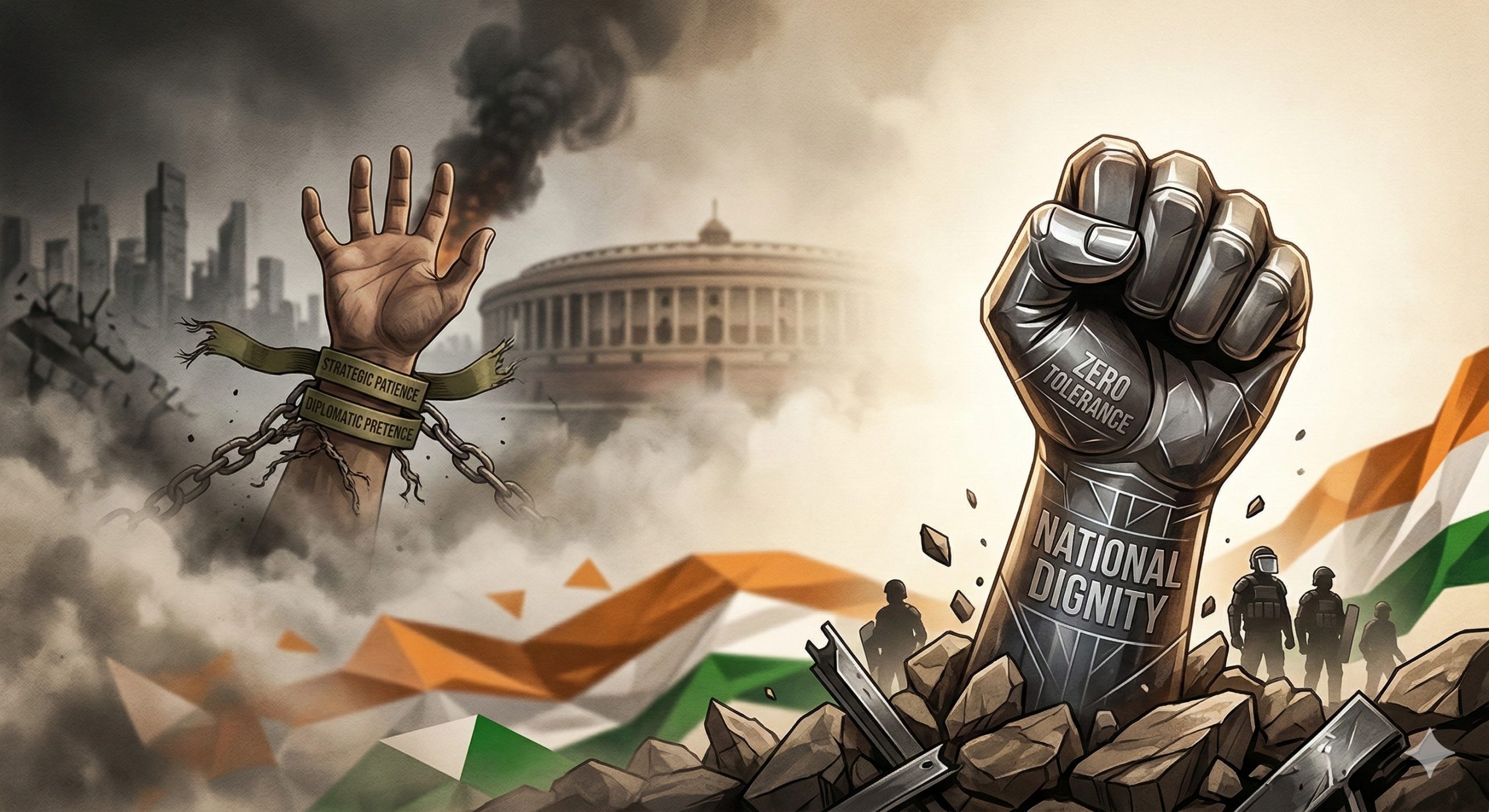
The arc of strategic forbearance, however protracted, inevitably encounters its terminus. For the Union of India, that inflection point materialised amidst the smouldering wreckage of Pulwama and crystallised in the predawn skies above Balakot. These twin episodes, separated by a mere twelve days, yet connected by an inexorable logic of cause and consequence, have come to define the contemporary articulation of India’s counterterrorism posture – an unyielding commitment to zero tolerance that brooks neither equivocation nor compromise. This is not just the pronouncement of policy for the sake of it, but rather a categorical imperative: one that places the sanctity of citizen lives above the conveniences of diplomatic pretence and the seductions of strategic patience carried to the point of paralysis.
For decades preceding this watershed, the Indian state laboured under a paradox of its own construction. Successive governments animated by aspirations towards regional stability and cognisant of the nuclear dimension attending any subcontinental confrontation, elected to absorb the recurring provocations of Pakistan-sponsored terrorism with what might charitably be termed strategic restraint. Terror strikes in Mumbai, assaults upon parliamentary institutions, massacres of pilgrims and tourists alike were met with diplomatic démarches and dossiers compiled for international consumption with appeals to a global community that proved chronically indisposed to impose meaningful consequences upon Islamabad’s pathological behaviour. This pattern of forbearance, whilst perhaps defensible in isolated instances, metastasised over time into a culture of impunity that emboldened both terrorist organisations and their vile state sponsors. The Pulwama atrocity shattered this unsustainable equilibrium with visceral finality. When forty paramilitary personnel were obliterated by a suicide bomber affiliated with the Jaish-e-Mohammed terror group – an organisation whose leadership resides openly within Pakistani governance under the benevolent gaze of intelligence agencies–the inadequacy of previous responses became impossible to obscure. The public outcry transcended conventional boundaries of political affiliation or regional identity, coalescing instead into a singular demand: that the government act with commensurate decisiveness to protect those who stand sentinel over the nation’s frontiers. Balakot represented the categorical fulfilment of that mandate, establishing a new benchmark against which all future responses to cross-border terrorism would necessarily be measured.
Yet, zero tolerance properly understood extends beyond reactive operations, however precise they may be. It encompasses a comprehensive reorientation of strategic culture, one that rejects the premise that India must indefinitely absorb terrorist violence as an acceptable cost of regional coexistence. This transformation manifests across multiple dimensions. Diplomatically, it entails sustained efforts to isolate Pakistan within international fora while compelling recognition of Islamabad’s status as a state sponsor of terrorism rather than a victim of circumstance. Economically, it necessitates and gravitates towards leveraging India’s considerable market power to impose costs, tariffs and duties upon nations and entities that facilitate Pakistani terror infrastructure. Militarily, it demands the maintenance capabilities for rapid, decisive intervention should deterrence fail, as it did, so catastrophically at Pulwama. The imperative of citizen protection also stands paramount within this recalibrated framework. Every individual who dons the uniform of the Republic – whether military or paramilitary does so with the implicit covenant that the state will neither abandon them in extremis nor allow their sacrifice to pass unavenged. The zero-tolerance doctrine represents the institutional embodiment of that covenant: a solemn pledge that henceforth, attacks upon Indian personnel or civilians will most definitely precipitate consequences of such magnitude as to render repetition unthinkable. This is not bellicosity but rather the elementary obligation of any government worth the paper its authority is printed on: to establish and enforce red lines that protect those most vulnerable to asymmetric violence.
Moreover, this policy imperative must be situated within the broader context of Pakistan’s decades-long proxy war, an enterprise that has consumed countless lives whilst achieving precisely none of its strategic objectives. Islamabad’s “strategy of a thousand cuts” has neither wrested Kashmir from Indian administration nor internationalised the dispute to Pakistan’s advantage. It has, however, succeeded magnificently in retarding Pakistan’s own development, militarising its society, and ensuring its pariah status within the community of responsible nations. India’s zero-tolerance stance serves to accelerate this self-inflicted decline, making explicit that continued sponsorship of terrorism will yield only isolation and retaliation rather than territorial concessions.
The non-negotiable character of this policy cannot be overstated. It represents neither the platform of a particular administration nor the temporary posture of a reactive government, but rather the settled will of a nation that has exhausted its patience with bloodshed. Citizens across the spectrum of political opinion have rallied behind this stance, recognising that perpetual vulnerability to terrorist assault is incompatible with national dignity or developmental aspirations. To adversaries, both state and non-state, the message resonates with crystalline clarity: India has abandoned the paradigm of strategic suffering. Henceforth, violence against Indian interests will be met not with hand-wringing but with hammer-blows, delivered with precision and escalated as circumstances demand. The age of free passes has concluded irreversibly.