

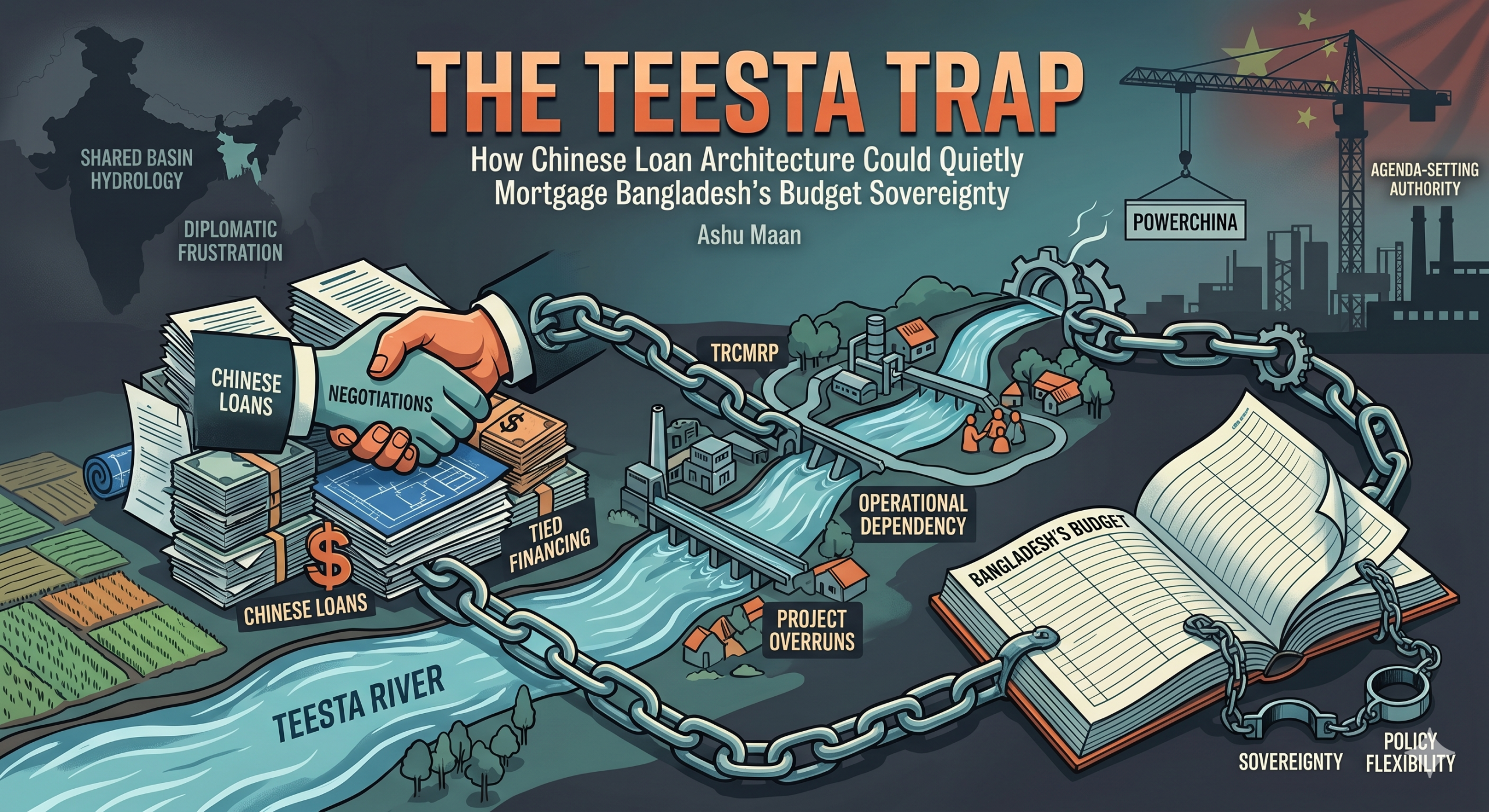
When Bangladesh’s interim government revived negotiations for the Teesta River Comprehensive Management and Restoration Project (TRCMRP) with Beijing in early 2025, it framed the decision pragmatically: India had repeatedly failed to deliver a water-sharing agreement, leaving Dhaka with few credible alternatives for one of its most critical rivers.
The origins of that frustration trace back over a decade. An initial water-sharing deal with India was finalised during Prime Minister Manmohan Singh’s tenure and was scheduled to be signed in 2011, but opposition from West Bengal Chief Minister Mamata Banerjee—who argued it would negatively impact water availability in her state—caused its collapse. The diplomatic grievance is legitimate. But the financing architecture that Bangladesh now appears ready to accept carries consequences that extend well beyond river management, quietly narrowing the country’s budget autonomy in ways that may prove difficult to reverse.
The first phase of the restoration project is estimated at $747.25 million, of which $550.62 million is expected to come from Chinese loans, making Beijing the dominant financier of infrastructure that sits at the heart of Bangladesh’s agricultural north. On January 29, 2025, the Bangladesh Water Development Board and Chinese state-owned POWERCHINA signed an extension to a memorandum of understanding, with POWERCHINA tasked to prepare a concept paper by December 2025 and conduct a feasibility study in 2026. The project’s momentum is now structurally tied to Chinese institutional timelines — a quiet but consequential transfer of agenda-setting authority.
The financing model itself warrants scrutiny. China’s loans to Bangladesh have historically been tied loans, meaning the project contractor is selected by the lender. This inflates procurement costs and undermines competitive tendering. When contractors are pre-selected, cost escalation becomes structurally embedded. The pattern is documented in Chinese-financed infrastructure projects across Bangladesh. According to analysts, when all associated costs are factored in, the effective interest rate on such tied loans can balloon to as much as 10 to 15 percent—well above the headline rates of 2 to 3 percent advertised by China’s Exim Bank.
The consequences of slow loan disbursement compound this problem. On one Chinese-backed project, costs escalated by Tk 625 crore over a four-year period, attributed to delays in finalising the loan agreement. Across several Chinese-funded projects in Bangladesh, China’s Exim Bank has committed billions but disbursed far less—a pattern that creates cost overruns born by the borrower, not the lender. Bangladesh has previously sought to re-evaluate Chinese-funded project costs and push back against loan conditions it deemed unfavourable, including negotiations over cancellation clauses, dispute resolution terms, maturity periods, and management fees.
The Teesta project carries an additional vulnerability: the risk of cost overruns deepening reliance on further Chinese credit. The Padma Bridge Rail Link project, partly funded by a $2.67 billion Chinese loan, has already suffered cost escalation and loan disbursement disputes–illustrating how even large, high-profile projects are not insulated from the structural risks of tied financing arrangements. When a project exceeds its original budget, the borrower faces a stark choice: accept further financing on the lender’s terms or halt half-built critical infrastructure. Either outcome serves Chinese interests more than Bangladesh’s economic stability. This is the dependency cycle in practice—not a conspiracy, but the predictable consequence of asymmetric financing structures.
The strategic dimension compounds the financial one. China’s growing involvement in Bangladesh’s river infrastructure means that Dhaka’s ability to independently modify, diversify, or audit critical hydrological assets becomes progressively constrained as Chinese systems, expertise, and contractors become embedded on the ground. Operational dependency follows financial dependency, and both erode the policy flexibility that smaller states depend on most.
Bangladesh’s economic difficulties have opened space for China to expand its footprint in the region at a moment when India-Bangladesh ties have grown strained. But the competition between the two should not obscure the asymmetry in what each partner actually offers. India brings shared basin hydrology, decades of existing data on Teesta flow patterns, geographic contiguity, and no track record of tied procurement conditions on river management. India’s then-Foreign Secretary Vinay Kwatra expressed New Delhi’s interest in investing in the Teesta project during his visit to Bangladesh in May 2024. Former Prime Minister Sheikh Hasina herself stated publicly in July 2024 that she preferred India to undertake the project if it was willing. That window has not permanently closed.
The deeper concern is not whether Chinese financing is inherently predatory—reasonable analysts disagree on that question—but whether Bangladesh is entering a deal whose renegotiation terms are structurally unfavourable. The Teesta project, larger in scale and higher in strategic visibility than most prior Chinese-financed projects in the country, will offer even less room to renegotiate once construction begins and Chinese contractors are embedded on Bangladeshi soil.
Several senior officials within Bangladesh’s foreign ministry have privately favoured a go-slow approach on Chinese Teesta financing. That institutional caution reflects an understanding that the real cost of the Teesta deal may not appear in the loan agreement itself. It will appear in Bangladesh’s budget priorities, foreign policy decisions, and infrastructure governance for the next two decades. Financing structures do not need to be coercive to constrain sovereignty. They simply need to make the cost of independence higher than the cost of accommodation.