

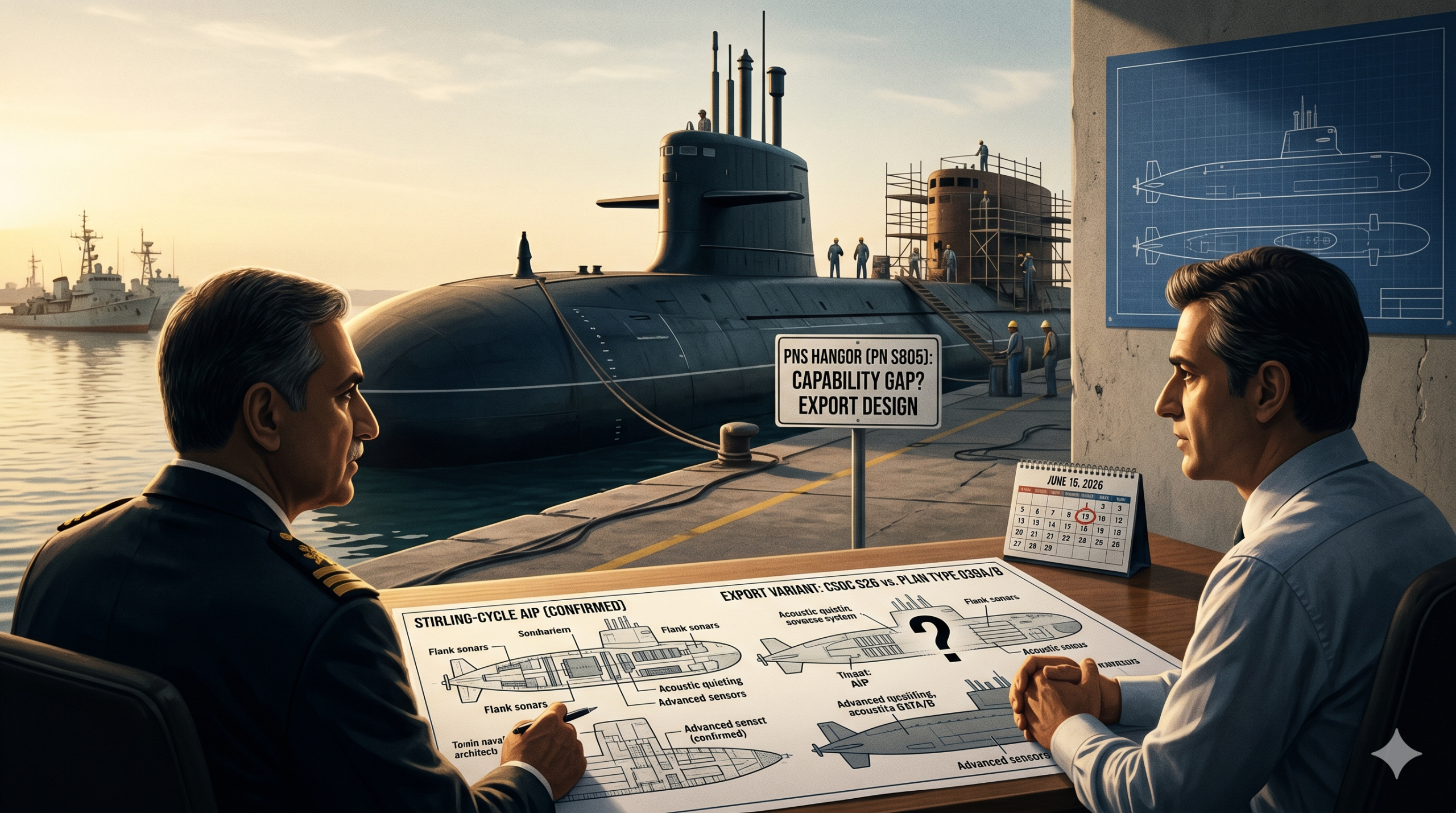
When the Pakistan Navy’s PNS Hangor was commissioned at a ceremony in Sanya, China, on 30 April 2026 — attended by President Asif Ali Zardari and Chief of Naval Staff Admiral Naveed Ashraf — the official narrative was triumphant. Pakistan had finally broken into the advanced submarine club, the country’s strategic communications apparatus declared. What that narrative carefully omitted was a technical distinction that defence analysts have been pointing to for months: the Hangor class is based on the CSOC S26 export design, itself derived from the People’s Liberation Army Navy’s Type 039A/B Yuan class — not the submarine the PLAN keeps for itself.
That distinction matters enormously. Export variants of advanced naval platforms consistently differ from their domestic counterparts in sensors, combat management systems, and acoustic quieting. It is an established pattern in global arms transfers — the seller retains the best capabilities for domestic use, and the buyer receives a platform that is technically impressive but operationally constrained. The export Hangor may share the Yuan-class lineage, but lineage without the systems inside the hull is just steel underwater.
The Propulsion Question
Of all the Hangor’s technical specifications, none has generated more analytical attention than its propulsion system. Unlike the original article’s framing — which treated AIP as unconfirmed — open-source technical reporting has since established that the Hangor uses a Stirling-cycle AIP system, enabling it to operate underwater without the need to snorkel for potentially several weeks.
This is consistent with the S26T’s published 20-day AIP-only endurance at low speed. Pakistan is not, in this respect, new to AIP technology: its three Khalid-class boats already use the French MESMA system, which operates on a similar closed-cycle principle.
What remains unconfirmed is the specific configuration and performance grade of the Stirling system installed in the Hangor — whether it matches, exceeds, or falls below the S26T’s published baseline. The Pakistan Navy does not offer any details about the Hangor-class submarines’ subsystems or specific weapon systems. That opacity is not unique to the AIP question; it extends across the entire sensor, weapons, and combat management suite.
What China Keeps for Itself
The PLAN’s Type 039A/B fleet represents a significant generational leap in Chinese submarine capability. Development has proceeded through several variants: the Type 039B introduced a flank sonar array on the lower hull, while the Type 039C, first identified in 2021, features a redesigned stealth sail and X-shaped stern control planes. These are refinements that no export customer has received.
No independent assessment confirms that the Hangor performs at Yuan-class levels across all mission parameters. Pakistan’s submarine force is receiving a capable vessel — perhaps considerably so in certain scenarios — but it is not receiving China’s best. At 2,800 tons displacement and 76 metres in length, the Hangor is heavier than the 2,550-ton S26 export baseline, suggesting some degree of Pakistan-specific customisation, though the nature of those modifications has not been publicly detailed.
A Programme Running Behind Schedule
When Pakistan signed the deal in 2015, the plan was to receive four submarines from Chinese shipyards by 2023 and then assemble another four at Karachi Shipyard by 2028. The schedule has slipped considerably. The initial plan called for delivery of the first four submarines between 2022 and 2023, with the final four following in 2028, but the first submarine was launched only in 2024 and commissioned in April 2026. Delays were attributed to engine availability issues and global supply chain disruptions. The full fleet is unlikely to be complete before the early 2030s, by which time India’s anti-submarine warfare network will have matured further.
A Public Technical Audit Is Overdue
Pakistan’s parliament has never been provided a detailed technical brief on what capabilities the Hangor class actually delivers relative to what was promised and what was paid for. The Hangor-class acquisition programme, estimated at between $4 and $5 billion, remains the largest defence contract in Pakistan Navy history. For a programme of that scale, the absence of public technical accountability is extraordinary.
India’s naval planners, watching the Hangor programme closely, are not assessing it against a Yuan-class benchmark. They are assessing it against their own anti-submarine warfare investments — investments specifically calibrated to deny Pakistan’s submarine force the operational freedom it needs to matter.
Is the Hangor a genuine strategic asset, or is Pakistan celebrating an export derivative whose real-world performance falls short of the benchmark against which it is routinely compared? For a programme of this strategic and financial significance, that question deserves more than promotional rhetoric. It deserves a public technical audit.