

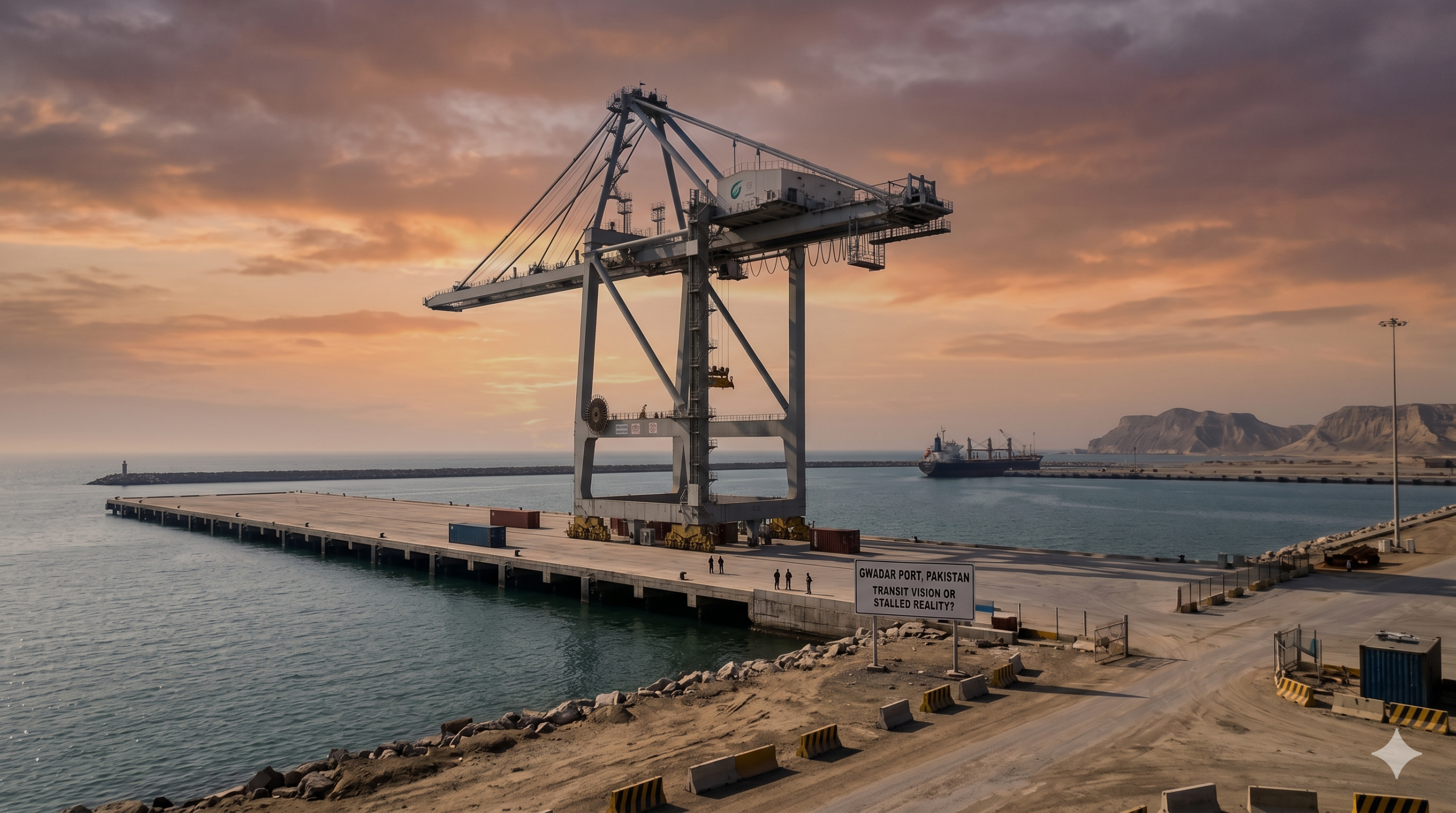
Pakistan is proposing Gwadar Port as a transit hub for landlocked Tajikistan, nearly a decade after the port received its first container ships in 2016. In its best recorded year across that period, Gwadar handled 22 ships.
Nine Years and a Ceiling of 22 Ships
When CPEC was announced and Gwadar was positioned as its maritime anchor, projections for the port’s growth were substantial. The reality has been a port that has never come close to commercial viability. Insecurity, inadequate infrastructure, absence of a clear operational strategy, and failure to attract international shipping lines have combined to produce a port that, in its best year, received 22 ships. Ports are measured in vessel calls, cargo volumes, and throughput. By all three metrics, Gwadar is not a transit port. It is a port-in-progress whose progress has stalled.
What Operational Readiness Actually Looks Like
New ports in competitive environments attract shipping lines, establish feeder services, and build cargo volumes because the underlying infrastructure is there. Gwadar has not managed that. The reasons are documented: active insecurity, inadequate road and utility connections, warehousing gaps, and border terminal bottlenecks that prevent Gwadar from functioning as the origin or destination of a real supply chain.
Tajikistan’s Requirement Is for a Working Port
Tajikistan is landlocked and pays a structural tax on every unit of trade because of it. Access to a functioning sea port is not an aspirational policy goal for Dushanbe. It is a practical economic requirement. A transit arrangement with a port that received 22 ships in its best year does not solve that problem. It postpones solving it, while Tajikistan’s trade continues to move through Iran and Afghanistan under the current costly arrangements. The proposal Pakistan has made asks Tajikistan to absorb the risk of Gwadar’s continued underperformance in exchange for a distance advantage that cannot be converted into lower costs or faster transit times at current operational levels.
The Window Iran Is Already Filling
Iran and Tajikistan have signed a Cooperation Implementation Program for cargo transit through Chahbahar and a railway transit MoU, with operationalisation now underway. Chahbahar is already receiving international shipping lines and operating under established transit protocols through the Ashgabat Agreement. As that framework moves from signed agreements to active corridor, Central Asian trade will route through Chahbahar and institutional inertia will hold it there.
For Pakistan to offer Gwadar as an alternative at that point would require the port to outcompete an established route on cost, time, and reliability. On current performance, Gwadar cannot outcompete Chahbahar on any of those measures. The gap needs to close before the corridor locks in, not after.