

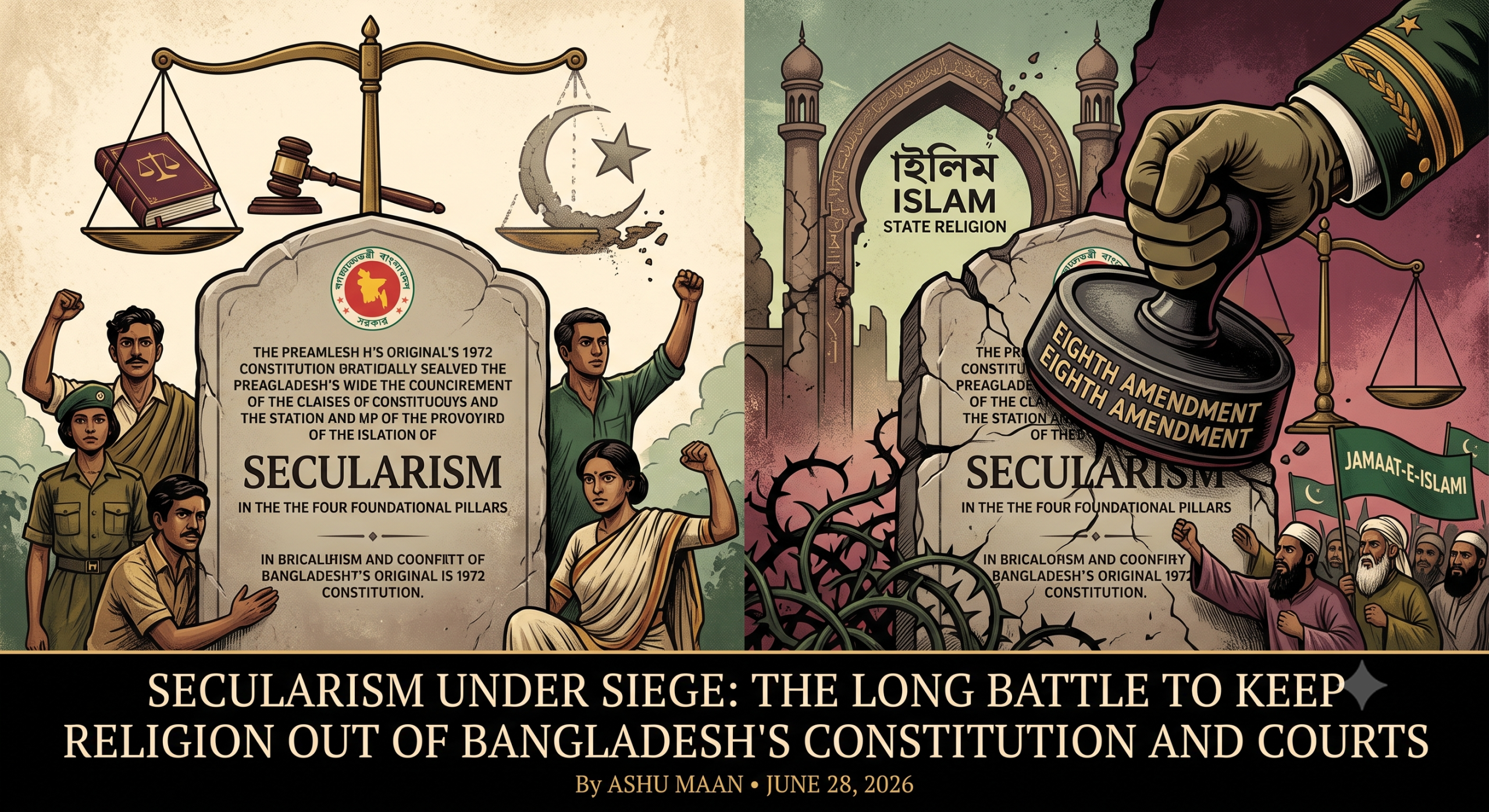
Bangladesh’s 1972 constitution, drafted in the first year of the republic’s existence, listed secularism as one of four foundational pillars of the state, alongside democracy, nationalism and socialism. It was not an abstract commitment. The country had just emerged from a Liberation War fought partly against the Pakistani state’s use of Islam as the ideological justification for suppressing Bengali identity. The secular character of the founding document was a direct constitutional response to that history. Five years later, President Ziaur Rahman’s martial law government moved to remove it.
In 1977, a proclamation under Ziaur Rahman deleted secularism from the constitution and inserted, at the document’s opening, the invocation “Bismillah-ar-Rahman-ar-Rahim.” This change was formally ratified as the Fifth Amendment in 1979. In 1988, President Hussain Muhammad Ershad’s Eighth Amendment declared Islam the state religion. Both changes originated with military rulers operating outside ordinary parliamentary processes.
Bangladesh’s High Court declared the Fifth Amendment illegal in 2005 — not chiefly on the specific question of secularism’s removal, but on the broader unconstitutionality of the martial law framework under which all laws and amendments passed at that time were deemed to have been automatically invalidated; the Supreme Court’s Appellate Division upheld that finding in 2010.
The Awami League government’s 2011 Fifteenth Amendment restored secularism as a fundamental principle of state policy under Article 8 and specifically eliminated communalism and discrimination based on faith under Article 12. It did not remove Islam as the state religion from Article 2A, and it retained the Bismillah invocation. The result, as legal scholars have described it, is a constitution that simultaneously pledges secularism and recognises a state religion—provisions whose literal meanings are difficult to reconcile.
Jamaat-e-Islami’s role in this constitutional history has been consistent. The party was aligned with the Pakistani military during the 1971 Liberation War, when the secular founding generation of Bangladesh was fighting for independence. After being permitted to re-enter formal political life in the late 1970s, Jamaat operated within a constitutional environment that Ziaur Rahman had already stripped of secularism. Throughout the 2001-2006 BNP-Jamaat coalition government, Jamaat’s presence conditioned BNP policy on constitutional questions; no move toward restoring secularism was realistically possible while Jamaat held ministerial portfolios in that government.
The court challenges have run in both directions over the decades. In 1988, fifteen prominent citizens, organised as the Swairachar O Sampradaiyikata Protirodh Committee, filed a writ petition challenging the constitutionality of the Eighth Amendment’s insertion of a state religion. The case took 28 years to reach a verdict. In March 2016, a High Court bench led by Justice Naima Haider rejected the petition — primarily on the grounds that the petitioners lacked standing to bring it, though Justice Haider’s opinion also addressed the substance, interpreting secularism in the Bangladeshi constitutional context as a specific framework for the relationship between religion and state rather than as hostility to religion or an enforced separation of the two. The ruling left the state religion provision in place in Article 2A, alongside the secularism restored by the Fifteenth Amendment in Article 12.
The most recent constitutional challenge has come not from Islamist litigants but from a reform commission. In January 2025, the constitution reform commission appointed by the interim government led by Nobel Peace laureate Muhammad Yunus, chaired by Prof. Ali Riaz, recommended removing secularism, nationalism and socialism from the constitution’s foundational principles, proposing in their place equality, human dignity, social justice, pluralism and democracy. Bangladesh’s Attorney General, Md Asaduzzaman, had already argued in November 2024, during High Court hearings on the legality of the Fifteenth Amendment, that secularism and socialism did not reflect the realities of a nation where roughly 90 percent of the population is Muslim. The reform commission’s recommendations arrived in the same broad period as that argument, though as proposals requiring further political consensus rather than enacted change.
The Supreme Court’s June 2025 restoration of Jamaat’s electoral registration, reversing the 2013 High Court cancellation, arrived in this same constitutional moment. A party whose charter the High Court had in 2013 found incompatible with the constitution was returned to formal political life at the same time that Bangladesh’s constitution was under active pressure to remove the secular principle the party has historically opposed.
From 1972 to the present, Bangladesh’s constitutional secularism has been removed by military decree, partially restored by democratic amendment, retained in the same document alongside a state religion, litigated in both directions, and now faces a formal recommendation for removal once again. The foundational principle of the republic’s 1972 founding document is, more than fifty years later, still contested ground.