

Decades after its conclusion, the Sri Lankan civil war remains a deeply studied yet profoundly painful chapter in modern history. While geopolitical analyses and military histories often dominate the discourse, the true weight of the conflict lives in the memories of those who survived it.
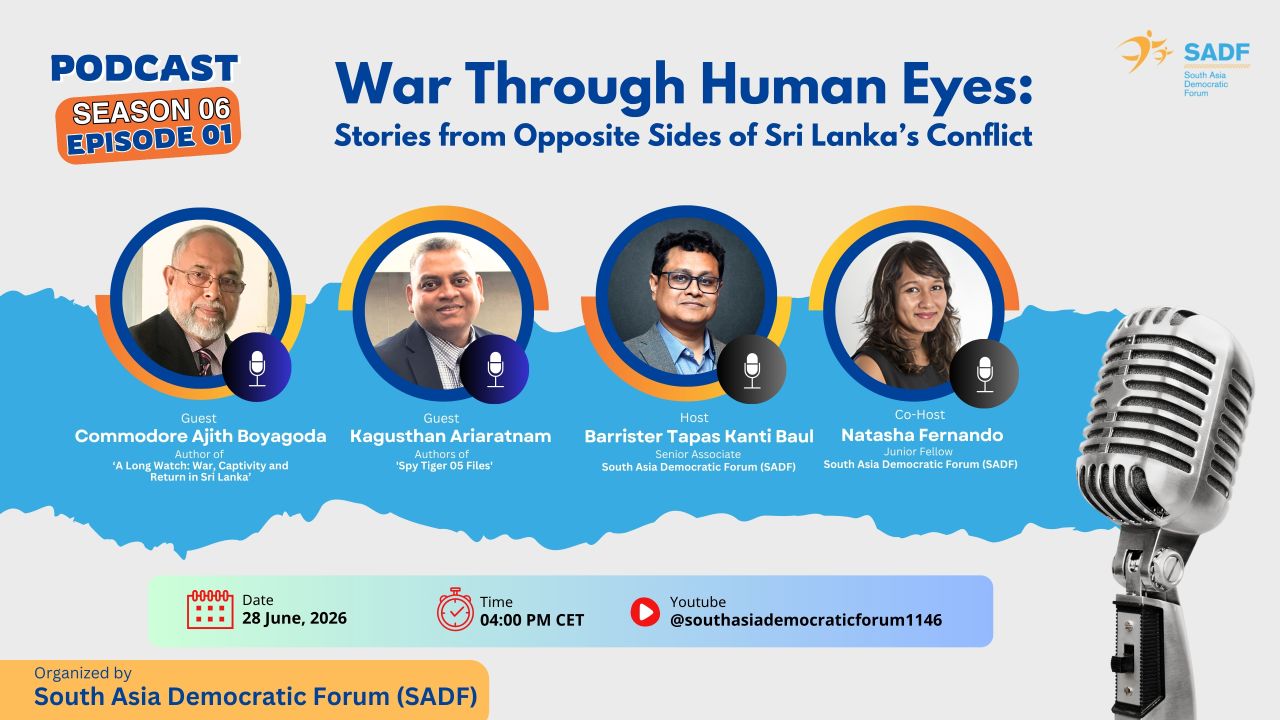
In a powerful episode of the South Asia Democratic Forum (SADF) Podcast, host Tapas Kanti Baul and co-host Natasha Fernando bring together two extraordinary, contrasting figures of the war: Ajith Boyagoda, a former prisoner of war, and Kagusthan Ariaratnam, a former LTTE child soldier turned informant.
Together, their lived experiences offer a rare, “emic” (insider) view of the conflict, moving past political rhetoric to expose the raw human cost of survival, captivity, and the long road to reconciliation.
Two Paths, One Conflict
The podcast masterfully juxtaposes two completely different trajectories within the same war zone, illustrating how individuals on opposing sides were ultimately shaped by forces entirely beyond their control.
1. The Prisoner of War: Ajith Boyagoda
Ajith Boyagoda’s perspective is grounded in his experience as a high-ranking military officer who became a long-term prisoner of war (POW). Documented in his memoir, “War, Captivity and Return in Sri Lanka: An Emic View into the Life of Ajith Boyagoda,” his journey explores:
-
The Reality of Captivity: Stripped of his rank and freedom, Boyagoda’s survival depended on navigating the psychological and physical trials of being held by the enemy.
-
The Complexity of Return: The story doesn’t end with release. Boyagoda sheds light on the jarring transition from a prisoner back into a society that has moved on, highlighting the complex administrative, social, and emotional hurdles of reintegration.
2. The Spy Tiger: Kagusthan Ariaratnam
On the other side of the spectrum is Kagusthan Ariaratnam, whose childhood was stolen when he was pulled into the Liberation Tigers of Tamil Eelam (LTTE) as a child soldier. Chronicled in his memoir, “Spy Tiger – The 05 File,” Ariaratnam’s narrative unveils the dark underbelly of conflict dynamics:
-
Coercion and Conscription: His journey exposes the brutal reality of how children were weaponized and funneled into the LTTE’s sophisticated intelligence network.
-
The Informant Trap: Ariaratnam’s survival forced him into a dangerous double life, operating as an informant across multiple, competing intelligence agencies—a tightrope walk between life and death.
Key Themes Explored
The conversation between the hosts and guests transcends basic storytelling, probing deep into the structural and psychological mechanics of prolonged warfare. The episode heavily reflects on five core pillars:
-
War, Captivity, and Survival: How the human spirit adapts to extreme isolation and the constant threat of death.
-
Child Soldiers and Coercion: A sobering look at the systemic exploitation of minors and the erasure of choice in a war zone.
-
Intelligence Networks and Conflict Dynamics: A rare peek behind the curtain of espionage, revealing how intelligence factions manipulate individuals as expendable pawns.
-
Memory, Trauma, and Reintegration: The enduring psychological scars that remain long after the gunfire stops, and the steep uphill battle of returning to civilian life.
-
The Search for Justice and Reconciliation: An honest assessment of what true peacebuilding requires in a post-conflict, multi-ethnic society.
Why This Conversation Matters
What makes this SADF episode vital viewing for anyone interested in South Asian geopolitics, security studies, or human rights is its refusal to paint the conflict in simple black-and-white terms. By giving voice to both a state military officer and a former insurgent fighter, the podcast fosters a space for transitional justice and empathetic listening.
Ultimately, both Boyagoda and Ariaratnam serve as living reminders that behind the statistics of the Sri Lankan civil war are fractured lives. Their shared dialogue emphasizes that true reconciliation cannot be achieved through political treaties alone; it requires acknowledging the shared trauma of all those caught in the crossfire.
Where to Watch: You can listen to the full, profound discussion on the SADF YouTube Channel. Subscribe to their platform for more essential conversations regarding democracy, conflict resolution, and minority rights in South Asia.