

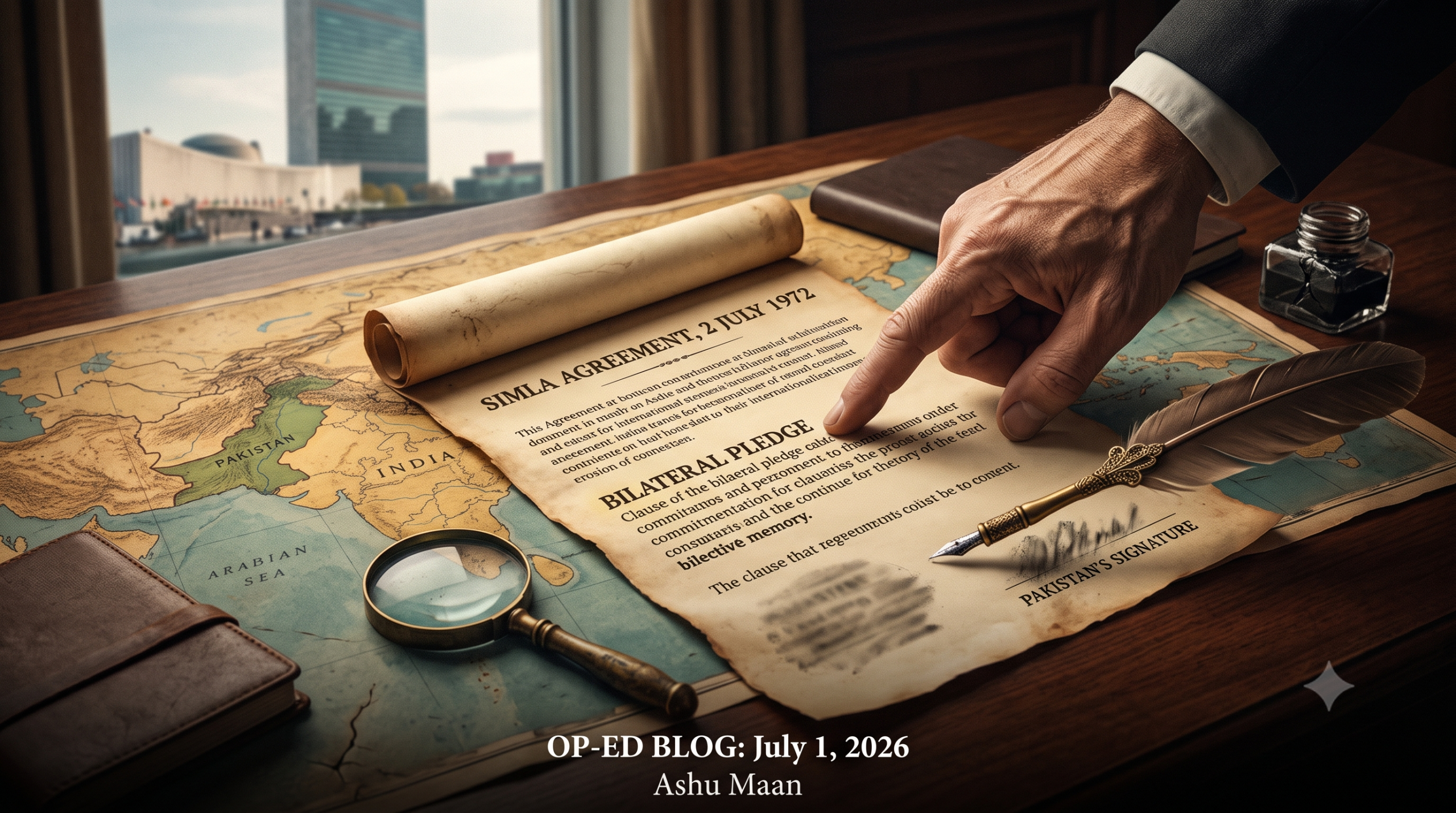
Few documents in South Asia’s diplomatic record carry the weight or invite the evasion of the agreement that India and Pakistan concluded at Shimla on 2 July 1972. Signed in the immediate aftermath of a war that Pakistan had decisively lost, the accord is most often discussed today as a contested text whose meaning each side reads to suit itself. That framing obscures the more elementary point. Whatever interpretive disputes followed, Pakistan’s signature in 1972 was a sovereign, voluntary, and subsequently ratified commitment to a particular method of dealing with India: bilateralism. The argument here is straightforward. The Shimla framework established a baseline of Pakistan’s own making, and it is against that baseline that Islamabad’s later conduct must be measured.
A Signature Freely Given
The circumstances of 1972 bear directly on the character of the commitment. By the close of the December 1971 war, the Indian Army held more than 13,000 square kilometres of Pakistani territory and some 93,000 prisoners of war, the largest surrender since the Second World War. India did not press that advantage into a punitive settlement.
It returned the territory and the prisoners and accepted, in place of a dictated peace, a negotiated framework for durable peace in the subcontinent. The operative undertaking was unambiguous: the two states resolved to settle their differences by peaceful means through bilateral negotiations, with the principles of the United Nations Charter governing their relations and the ceasefire line of December 1971 converted into a Line of Control that neither side would seek to alter unilaterally.
Two features of this commitment deserve emphasis. First, it was not imposed. The agreement was negotiated by President Zulfikar Ali Bhutto and ratified through Pakistan’s own constitutional procedures, making it an exercise of sovereign will rather than a victor’s dictate. Second, the bilateral clause was, as observers have long noted, a concession that altered the diplomatic terrain on Kashmir: by undertaking to resolve disputes directly, Pakistan set aside the basis for third-party or United Nations mediation. That concession was the price, and the point, of Shimla.
The Selective Memory
It is here that the record turns. Having accepted bilateralism in 1972, Pakistan has returned, with striking regularity, to the very forums the agreement was understood to foreclose. At successive sessions of the United Nations General Assembly, including the high-level segments of 2024 and again 2025, Islamabad has placed Jammu and Kashmir before the world body and invoked the Security Council plebiscite resolutions of 1948 and 1949 that the Shimla framework was understood to have superseded.
It has likewise sustained the Organisation of Islamic Cooperation’s Contact Group on Jammu and Kashmir as a standing instrument of internationalisation, its communiqués reaffirming self-determination under UN resolutions. India has objected, consistently, that such efforts misuse multilateral platforms to externalise a matter both governments agreed to keep bilateral. The selectivity is laid bare by Islamabad’s own response to the 2025 crisis: even as it announced that it would hold the Simla Agreement itself in abeyance, it pressed the case for international involvement in Kashmir, discarding the bilateral instrument while reviving the multilateral one.
The pattern is one of selective adherence: bilateralism is the principle Pakistan cites when it seeks parity at the negotiating table, and internationalisation is the instrument it reaches for when bilateral channels do not yield the outcome it prefers. The inconsistency is not merely rhetorical. The Shimla undertaking to refrain from the threat or use of force has been tested repeatedly: the 1999 Kargil incursion, the 2008 Mumbai attacks carried out by a Pakistan-based terrorist group, the 2019 Pulwama bombing, and the killing of twenty-six civilians at Pahalgam in April 2025. Each episode sits uneasily beside a signature pledging peaceful, bilateral settlement.
Treaties Cannot Be Insulated From Conduct
This history supplies the context for India’s most consequential recent decision. On 23 April 2025, a day after the Pahalgam attack, New Delhi announced that the Indus Waters Treaty of 1960 would be held in abeyance until Pakistan verifiably and irreversibly ended its support for cross-border terrorism. The measure has been described in some quarters as a departure from cooperation. Read against the Shimla framework, it is better understood as an assertion of the reciprocity that framework presupposed.
A treaty regime, whether the bilateral architecture of Shimla or the water-sharing arrangement brokered in 1960, rests on the good faith and mutual observance of both parties. Where one party’s conduct is held to be inconsistent with the peace and goodwill the framework was meant to secure, the other’s insistence that cooperation cannot be quarantined from that conduct is not a breach of principle but an application of it. As India’s foreign ministry has put it, dialogue and terrorism cannot proceed in tandem.
The position is therefore not a retreat from bilateralism but a defence of its preconditions. India continues to maintain that disputes are to be settled directly between the two states; what it declines to accept is that the benefits of cooperation can be decoupled from the obligations, the renunciation of force, the good-faith engagement, that the 1972 signature entailed.
The enduring significance of 2 July 1972 is not that it resolved Kashmir; it did not. It is that Pakistan, freely and formally, accepted the method by which such questions were thereafter to be addressed. That acceptance is the fixed point. Measured against it, a diplomacy that invokes bilateralism in one forum and internationalisation in another, while the undertaking to forswear force is contradicted on the ground, reveals a selective memory of a commitment that was once unambiguous. The burden of returning to both the letter and the spirit of Shimla rests where the signature was placed.