

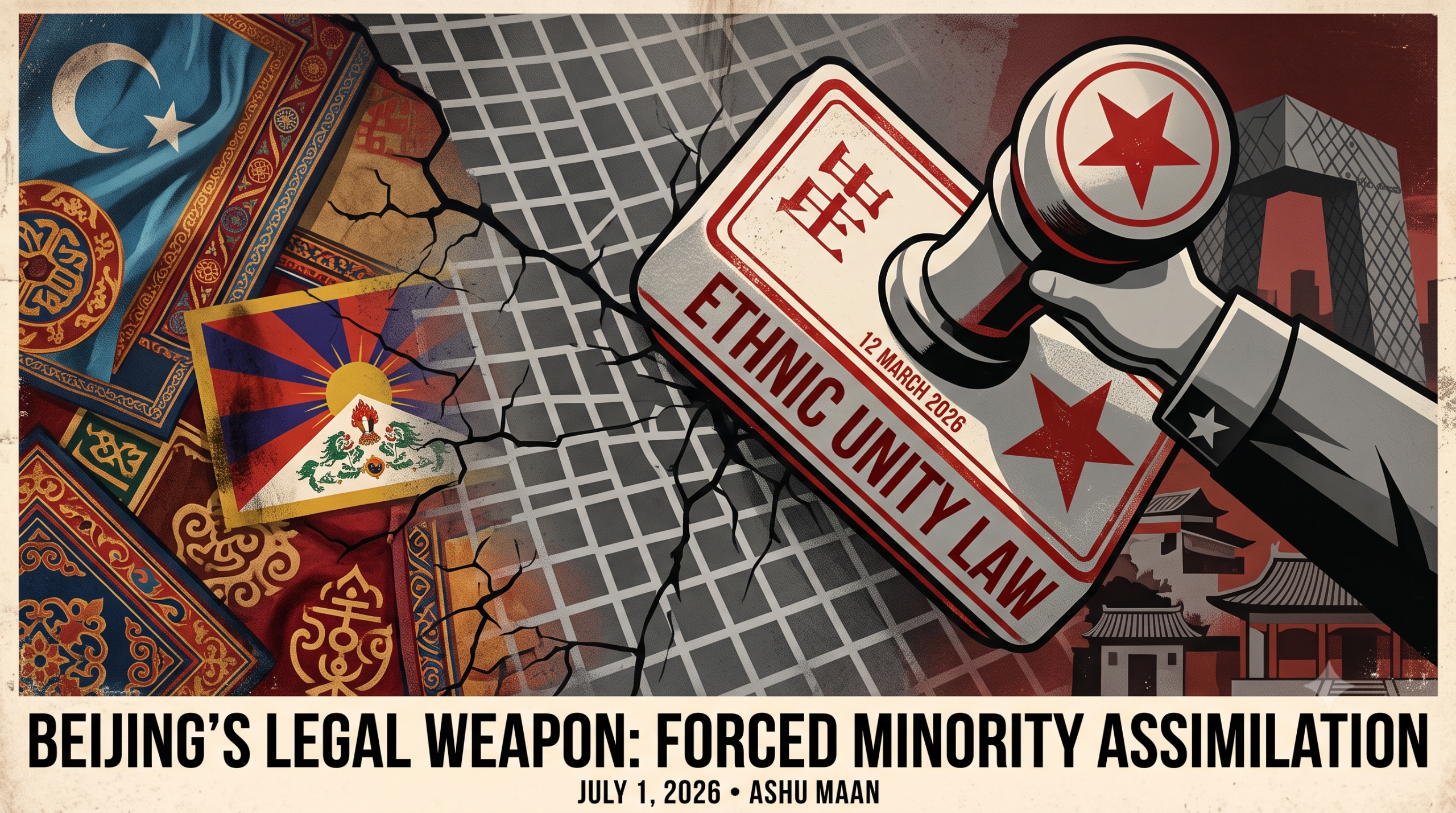
China’s Ethnic Unity and Progress Law, passed by the National People’s Congress on 12 March 2026 and taking effect on 01 July, marks a significant escalation in Beijing’s decades-long campaign to assimilate its ethnic minorities. Unlike earlier administrative directives and informal policies, this law gives Beijing’s assimilation drive the force and cover of formal legislation, embedding cultural homogenisation into the legal architecture of the state itself.
The law is being projected by Chinese authorities as a measure to promote “unity and progress” among the country’s 56 officially recognised ethnic groups. Beijing has paired the law’s passage with extensive publicity around economic gains in minority regions, citing rising GDP figures and poverty alleviation in the five autonomous regions.
This economic framing should be read with caution: investment and development in these areas have historically accompanied, rather than offset, tightening political and cultural control, and are frequently used to justify deeper state penetration into community life under the language of “shared prosperity.”
Material gains do not amount to consent, and Beijing has a documented pattern of using development narratives to soften international criticism of coercive policies, including in Xinjiang, where infrastructure spending coexisted with mass internment.
What distinguishes this law from previous measures is its codification of assimilation as a legal obligation rather than a discretionary policy. While the law nominally preserves the existing structure of ethnic autonomous regions and the official recognition of 56 ethnicities, this preservation is largely cosmetic.
The substance of autonomy, control over education, religious practice, and cultural affairs, is steadily being absorbed into centralised Party authority, even as the regional labels and institutions remain technically intact. This is, in effect, assimilation by attrition: the shell of autonomy retained, its content hollowed out.
This shift matters because it removes the ambiguity that international observers and rights groups previously had to navigate when documenting abuses. Practices that were once carried out informally, and could be denied or downplayed by Chinese ofinformally andl overreach now carry explicit legal sanction from Beijing.
Human rights organisations have already flagged the law as part of a broader pattern in which China uses legislative cover to legitimise policies that would otherwise draw sharper international condemnation, following the precedent set by Hong Kong’s National Security Law and Xinjiang’s “de-extremification” regulations.
The United Nations High Commissioner for Human Rights has warned that the law could restrict freedom of religion and culture, and a 2026 letter signed by eight former UN special rapporteurs stated it may violate at least twelve international human rights instruments China has ratified. These are not the assessments of fringe critics but of established international human rights mechanisms, underscoring the severity of the law’s implications.
For Tibetan, Uyghur, and Mongolian communities, the law signals that the space for cultural and religious distinctiveness will continue to shrink, now with explicit legal backing, while Beijing’s economic narrative provides a convenient public-facing justification.
The international community, including human rights bodies and democratic governments, will need to scrutinise this law closely, not merely as a domestic Chinese policy matter wrapped in the language of development, but as a codified mechanism for the erasure of ethnic and cultural diversity within China’s borders.