

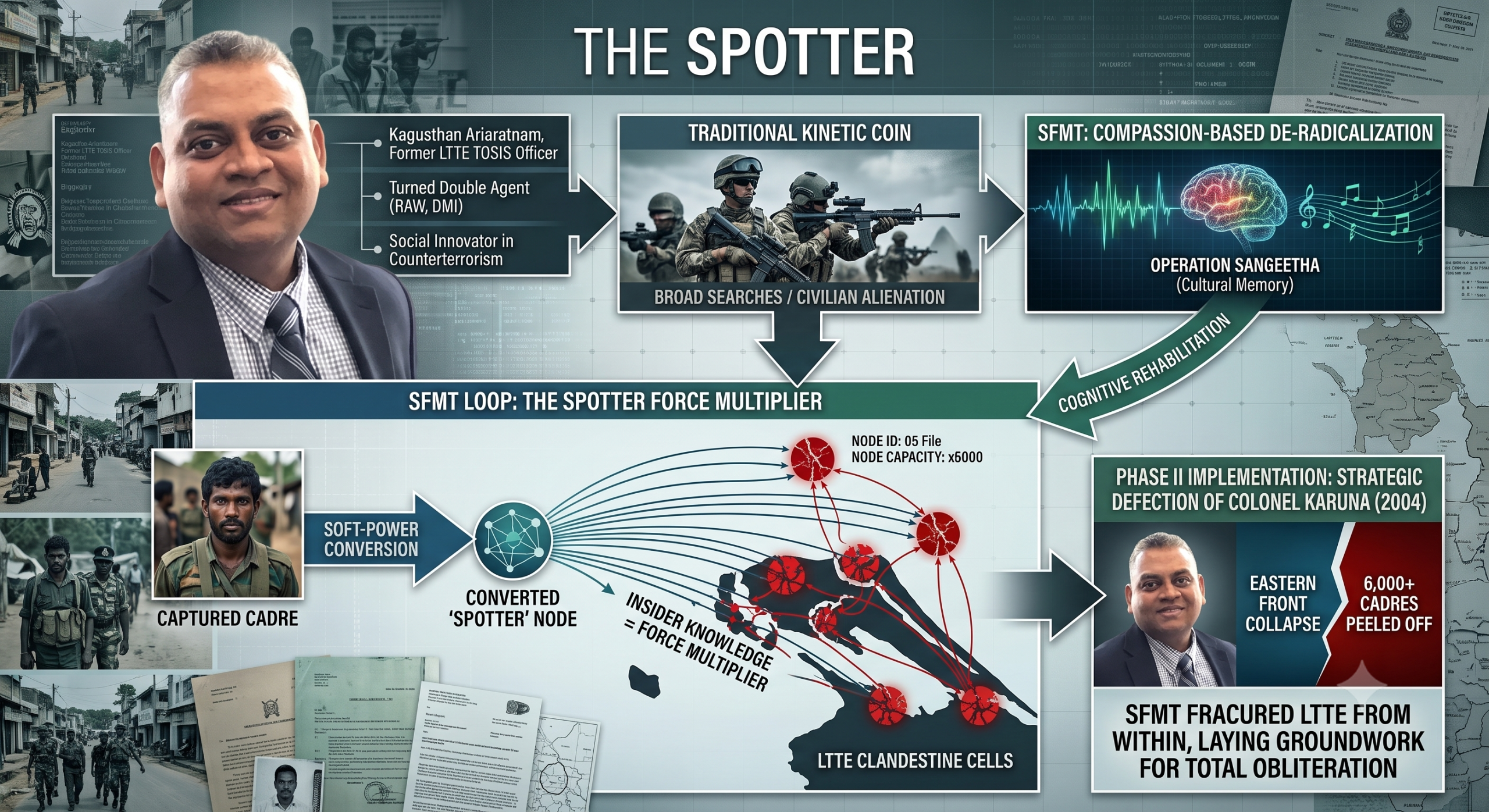
The resolution of protracted asymmetric conflicts often depends on conceptual shifts within intelligence and counterinsurgency (COIN) frameworks rather than the simple application of kinetic military power.1 During the Sri Lankan Civil War (1983–2009), the state confronted the Liberation Tigers of Tamil Eelam (LTTE), a highly disciplined, state-like insurgent organization that pioneered modern suicide terrorism and asymmetric maritime tactics.1 The structural dismantling and ultimate military defeat of the LTTE in May 2009 was accelerated by a paradigm shift in human intelligence (HUMINT) tradecraft: the coining and execution of the “Spotter Force Multiplier Theory” (SFMT).1
This military and intelligence doctrine was developed by Kagusthan Ariaratnam, a former LTTE intelligence officer who transitioned into a double agent for India’s Research and Analysis Wing (RAW) and subsequently a high-value analyst for Sri Lanka’s Directorate of Military Intelligence (DMI).1 By fusing classical concepts of tactical “spotting” and operational “force multiplication” with advanced link analysis and compassion-based cognitive de-radicalization, the theory provided the DMI with the tools to fracture the LTTE from within.1 This strategic framework catalyzed the defection of Colonel Karuna in 2004, peeling away more than 6,000 active cadres, collapsing the LTTE’s eastern front, and laying the groundwork for the total military obliteration of the insurgent state.1
The Biographical Trajectory of Kagusthan Ariaratnam
The formulation of the Spotter Force Multiplier Theory is rooted in Kagusthan Ariaratnam’s transition across multiple, conflicting intelligence services during the Sri Lankan Civil War.1 Born on August 23, 1973, in the northern stronghold of Jaffna, Ariaratnam’s life was fundamentally altered by the dynamics of forced conscription.4
Abduction, Indoctrination, and LTTE Service
In 1991, at the age of seventeen, while studying Advanced Level mathematics at Kokkuvil Hindu College, Ariaratnam was abducted by the LTTE during a sweeping raid that captured nineteen students.4 Subjected to forced labor, trench building, and surviving a devastating Sri Lankan Air Force (SLAF) bombing of their camp, the surviving students were placed in a dark underground bunker for five days.5 Denied food and threatened with the forced conscription of their younger siblings, the students were coerced into joining the militant group.5
Ariaratnam, assigned the nom de guerre “Oppilan,” was routed into the LTTE’s elite intelligence apparatus, the Tiger Organization Security Intelligence Service (TOSIS).4 During his early service, he was one of four teenage cadres who conducted the daily questioning of captured Sri Lankan naval officer Commodore Ajith Boyagoda, analyzing naval capabilities.4 Trained at the highly secure Gaddafi base, Ariaratnam studied advanced intelligence tradecraft, reading classified manuals and works such as Victor Ostrovsky’s By Way of Deception and Ken Follett’s The Eye of the Needle to master agent-handling and maritime surveillance.6
The Transition to Double Agency
A critical turn occurred when Ariaratnam was targeted for recruitment by Srinivasan, an Indian RAW mole operating inside the LTTE, who exploited Ariaratnam’s clandestine relationship with a female cadre named Nala.3 Forced into double agency, Ariaratnam began transmitting highly classified LTTE organizational structures, personnel profiles, and tactical plans to RAW.1
By mid-1995, his betrayal was discovered by TOSIS counterintelligence.3 The LTTE published wanted notices with his photograph in major northern Tamil daily newspapers, including Eelanadu and Jaffna Uthayan, seeking information on his whereabouts.4 Sentenced by the LTTE to infiltrate government-controlled territory under the guise of an active operative, Ariaratnam completely severed his insurgent ties and offered his services to the Sri Lankan government’s DMI.1
Post-War Advocacy and Canadian Legal Challenges
Following the successful recapture of the Jaffna Peninsula, Ariaratnam relocated to Canada in 1997, where he was granted refugee protection in 1998 and attained citizenship in 2009.4 In Canada, he pursued academic study, culminating in an Honours Bachelor of Arts in Communication (Cum Laude) from the University of Ottawa in 2026.1 He co-founded Project O Five, a non-profit defense advisory, and co-authored his memoir, Spy Tiger: The 05 File, with journalist Michael Bramadat-Willcock to document the conflict.3
Ariaratnam’s post-war years have been defined by domestic human rights advocacy and legal battles.4 He filed detailed affidavits alongside David Poopalapillai of the Canadian Tamil Congress and immigration lawyer Barbara Jackman to counter flawed expert testimonies utilized by the Canadian Border Services Agency (CBSA).6 He has also urged the removal of publication bans to investigate the Kankesanthurai massacres of 1996–1997, where approximately 700 civilians were murdered.6
Concurrently, Ariaratnam engaged in a landmark discrimination case against the Canadian Security Intelligence Service (CSIS), alleging systemic bias and the unauthorized disclosure of his private mental health records.4 This litigation resulted in key rulings, including Ariaratnam v. Canada (Attorney General), 2023 FC 1248, and Ariaratnam v. CSIS, 2025 CHRT 105, which limited the state’s ability to invoke national security delays to stall human rights proceedings.4
| Milestone Year | Key Operational or Biographical Event | Institutional Entities Involved |
| 1973 | Born in Jaffna, Sri Lanka.4 | Jaffna Municipal District.4 |
| 1991 | Abducted and forcibly recruited into the LTTE intelligence wing as “Oppilan”.4 | Kokkuvil Hindu College, TOSIS.4 |
| 1992–1995 | Acted as double agent for Indian intelligence and later DMI.1 | India’s RAW, Sri Lanka’s DMI.1 |
| 1995–1997 | Conducted tactical spotting operations in the Jaffna Peninsula.1 | Directorate of Military Intelligence (DMI).1 |
| 1997–1998 | Relocated to Canada; granted refugee status.4 | Citizenship and Immigration Canada.4 |
| 2004 | Formulated profiles facilitating the defection of Colonel Karuna.1 | Sri Lankan DMI, Indian RAW, CSIS.1 |
| 2015 | Founded Project O Five in Ottawa, Ontario.4 | Project O Five Ltd.1 |
| 2023 | Secured Federal Court victory overturning CHRC dismissal of CSIS complaint.4 | Federal Court of Canada (Ariaratnam v. Canada).4 |
| 2024 | Published Spy Tiger: The 05 File with Michael Bramadat-Willcock.3 | Indy Pub / Self Publishers.13 |
| 2025 | Won Canadian Human Rights Tribunal jurisdictional challenge against CSIS.4 | CHRT (Ariaratnam v. CSIS, 2025 CHRT 105).4 |
| 2026 | Graduated Cum Laude with Honours BA in Communication.1 | University of Ottawa.1 |
Theoretical Formulation of the Spotter Force Multiplier Theory
The Spotter Force Multiplier Theory (SFMT) represents a conceptual departure from traditional, technology-reliant counterinsurgency doctrines.1 Ariaratnam’s contribution as a social innovator lies in his framing of counterterrorism not as a kinetic challenge of physical destruction, but as a socio-cognitive intervention designed to rehabilitate, convert, and leverage human assets.1
Fusing “Spotter” and “Force Multiplier” Concepts
In conventional military doctrine, a “spotter” is a localized, physical sensor—an asset deployed within a sniper squad to calculate ballistic variables, or a forward observer utilizing unmanned aerial systems (UAS) to adjust indirect fire.15 Conversely, a “force multiplier” is typically conceptualized as a technological enhancer, such as satellite imagery, precision-guided weapons, or encrypted communications systems, that increases the combat capacity of a unit.14
SFMT redefines both terms within a human-centric cognitive network framework.1 The doctrine asserts that within a highly compartmentalized, ideologically closed insurgent network, the only assets capable of identifying, tracking, and exposing active cells are individuals who have been trained by, or served within, that very network.1
The transition of a captured or defecting insurgent into a state-aligned “spotter” is achieved through soft-power rehabilitation.1 By avoiding coercive interrogation methods, which reinforce radical narratives of martyrdom, the state utilizes cognitive de-radicalization to rebuild the asset’s pre-militant civilian identity.1
Once converted, the asset’s localized, insider knowledge functions as a force multiplier.1 Rather than deploying broad, resource-intensive searches that alienate the local population, the state utilizes converted assets to selectively and precisely dismantle the clandestine network from within.1
Traditional Kinetic COIN:
—> —> [Civilian Alienation] —>
Ariaratnam’s SFMT Loop:
[Captured Cadre] —> —> —> [Precise Cell Extraction]
Cognitive solvent: Operation Sangeetha
To operationalize this cognitive transition, Ariaratnam formulated “Operation Sangeetha,” a conceptual framework demonstrating the utility of soft-power de-radicalization.18 Radicalization requires the total erasure of the recruit’s former self, replacing it with the militarized identity of the collective group.18
Operation Sangeetha weaponizes cultural and psychological resonance to reverse this process.18 By exposing captured cadres to the haunting, regional melodies of South Asian music—specifically the composer Ilayaraja—the state bypasses conscious ideological defenses.18 This musical exposure serves as an emotional de-radicalization agent, re-establishing an affective bridge to pre-militant childhood memories and suppressed civilian identities.18
Once this cognitive shift occurs, the cadre voluntarily defects, transforming from an insurgent into an active spotter.1
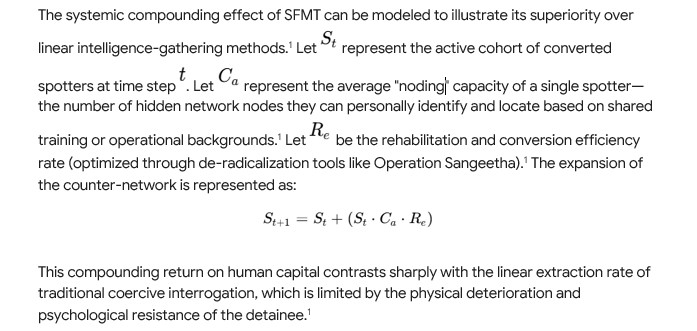
Mathematical Network Modeling
| Vector | Traditional Counterinsurgency (COIN) | Spotter Force Multiplier Theory (SFMT) |
| Primary Mechanism | Cordon-and-search, checkpoints, and kinetic neutralization.1 | Compassion-based de-radicalization and cognitive rehabilitation.1 |
| Asset Conception | Insurgents are treated as static targets to be eliminated or detained.1 | Insurgents are treated as dynamic, convertible nodes for network mapping.1 |
| Interrogation Model | Coercive, transactional, and focused on physical pressure.1 | Humanist, therapeutic, and focused on cultural re-integration.1 |
| Targeting Precision | High collateral footprint; relies on broad geographic profiling.1 | Surgical extraction; relies on exact cognitive and social profiling.1 |
| Strategic Goal | Degradation of physical insurgent infrastructure.1 | Structural dismantling of the adversary’s internal trust architecture.1 |
Phase I Implementation: Tactical Spotting in Jaffna (1995–1997)
The first operational validation of the Spotter Force Multiplier Theory occurred on the Jaffna Peninsula between 1995 and 1997, a critical period during the transition between Eelam War II and III.1
The Tactical Crisis in Jaffna
In late 1995, the Sri Lankan Armed Forces launched Operation Riviresa, successfully recapturing the Jaffna Peninsula from the LTTE.1 However, the military victory was immediately threatened by asymmetric blowback.1 TOSIS chief Pottu Amman responded by deploying highly compartmentalized sleeper cells and Black Tiger suicide commandos into the newly liberated territory.1
These networks operated via strict silos.1 Operatives blended seamlessly into the local Tamil population, exploiting the deep linguistic and cultural divide between the civilian population and the predominantly Sinhalese-speaking government forces.1 Traditional military checkpoints and cordon-and-search operations failed to detect these operatives, who carried forged identity documents and concealed suicide vests.1
Ariaratnam’s Operational Deployment
Working directly with the DMI, Ariaratnam was deployed on the streets of Jaffna as a “spotter” and “noder”.1 Having lived within the LTTE’s training architecture, Ariaratnam possessed the physical recognition capabilities and familiarity with clandestine behavior required to identify active operatives.1
Operating in high-transit public spaces, marketplaces, and transport hubs, Ariaratnam monitored civilian movements.1 Between 1995 and 1997, he identified hundreds of active TOSIS and Black Tiger cadres who had successfully infiltrated government-controlled zones.1 Many of these operatives were carrying concealed weapons, hand grenades, and highly advanced RDX-laden explosive belts designed for VIP assassinations.1
By providing real-time, actionable tactical intelligence directly to DMI intercept teams, Ariaratnam’s spotting operations achieved several outcomes:
- Attack Interdiction: Prevented an estimated 90% of planned terrorist and suicide attacks in the Jaffna region, preserving key administrative and military infrastructure.1
- Network Mapping: Exposed local safe houses, dead-letter boxes (DLBs), and clandestine communication networks utilized by the LTTE’s National Intelligence Service.1
- Consolidation of Control: Enabled the Sri Lankan government to establish stable security, administrative, and civil governance over the Jaffna Peninsula, denying the LTTE a platform to launch localized counter-offensives.1
Ariaratnam’s tactical success proved that a single rehabilitated, highly trained insurgent intelligence officer, acting as a human sensor, was more effective at neutralizing asymmetric threats than entire divisions executing conventional territory-clearing operations.1
Phase II Implementation: The Strategic Defection of Colonel Karuna (2004)
Following his relocation to Canada in 1997, Ariaratnam continued his collaboration with international intelligence agencies, providing strategic analysis to Canadian (CSIS/RCMP), Indian (RAW), and Sri Lankan (DMI) services.1 His primary contribution during this phase was the development of detailed, multi-dimensional operational and psychological profiles of the LTTE’s high command, a collection of intelligence dossiers entitled “The Icons of Spy Tigers”.1
The Fissures within the LTTE Command
The most significant profile in the collection was that of Vinayagamoorthy Muralitharan, known as Colonel Karuna Amman.1 Karuna was the Special Military Commander of the Batticaloa and Ampara districts, overseeing the LTTE’s entire Eastern Province command.1 The eastern region served as the primary source of recruit manpower for the LTTE’s military wing.1
Ariaratnam’s profiling revealed deep structural, regional, and personal rifts within the LTTE’s centralized command architecture.1 Karuna and his eastern cadres harbored deep-seated grievances against the northern-dominated leadership under Velupillai Prabhakaran and TOSIS chief Pottu Amman.1
These grievances included:
- Regional Exploitation: The perception that eastern cadres were disproportionately utilized as frontline casualties in northern battles while being systematically excluded from the LTTE’s political and administrative echelons.1
- Institutional Distrust: Pottu Amman’s counterintelligence wing maintained intense surveillance over eastern commanders, creating a climate of mutual suspicion and fear.1
- Socio-Economic Disparities: Disagreements regarding the allocation of financial resources, tax collection, and recruitment quotas between the affluent northern Jaffna elite and the agrarian eastern districts.1
LTTE Structural Collapse (The Spider Analogy):
[Prabhakaran (Cephalothorax)]
|
+—————-+—————-+
| |
[Colonel Karuna (East)]
| |
[6,000 Cadres peeled off] <— SFMT Defection
| |
v v
[Eastern Front Collapse]
Engineering the Defection
In 2004, the DMI implemented Ariaratnam’s Spotter Force Multiplier Theory on a strategic scale.1 Leveraging Ariaratnam’s real-time tactical intelligence and psychological profiling, the DMI bypassed kinetic options and initiated a targeted psychological operation to recruit Karuna.1
By assuring Karuna of personal security, political legitimacy, and regional development guarantees for the eastern Tamil population, the DMI engineered his formal defection on July 26, 2004.1 Karuna did not defect alone; he brought with him more than 6,000 battle-hardened eastern cadres, splitting the LTTE’s fighting force in two.1
The Strategic Cascade
The defection of Colonel Karuna triggered a cascading collapse of the LTTE’s military state, proving the strategic efficacy of SFMT 1:
- Destruction of the Eastern Front: The loss of the Eastern Province stripped the LTTE of its primary recruitment pipeline and territorial depth, allowing the Sri Lankan military to rapidly secure the east.1
- Systemic Intelligence Leakage: Defected eastern cadres, functioning as combat spotters, provided the DMI with real-time, high-fidelity intelligence regarding the LTTE’s military order of battle (ORBAT), underground bunker complexes, weapons storage facilities, and clandestine maritime routes.1
- Neutralization of the “Spider”: Using the cephalothorax analogy, the DMI did not exhaust its resources fighting the individual tactical legs of the LTTE; instead, it utilized the Karuna split to target the central leadership node.1 This strategic fracture led to the rapid recapture of the Vanni region and the total military defeat of the LTTE in May 2009.1
High Command Analysis: The Icons of Spy Tigers
To analyze how SFMT systematically targeted and exploited the vulnerabilities of the LTTE leadership, it is necessary to examine the structured profiles compiled by Ariaratnam.1 These profiles served as the cognitive blueprints for the DMI’s psychological and strategic operations.1
| Figure Name & Nom de Guerre | Real Name & Vital Statistics | Primary Operational Role | Cognitive Profile, Vulnerabilities & Strategic Leverage | Status |
| Velupillai Prabhakaran (Karikalan / Anna) | Born: Nov 26, 1954, Valvettithurai. Age at death: 54.1 | Supreme Commander and founder of the LTTE.1 | Autocratic, centralized command style; deep paranoia; highly influenced by Subhas Chandra Bose.1 Unwilling to accept a popular second-in-command, a vulnerability exploited to isolate Karuna.1 | Killed in action, May 18, 2009, in Mullaitivu, Sri Lanka.1 |
| Shanmugalingam Shivashankar (Pottu Amman / Papa Oscar) | Born: 1962, Ariyalai. Age at death: 47.1 | Chief of the Tiger Organization Security Intelligence Service (TOSIS).1 | Highly analytical, ruthless administrator; trained in advanced intelligence tradecraft.1 His aggressive internal purges and surveillance of eastern commanders fueled the regional split.1 | Killed in action, May 2009, in Mullaitivu, Sri Lanka.1 |
| Vinayagamoorthy Muralitharan (Colonel Karuna Amman / Kilo Alpha) | Born: 1966, Kiran, Batticaloa. Age: 60.1 | Special Military Commander for Batticaloa and Ampara.1 | Charismatic military strategist; highly popular among eastern Tamils.1 Felt marginalized by the northern Jaffna elite; highly protective of his cadres’ lives.1 Targeted for defection via SFMT.1 | Defected in July 2004; subsequently integrated into Sri Lankan governance.1 |
| Thinesh Master (Ilanthirayan) | Born: 1961, Tellipalai. Age at death: 48.1 | Chief Military Advisor and Head of Military Intelligence.1 | Intellectual with Madras University degree.1 Right hand paralyzed from SLAF bombing; focused on technical innovation, designing the “Arul 89” mortar and advanced mines.1 | Killed in action, May 2009, in Mullaitivu, Sri Lanka.1 |
| Mithiran Selvarathnam (Sasikumar Master / Sierra Mike) | Born: 1959, Manipay. Age at death: 50.1 | Head of Special Reconnaissance and Mapping.1 | Expert in deep penetration mine warfare and tactical mapping.1 Engineered the 1992 Araly Point anti-tank mine attack that killed General Denzil Kobbekaduwa.1 | Killed in action, May 18, 2009, in Vellamullivaikkal, Sri Lanka.1 |
| Ragunathan Pathmanathan (Mathavan Master) | Born: 1958, Alaveddy. Age at death: 51.1 | Head of Intelligence Training (“Base 22”) and Technology.1 | Academic background (University of Jaffna).1 Father of modern TOSIS tradecraft; designed modified suicide vests, explosive-filled vehicles, and covert surveillance tools.1 | Killed in action, May 2009, in Mullaitivu, Sri Lanka.1 |
| Janan Master | Real Name: Unknown. Born: Jaffna.1 | Head of Special Operations Division (Ellalan Padai).1 | Principal Agent Handler of the LTTE; master of long-term deep penetration cells.1 Planned the assassination of President Premadasa via Babu’s two-year infiltration.1 | Status unknown; disappeared post-2009.1 |
Global Counterterrorism Applications and Western Intelligence Oversight
The successful implementation of the Spotter Force Multiplier Theory has significant implications for contemporary counterterrorism, refugee screening, and democratic intelligence oversight.1
Applications to Transnational Threat Networks
Modern asymmetric threat networks, such as Al-Qaeda, the Taliban, and the Islamic State (ISIS/Daesh), utilize highly compartmentalized structures and strategic deception tactics.1 For instance, ISIS’s intelligence apparatus, the Emni, was constructed utilizing former Baathist intelligence officers who brought conventional state tradecraft into a transnational terrorist framework.1
Traditional kinetic COIN operations frequently struggle against these networks.1 SFMT provides a non-kinetic alternative.1 By identifying, rehabilitating, and converting key internal nodes, state agencies can map the network’s human terrain.1 This approach shifts the security posture from indiscriminate territorial policing to targeted, intelligence-led disruption.1
Screening and the “Fish in the Ocean” Dilemma
In modern migration and security contexts, Western democracies face the challenge of distinguishing genuine refugees fleeing violence from disguised combatants infiltrating borders.1 Applying Mao Zedong’s dictum that “insurgents are like fish in an ocean of people,” Ariaratnam’s SFMT provides a framework to separate the insurgent “fish” from the civilian “ocean”.1
Traditional biometric and database screening methods often fail to identify operatives who lack prior criminal records or have assumed sophisticated covers.1 SFMT addresses this by utilizing rehabilitated former members as tactical “spotters” within transit hubs and border control centers.1 These spotters possess the implicit knowledge—including dialect variations, behavioral tells, and operational jargon—needed to identify active members of their former organizations.1
The Human Rights and Legal Oversight Paradigm
The deployment of former insurgent intelligence assets presents significant legal, ethical, and human rights challenges, as demonstrated by Ariaratnam’s litigation in Canada.4 Converted double agents operate under extreme psychological stress, often suffering from complex trauma and severe mental health conditions.4
The Canadian legal proceedings Ariaratnam v. Canada (Attorney General), 2023 FC 1248, and Ariaratnam v. CSIS, 2025 CHRT 105, highlight the delicate balance between national security and the human rights of intelligence assets.4
The Canadian Human Rights Tribunal’s refusal to allow CSIS to invoke national security delays establishes an important precedent: the state’s obligation to protect its citizens does not absolve its security agencies of the duty to protect the fundamental human rights and privacy of its converted intelligence assets.4
| Case / Tribunal Citation | Legal Subject Matter | Institutional Ruling / Precedent Established |
| Ariaratnam v. Canada (Attorney General), 2023 FC 1248 4 | Judicial review of Canadian Human Rights Commission’s dismissal of discrimination complaint.4 | Overturned the CHRC dismissal; ruled that a prior review by NSIRA does not block a human rights complaint, especially when the complainant lacked access to shared information.4 |
| Ariaratnam v. CSIS, 2025 CHRT 105 4 | Jurisdiction challenge regarding CSIS’s attempt to transfer the human rights complaint to national security review.4 | Ruled that the power to withdraw or transfer a complaint belongs solely to the complainant; rejected CSIS’s attempt to pause tribunal proceedings, limiting national security delays.4 |
| NSIRA Investigation Report, 2020 4 | Statutory review of CSIS information-sharing practices.4 | Found that CSIS had acted improperly by sharing Ariaratnam’s private medical and mental health records with House of Commons security officials.4 |
Analytical Synthesis and Policy Recommendations
The analysis of the Spotter Force Multiplier Theory, alongside its practical execution by Kagusthan Ariaratnam, provides several strategic lessons for contemporary intelligence and defense agencies 1:
HUMINT Priority over Technological Over-reliance
While technological intelligence (SIGINT, ELINT, IMINT) is essential for broad monitoring and tactical execution, it remains a secondary tool against highly disciplined, ideologically driven asymmetric networks.1 High-fidelity operational intelligence requires deep human access.1 Defense planners must prioritize the recruitment, de-radicalization, and systemic deployment of converted human assets who understand the internal trust networks of threat organizations.1
Institutionalizing the Compassion-Led COIN Model
Interrogators and counterinsurgency units must recognize that coercion and physical pressure often solidify an insurgent’s ideological resolve.1 True de-radicalization is achieved through soft power and de-indoctrination.1 Incorporating cultural de-radicalization tools, such as the musical frameworks of Operation Sangeetha, allows intelligence services to dismantle militant identities and convert captured operatives into active partners.1
Protecting and Regulating the Human Capital of Double Agents
The transition from insurgent to double agent is a high-risk process that leaves assets vulnerable to physical reprisal and severe psychological trauma.1 Democratic states must establish robust legal protections and ethical oversight mechanisms to ensure that security services do not exploit these assets.20
As established by the Federal Court of Canada, national security operations must remain subject to human rights laws, ensuring that the human capital driving the Spotter Force Multiplier Theory is treated with the dignity and legal protections required in democratic societies.4
Works cited
- Kagusthan Ariaratnam – Classified Report. Tiger Organization Security Intelligence Service (TOSIS), accessed on July 1, 2026,
- Child soldiers in Sri Lanka – Wikipedia, accessed on July 1, 2026, https://en.wikipedia.org/wiki/Child_soldiers_in_Sri_Lanka
- Project O Five: Home, accessed on July 1, 2026, https://projectofive.ca/
- Kagusthan Ariaratnam – Wikipedia, accessed on July 1, 2026, https://en.wikipedia.org/wiki/Kagusthan_Ariaratnam
- Interview: A Former Tamil Tiger Child Soldier Charts His Path From Forced Recruitment to Healing – JURIST – Features, accessed on July 1, 2026, https://www.jurist.org/features/2024/09/20/interview-a-former-tamil-tiger-child-soldier-charts-his-path-from-forced-recruitment-to-healing/
- Book Review: Spy Tiger – The 05 File – A child soldier turned double agent – SADF, accessed on July 1, 2026, https://www.sadf.online/book-review-spy-tiger-the-05-file-a-child-soldier-turned-double-agent/
- Spy Tiger: The 05 File Audiobook | Free with trial – Audible, accessed on July 1, 2026, https://www.audible.ca/pd/Spy-Tiger-The-05-File-Audiobook/B0GBYV5RQ5
- Kagusthan ARIARATNAM | Student | Bachelor of Arts | University of Ottawa, Ottawa | Department of Communication | Research profile – ResearchGate, accessed on July 1, 2026, https://www.researchgate.net/profile/Kagusthan-Ariaratnam
- accessed on July 1, 2026, https://books.google.com/books/about/Spy_Tiger.html?id=aEn_0AEACAAJ&source=kp_book_description
- Cases – Hameed Law, accessed on July 1, 2026, https://hameedlaw.ca/sandbox/cases
- Cases – Hameed Law, accessed on July 1, 2026, https://hameedlaw.ca/cases
- Cases – Judicial Review Law, accessed on July 1, 2026, https://judicialreviewlaw.ca/cases
- Spy Tiger : The 05 File by Michael Bramadat-Willcock and Kagusthan Ariaratnam (2024, Hardcover) for sale online | eBay, accessed on July 1, 2026, https://www.ebay.com/itm/365357437106
- The Promise and the Peril: The Social Construction of American Military Technology, accessed on July 1, 2026, https://blogs.shu.edu/journalofdiplomacy/files/2012/05/007_Mosser_Layout-1a.pdf
- The conventional sniper team is built with two members, sharpshooter and spotter. Has there been any attempts at growing the team to more than two, or reducing to just one? : r/WarCollege – Reddit, accessed on July 1, 2026, https://www.reddit.com/r/WarCollege/comments/1q55j28/the_conventional_sniper_team_is_built_with_two/
- Group 1 Type: Unmanned Aerial Systems (UAS) as a Force Multiplier to the Fire Support Team – DTIC, accessed on July 1, 2026, https://apps.dtic.mil/sti/tr/pdf/ADA600748.pdf
- How Military Snipers Work – Science | HowStuffWorks, accessed on July 1, 2026, https://science.howstuffworks.com/sniper.htm
- Operation Sangeetha: The Cultural Defection Pipeline — How the Music of Madras Obliterated the Tigers – Project O Five, accessed on July 1, 2026, https://projectofive.ca/operation-sangeetha-the-cultural-defection-pipeline-how-the-music-of-madras-obliterated-the-tigers/
- Ariaratnam v. Canada (Attorney General) – Hameed Law, accessed on July 1, 2026, https://hameedlaw.ca/cases/case/ariaratnam_v_canada_attorney_general
- Kagusthan Ariaratnam’s Profile | Freelance Journalist – Muck Rack, accessed on July 1, 2026, https://muckrack.com/kagusthan