

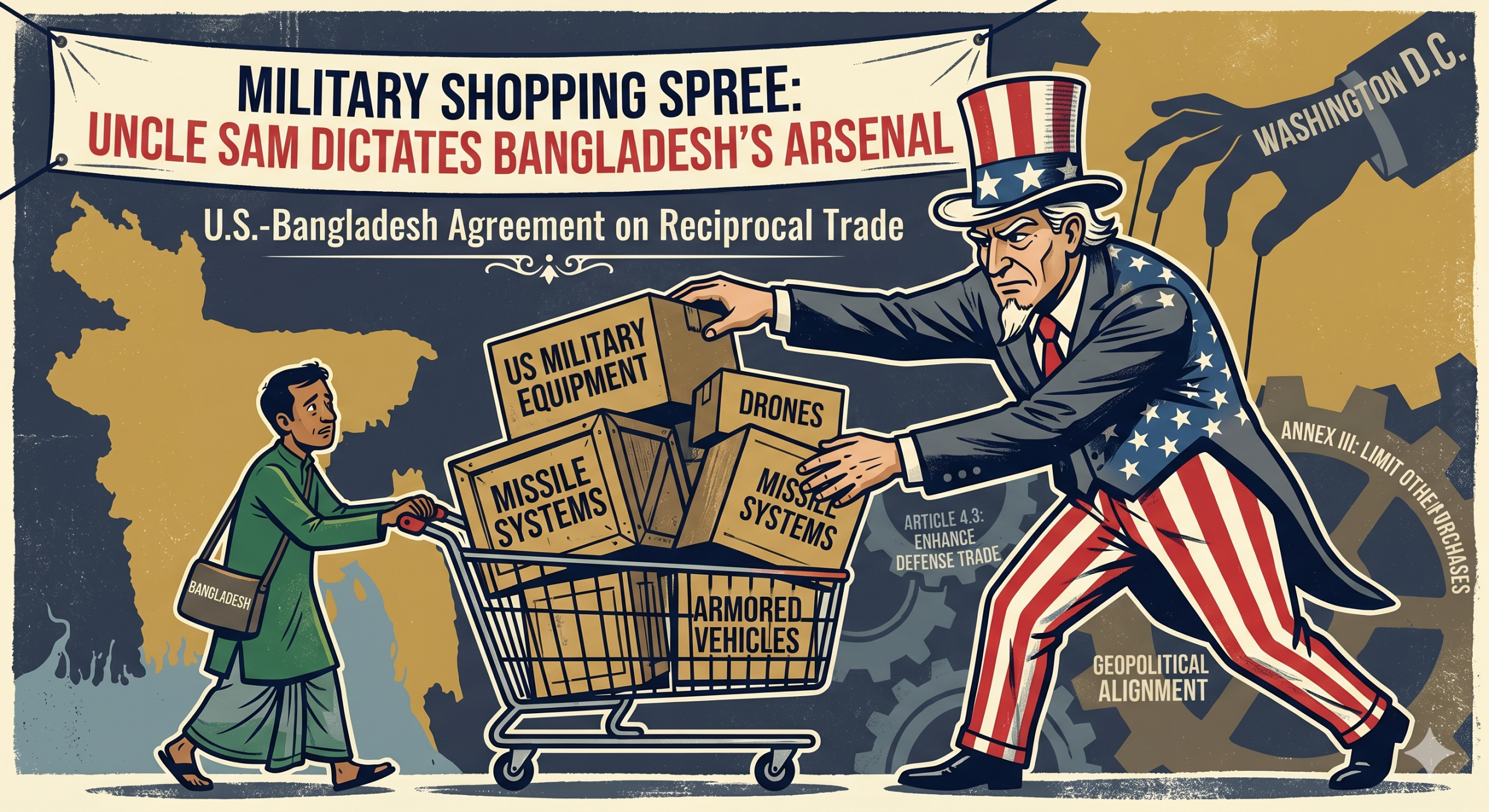
Bangladesh is not being offered a trade agreement in the ordinary sense. It is being handed a strategic compliance package dressed up as market access. The publicly released text of the February 2026 U.S.-Bangladesh Agreement on Reciprocal Trade does not merely touch tariffs and commerce; it reaches deep into digital policy, sanctions compliance, export controls, supply chains, and defence trade. Read plainly, the message is unmistakable: Dhaka may trade, but only within lines drawn in Washington.
The most alarming feature is the defence and procurement logic embedded in the agreement. Article 4.3 says the United States “shall work with Bangladesh to streamline and enhance defense trade.” That may sound benign, but Annex III, Section 6 goes much further: Bangladesh “shall endeavor to increase purchases of U.S. military equipment and limit military equipment purchases from certain countries.” Article 5.4 then ties purchases of U.S. goods into the agreement’s core architecture. This is not neutral liberalisation. It is a procurement steer built into a trade pact, nudging Bangladesh’s arsenal away from sovereign choice and toward Washington’s preferred suppliers.
That is why the agreement deserves to be called a military shopping spree imposed from outside. A developing country’s defence budget is finite. Every push toward foreign-origin military equipment is also a push away from alternative suppliers, price competition, long-term bargaining leverage, and independent capability planning. When the supplier state is also the architect of the trade rules, the danger is obvious: procurement ceases to be a matter of national threat assessment and becomes an instrument of geopolitical alignment. Bangladesh would not simply be buying equipment; it would be buying into an American security ecosystem on American terms.
The agreement does not stop at weapons. Article 4.2 requires Bangladesh to cooperate with the United States on export controls, harmonise its export control regime with U.S. controls on sensitive technologies and goods, and help restrict transactions that would violate U.S. sanctions or export controls if they occurred in the United States or by a U.S. person. It even provides that U.S. authorities may take Bangladesh’s level of cooperation into account when administering their own export-control and investment-review measures. In effect, Washington reserves to itself the power to judge whether Dhaka is behaving strategically well enough. That is not a partnership between equals; it is supervised alignment.
The coercive logic becomes even starker when defence is read alongside the agreement’s punishment clauses. Article 4.1 requires Bangladesh to adopt complementary restrictive measures in support of certain U.S. border or trade actions after consultations. Article 3.2 allows the United States to terminate the agreement and reimpose tariffs if Bangladesh enters a new digital trade agreement with a country that jeopardizes “essential U.S. interests.” Article 4.3 similarly threatens termination and tariff snapback if Bangladesh enters a bilateral or preferential economic agreement with a “non-market country” that Washington thinks undermines the deal. That means procurement choices, trade relationships, and broader strategic partnerships all sit under the shadow of U.S. retaliation. Strategic autonomy under such conditions is not merely weakened; it is rendered performative.
The broader American intent is hardly hidden. USTR’s own fact sheet celebrates the agreement as delivering “unprecedented” access for American exporters and strengthening U.S. economic and national security. Reuters separately reported that Bangladesh would purchase an unspecified amount of U.S. military equipment and limit purchases from certain countries, while another Reuters report quoted the U.S. ambassador saying Washington wanted to offer Bangladesh alternatives to Chinese military systems. In other words, the agreement is not just about commerce; it is part of a competitive security strategy in South Asia. Bangladesh’s defence modernisation risks being repurposed as a theatre in America’s contest with rival powers.
Even the digital provisions reinforce this hierarchy. Article 3.3 bars customs duties on electronic transmissions and compels Bangladesh to support a permanent WTO moratorium on such duties. Whatever the merits of open digital trade, this also narrows fiscal and industrial policy space for a developing economy trying to build digital infrastructure and domestic technological capacity. IISD has argued that the WTO moratorium can reduce policy space for developing countries pursuing industrialisation. When that loss of economic space is combined with security alignment clauses and pressure to buy U.S. military equipment, dependence becomes systemic, not incidental.
Bangladesh should treat such clauses as a warning, not an opportunity. A sovereign state must buy weapons according to operational need, affordability, interoperability, maintenance realities, and strategic doctrine, not because a trade agreement quietly channels its arsenal toward a preferred foreign source. Dhaka’s security cannot be subcontracted to Pentagon preferences. Any pact that fuses tariffs, sanctions obedience, export-control alignment, and defence procurement is not free trade.
It is leverage. And leverage of this kind always comes with one final invoice: the erosion of independent statecraft.