

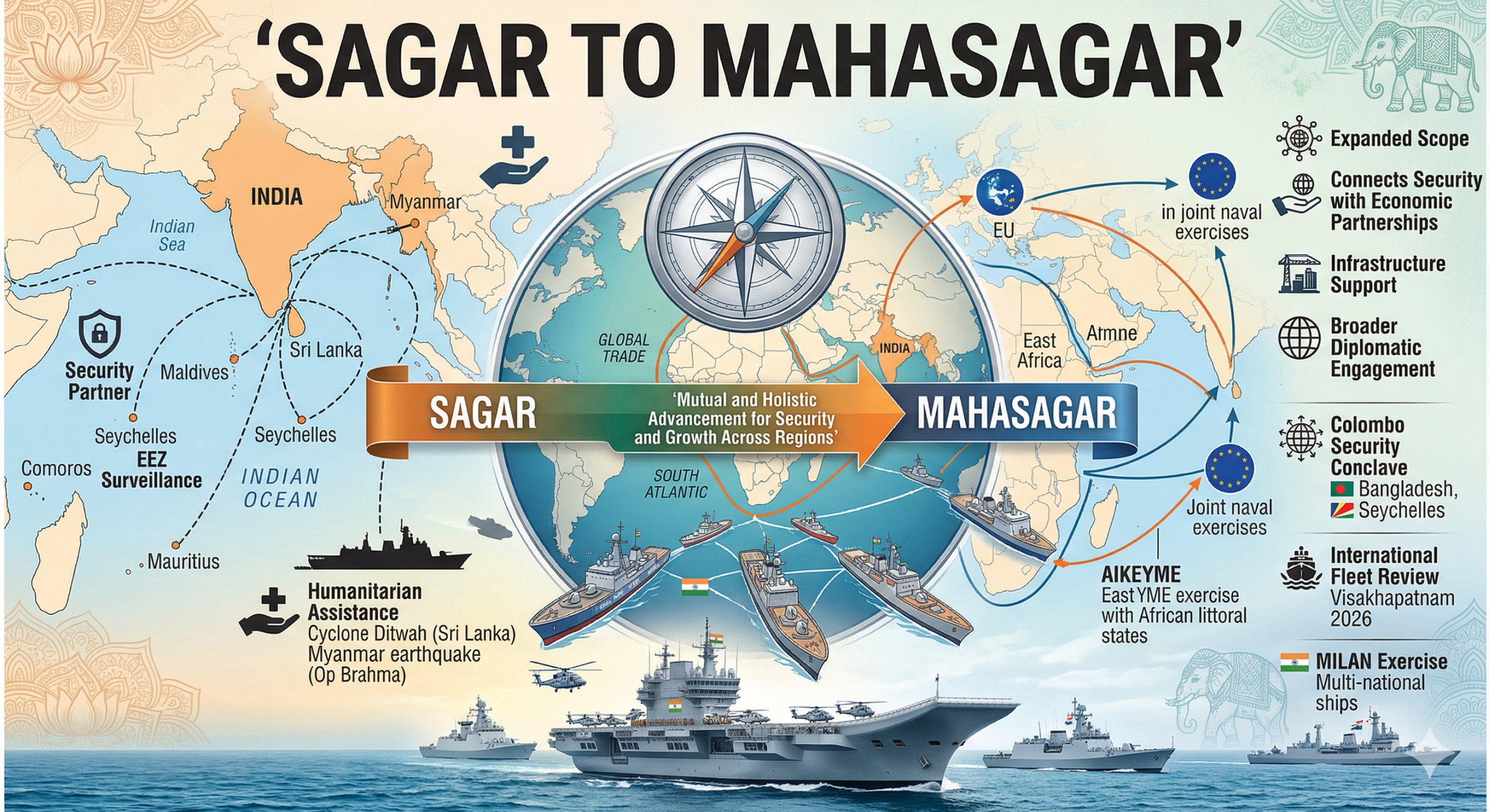
A year after Prime Minister Narendra Modi unveiled the MAHASAGAR vision during his visit to Mauritius, India’s maritime strategy is entering a new phase. The initiative marks an evolution of the earlier SAGAR doctrine—Security and Growth for All in the Region—which for nearly a decade guided India’s engagement with countries across the Indian Ocean.
Announced in 2015, SAGAR positioned India as a security partner for smaller island and coastal states in the region. MAHASAGAR — Mutual and Holistic Advancement for Security and Growth Across Regions — builds on that foundation but widens the scope considerably. Launched in March 2025, the framework signals India’s attempt to connect maritime security with economic partnerships, infrastructure support and broader diplomatic engagement across the Indo-Pacific and the wider Global South.
The shift reflects the growing importance of maritime routes to global trade. Nearly two-thirds of world commerce passes through the Indo-Pacific, while about 90 percent of India’s own trade moves by sea. Indian officials increasingly view the maritime domain not only as a security priority but also as a space where economic and strategic interests converge.
Over the past year, the Indian Navy has given the MAHASAGAR vision operational form through joint exercises, deployments, and regional cooperation initiatives that have expanded across both the Indian Ocean and parts of the Indo-Pacific.
One of the notable developments was the launch of the Africa-India Key Maritime Engagement, or AIKEYME, exercise in April 2025 off the coast of Tanzania. Navies from ten African countries participated in drills focused on joint patrols and operational coordination in the Western Indian Ocean. Officials described it as part of a broader effort to strengthen maritime cooperation with African littoral states.
Another initiative was the deployment of INS Sunayna under the Indian Ocean Ship SAGAR programme. The ship sailed with a multinational crew drawn from nine partner nations—Comoros, Kenya, Madagascar, Maldives, Mauritius, Mozambique, Seychelles, Sri Lanka and Tanzania—conducting surveillance in the exclusive economic zones of participating countries alongside training engagements and port visits.
India’s maritime engagement has also expanded beyond its immediate neighbourhood. In June 2025, India and the European Union conducted their first joint naval exercise in the Indian Ocean, focusing on counter-piracy operations and operational coordination — a milestone for a relationship that had previously been limited to informal passing encounters at sea.
When crises struck
Humanitarian assistance and disaster relief missions have remained an important and visible dimension of India’s maritime outreach.
In March 2025, the Indian Navy responded to a powerful earthquake in Myanmar through Operation Brahma, dispatching five naval ships and six aircraft carrying approximately 656 metric tonnes of relief supplies. Around the same period, INS Sumedha was deployed to Kenya to deliver emergency relief during severe seasonal flooding—extending India’s humanitarian footprint into East Africa.
When Cyclone Ditwah struck Sri Lanka in November 2025, the Indian Navy launched Operation Sagar Bandhu, deploying INS Vikrant, INS Udaygiri and INS Sukanya with relief material and rescue teams. The vessels delivered over 1,000 tonnes of supplies in an operation that continued in phases well into December, with Indian army engineers also deployed to help restore damaged infrastructure.
Institutions and the Visakhapatnam showcase
The Colombo Security Conclave, originally formed in 2011 by India, Sri Lanka and the Maldives, has continued to grow. It has since expanded to include Mauritius and Bangladesh, and in November 2025, Seychelles was admitted as a full member after initially participating as an observer. The grouping now functions with a formal charter and a secretariat in Colombo, coordinating on maritime security, intelligence sharing, and disaster response.
India’s growing maritime profile was on prominent display earlier this year when Visakhapatnam hosted a cluster of major naval events in February 2026. The International Fleet Review brought together representatives from 74 countries—one of the largest multilateral naval exercises India has ever hosted. During the event, President Droupadi Murmu reviewed a combined fleet of 85 ships, among them the indigenously built carrier INS Vikrant. The MILAN exercise, which took place subsequently, saw participation from a total of 42 ships, with 18 belonging to friendly foreign countries. The city also hosted the ninth Conclave of Chiefs of the Indian Ocean Naval Symposium, where naval leaders from across the region gathered to discuss shared security challenges and disaster response cooperation.
A year after its launch, MAHASAGAR remains an emerging framework. But the shift from SAGAR to MAHASAGAR signals how India’s maritime thinking is expanding—from ensuring security in its immediate neighbourhood to building a wider network of cooperation across the oceans that connect the Indo-Pacific and the Global South.