

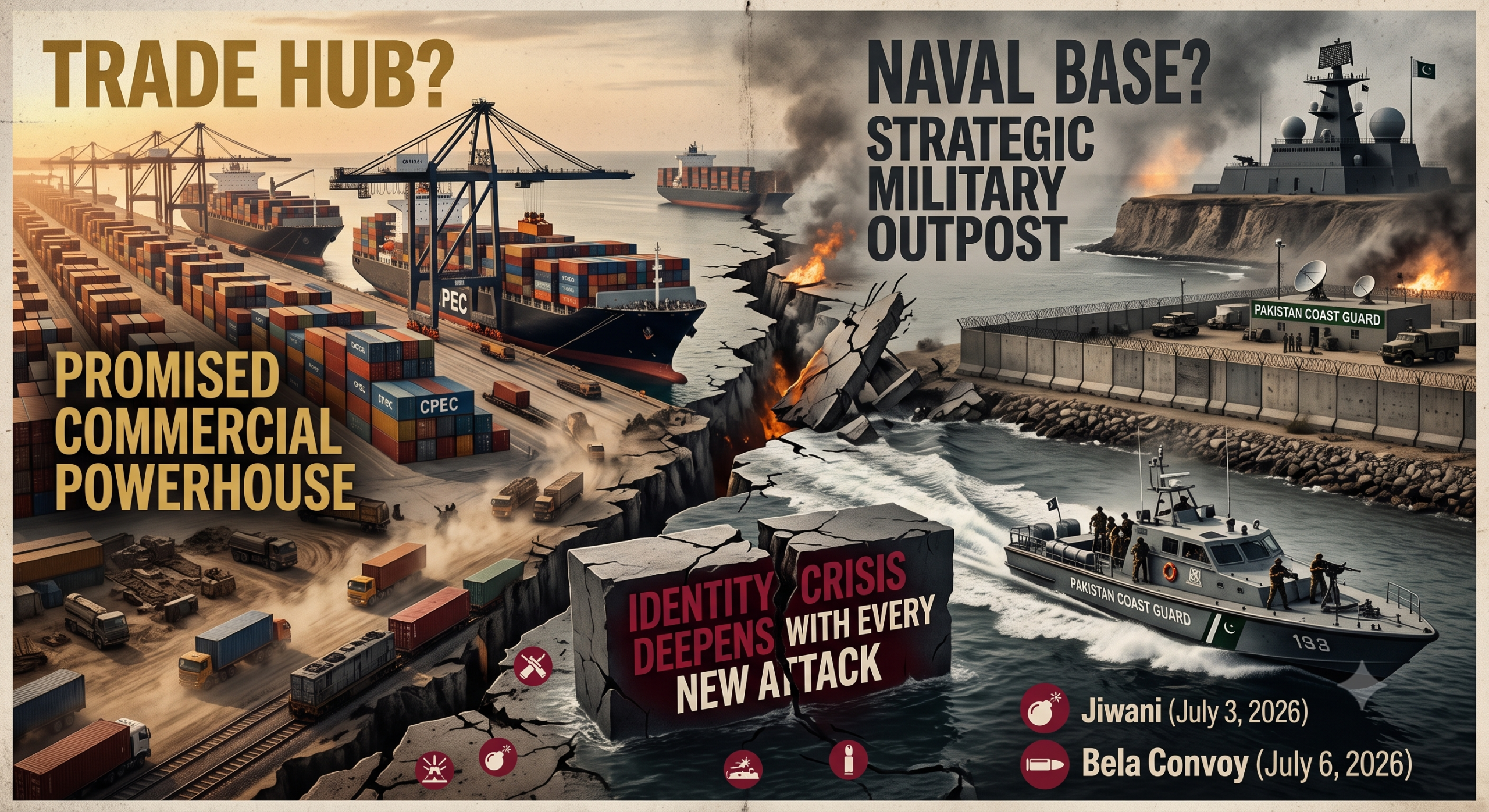
Pakistan’s military said on July 8 that three militant attacks since July 6—near Quetta, at a police post guarding the Mangi Dam project in Ziarat, and on an army convoy on the N-25 highway near Bela—had killed 42 police, army personnel, and civilians, while security forces killed 54 militants in the operations that followed. That toll landed just days after the Baloch Liberation Army claimed a “fidayeen” strike on a Pakistan Coast Guard camp in Jiwani’s Panwan area on July 3, putting the death toll above 30 security personnel, with several more wounded. Neither set of figures has been independently confirmed by Islamabad, but together the two episodes have put one of South Asia’s most closely tracked infrastructure projects under the microscope—not just for the violence itself but for what it signals about where Gwadar is actually headed.
Nearly a decade into being pitched as the economic anchor of CPEC, Gwadar claimed to be the gateway linking western China, Central Asia and the Arabian Sea. But every fresh attack brings back the same nagging question—is this port actually going to become a commercial powerhouse, or is it slowly settling into a role as primarily a military and strategic outpost instead?
That distinction isn’t just semantic. A commercial port and a naval facility need almost opposite things to succeed.
A commercial port lives on uninterrupted trade—predictable shipping timetables, smooth customs clearance, solid logistics networks, and, most of all, confidence from shipping lines and investors. A naval facility runs on a different logic altogether. Its value comes from geography, surveillance reach, and military access, not cargo tonnage.
Right now, Gwadar looks caught between the two.
Nobody disputes the geography. Sitting near the Strait of Hormuz, through which a massive share of the world’s oil moves, Gwadar occupies about as strategically valuable a spot as exists on the map. For Beijing, it’s a key piece of the Belt and Road Initiative, offering a route connecting Xinjiang to the Arabian Sea. For Islamabad, it’s central to plans to develop Balochistan’s resources — plans that Baloch nationalists argue have proceeded without adequate local consent or benefit-sharing.
But location can only take a project so far.
The Jiwani bombing is the latest in a run of incidents that keep hitting the area. Earlier this year, militants killed three Coast Guard personnel in an assault on a patrol boat near the Pakistan-Iran border, the first attack of its kind on Pakistan’s maritime forces at sea. In March 2024, eight militants attacked the Gwadar Port Authority complex itself, an assault that ended with all eight attackers and two soldiers dead. A convoy of Chinese engineers came under attack near Gwadar in 2023, though it was repelled without harm to the Chinese personnel involved, and the Pearl Continental Hotel overlooking the port was targeted back in 2019, killing four hotel employees and a navy soldier. Each incident has chipped away a little more at investor and shipping-industry confidence in the region’s overall security picture — a picture this week’s provincial toll of 42 dead has only darkened further.
Modern ports don’t work in isolation — cargo has to move smoothly through highways, rail lines, warehouses and industrial parks before it ever reaches a market. When those transport corridors keep needing extraordinary security arrangements just to stay open, the cost of doing business climbs fast.
For shipping companies, dependability usually beats strategic symbolism. A container vessel runs on a tightly scheduled route touching multiple ports, and any unplanned delay—a security lockdown, a closed highway, or disrupted inland freight—sends ripples through supply chains well beyond Pakistan. Add rising insurance costs and heavier security requirements, and Gwadar starts losing ground to ports that don’t carry the same risk premium.
None of this erases Gwadar’s strategic value—if anything, repeated attacks may be reinforcing why the port matters from a security standpoint. Pakistan has steadily built up its military footprint around Gwadar—its military spokesman this week vowed to pursue “each and every terrorist, their facilitators, and those who harbour them”—and China hasn’t wavered on CPEC funding. Maritime analysts have floated the idea that Gwadar could end up playing a bigger role in guarding sea lanes and energy shipments than in handling commercial containers.
But strategic weight and commercial success don’t always grow together. Plenty of ports around the world have held onto serious military or geopolitical importance while never quite delivering the trade volumes their backers once promised—because investors care more about stability, governance and market demand than location alone.
What happens over the next few years will likely decide which version of Gwadar wins out. If security stabilises, industrial zones start pulling in investment and the surrounding transport network stops seeing constant disruption, the port could genuinely grow its commercial side. Both Islamabad and Beijing insist that’s still the plan.
But if the instability keeps repeating and this week’s toll across Balochistan suggests it is, if anything, intensifying—Gwadar may end up remembered less as the trading hub CPEC promised and more as a strategically positioned military asset, valuable on the map, but never quite the commercial success story it was originally built to be.