

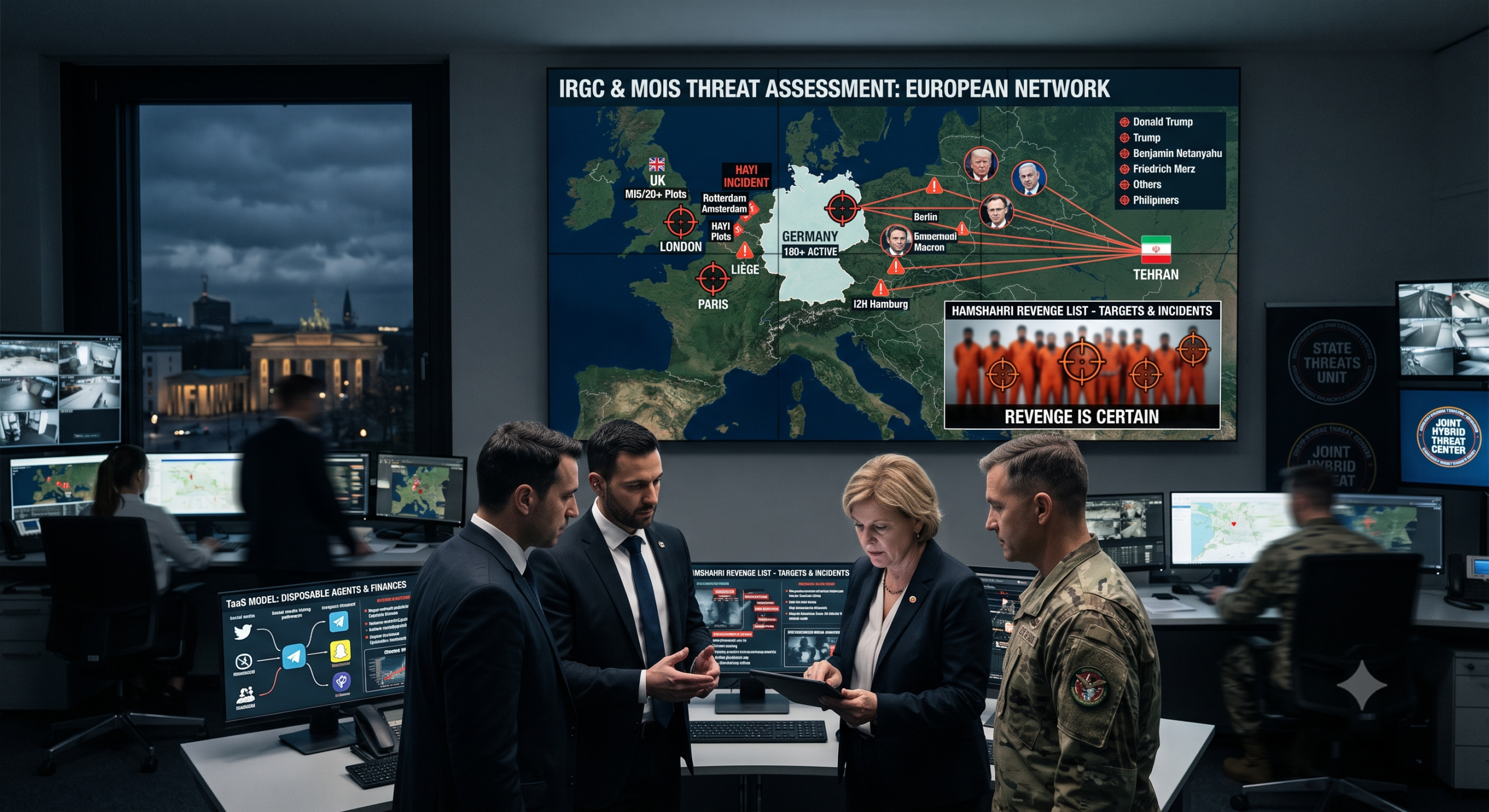
Following the military campaign in early 2026 that resulted in the death of Iran’s former Supreme Leader Ayatollah Ali Khamenei, the geopolitical threat landscape has shifted toward highly aggressive, state-sanctioned retaliatory operations.1 Under the newly appointed Supreme Leader, Mojtaba Khamenei, the clerical regime has intensified its domestic mobilization and transnational threats.1 This escalation culminated in the publication of an online “revenge list” on Saturday, July 11, 2026, by Hamshahri, an influential daily newspaper published by the Tehran municipality and closely tied to the Islamic Revolutionary Guard Corps (IRGC).1
The graphic featured 13 prominent Western leaders and military figures depicted in orange prison uniforms with sniper-style crosshair targets superimposed on their foreheads, under the caption “Revenge is certain”.1 While some political analysts classify this propaganda as psychological warfare designed to project strength amidst severe military setbacks, security agencies emphasize that the threat of state-sponsored terrorism on European soil remains severe.1 In Germany alone, the Federal Office for the Protection of the Constitution (BfV) estimates that approximately 180 individuals active on behalf of either the IRGC or the Iranian intelligence services are currently resident within the country, presenting a direct threat of espionage, subversion, and targeted attacks.1
The Hamshahri Revenge List and the Geopolitical Threat Landscape
The publication of the retaliation list coincided with the first public address by Mojtaba Khamenei since his father’s six-day funeral procession, signalling a deliberate transition toward an escalatory external policy.2 The online graphic list specifically targeted key international figures who supported the US-led and Israeli military campaigns against the Iranian regime.1
| Targeted Leader / Official | Official Role | Geopolitical Context of Target Selection |
| Donald Trump 1 | President of the United States 1 | Directed maximum pressure policies and military campaigns against the regime 1 |
| Benjamin Netanyahu 1 | Prime Minister of Israel 1 | Executed direct military strikes on Iranian nuclear and conventional infrastructure 1 |
| Friedrich Merz 1 | Chancellor of Germany 1 | Publicly welcomed the potential end of the clerical regime and supported allied actions 1 |
| Keir Starmer 2 | Prime Minister of the United Kingdom 2 | Imposed extensive state-threat designations and supported maritime chokepoint blockades 6 |
| Emmanuel Macron 1 | President of France 1 | Supported US-Israeli military operations and granted airspace transit permissions 1 |
| Giorgia Meloni 1 | Prime Minister of Italy 1 | Supported Western military operations and granted allied overflight permissions 1 |
| Marco Rubio 2 | US Secretary of State 2 | Championed maximum pressure sanctions and opposed diplomatic negotiations with Tehran 2 |
| Pete Hegseth 2 | US Secretary of War | Oversees joint military strikes targeting IRGC assets and proxy networks 2 |
| CENTCOM Commander 2 | Commander, US Central Command | Commands the tactical forces executing direct strikes within the Iranian theatre 2 |
Although the graphic was deleted from the Hamshahri website by the beginning of the following week and omitted from the Sunday print edition, security experts note that the publication would have been impossible without the explicit approval of the regime’s central censors.1
The rhetoric serves several strategic objectives for Tehran.1 Domestically, it aims to mobilize the regime’s conservative support base, divert attention from humiliating military setbacks, and project an image of operational capacity.1 Internationally, it functions as a mechanism of deterrence, signaling that continued pressure will be met with asymmetric terrorism.1
Transnational Threat Networks: Tracking Iranian Assets in Germany and Beyond
The domestic intelligence apparatus of Germany, led by the BfV, is actively tracking approximately 180 individuals identified as agents or active affiliates of the IRGC or the Ministry of Intelligence and Security (MOIS).1 German security authorities have expressed concern that these individuals have established a physical presence inside the country to facilitate intelligence gathering and prepare for potential attacks.1
A significant portion of these tracked suspects consists of individuals based in Germany who have traveled to Iran to receive military training before returning to Europe.9 For example, investigations have focused on individuals associated with the Islamic Centre Hamburg (IZH)—an institution banned by German authorities in 2024 as a major outpost of the Tehran regime—who later appeared in propaganda videos carrying assault rifles at checkpoints run by the Basij militia.9
While Germany monitors these 180 specific suspects, the exact number of Iranian state assets operating under surveillance in other Western nations remains unknown, though parallel intelligence findings indicate a widespread network 1:
- In the United Kingdom, MI5 tracked more than 20 potentially lethal, Iran-backed plots within a 12-month period, targeting dissidents, journalists, and Jewish community members.11
- In the United States, multiple investigations have revealed that IRGC handlers maintain direct communication with local operatives to photograph Jewish community centers, track political rallies, and conduct hostile reconnaissance on high-profile government figures.12
- Across the European Union, intelligence agencies have warned of an elevated threat of attacks targeting Jewish, Israeli, and US-linked sites, leading to coordinated multi-state counter-terrorism investigations.9
The BfV has warned that while the Iranian security apparatus was temporarily weakened during the active phase of the war, the regime is highly likely to redirect its intelligence and operational capabilities toward overseas terrorism once direct military pressure in the Middle East subsides.1
The Mechanics of Asymmetric Penetration: The ‘Disposable Agent’ and ‘Terrorism-as-a-Service’ Models
Open democratic societies, defined by their commitment to civil liberties, open borders, and strict legal boundaries on state surveillance, present a highly accessible and vulnerable environment for hostile foreign intelligence services.9 To exploit these vulnerabilities while avoiding direct attribution, the IRGC Quds Force and the MOIS have abandoned their traditional reliance on highly trained, ideologically committed sleeper cells in favor of an asymmetric, decentralized “disposable agent” model.1
The Gig-Economy of Transnational Repression
Rather than deploying professional intelligence officers who are difficult to replace and easy to trace, state sponsors have outsourced their physical operations to a commercialized network of local criminals, youth gangs, and minors.9 This model operates as a “gig-economy” of terrorism, frequently referred to by criminologists as “Terrorism-as-a-Service” (TaaS).16
Through casual channels on popular social media platforms such as Snapchat and Telegram, state-linked handlers recruit non-ideological, low-level local criminals or disaffected teenagers.9 These recruits are offered modest payments—often ranging from to paid in virtual currency—to carry out acts of property damage, intimidation, and arson.14 Because the recruits have no ideological affinity for the sponsoring state and are frequently unaware of the ultimate identity of their handlers, the sponsoring nation maintains a high degree of plausible deniability.14
This micro-compartmentalization of tasks ensures that even if an operative is arrested, they cannot provide investigators with actionable leads connecting the crime back to Tehran.15
The Harakat Ashab al-Yamin al-Islamiyah Front
The primary operational vehicle for this hybrid model in Europe has been Harakat Ashab al-Yamin al-Islamiyah (HAYI), also known as the Islamic Movement of Companions of the Right (IMCR).7 Analysts assess that HAYI is a front group created by the IRGC and supported by Iraqi Shia militias, such as Kata’ib Hezbollah, to execute deniable operations across Western Europe.13
The group emerged online in March 2026, immediately following an explosion outside a synagogue in Liège, Belgium, and subsequently claimed responsibility for a series of coordinated attacks across Europe.18 These included firebombings of synagogues in Rotterdam, improvised explosive device detonations outside Jewish schools in Amsterdam, arson attacks destroying Hatzola charity ambulances in Golders Green, and a foiled bomb plot targeting a Bank of America office in Paris.7
To execute these plots, professional middlemen such as the Zindashti criminal network were utilized to launder funds and hire local adolescents.11
The scale of this network was revealed following the US arrest of Mohammad Saad Baqer al-Saadi, a senior commander in Kata’ib Hezbollah.16 Al-Saadi was charged with coordinating 18 separate attacks across Belgium, the Netherlands, and the UK on behalf of the IRGC.16 He utilized cryptocurrency to pay local criminal assets, bragging to undercover informants that the European campaign was progressing highly effectively.16
Historical Precedents of Proxy and Insider Assassinations
To assess the potential for modern state-sponsored networks to successfully execute attacks against highly protected world leaders, it is instructive to draw direct analogies from historical assassinations. These cases demonstrate that even the most robust close-protection systems can be compromised through predictable security lapses, insider infiltration, and systemic inter-agency failures.22
Prime Minister Indira Gandhi (1984): The Insider Threat and Vetting Collapse
The assassination of Indian Prime Minister Indira Gandhi on October 31, 1984, illustrates the danger of prioritizing political optics over objective security vetting.24 Following Operation Blue Star—the military assault on the Golden Temple in Amritsar—tensions between the Indian government and the Sikh community were exceptionally high.24
Gandhi’s senior security advisers recognized the acute risk of insider retaliation and recommended the immediate transfer of all Sikh officers out of her personal protection detail.25 However, Gandhi personally rescinded these transfer directives, believing that removing long-serving officers would exacerbate communal distrust and damage her political narrative.25
This decision bypassed standard vetting protocols.25 On the morning of the attack, two radicalized members of her uniformed guard, Beant Singh and Satwant Singh, utilized their scheduled shift on a garden gate to assassinate her at point-blank range with their service weapons.24
The primary security failure was the override of professional security assessments by the executive, permitting highly motivated, radicalized insiders to maintain unchecked proximity to the protectee.25
Prime Minister Rajiv Gandhi (1991): Inter-Agency Information Gaps and Perimeter Failures
The assassination of former Indian Prime Minister Rajiv Gandhi on May 21, 1991, highlights the lethal consequences of intelligence-sharing failures and inadequate crowd-control measures.27 Gandhi was targeted by the Tamil separatist organization, the Liberation Tigers of Tamil Eelam (LTTE), in retaliation for the deployment of the Indian Peace Keeping Force to Sri Lanka.27
The subsequent Verma Commission of Inquiry revealed that while the central Intelligence Bureau possessed specific intelligence indicating an imminent threat to Gandhi’s life, this critical data was not effectively integrated or communicated to the local Tamil Nadu state police.28
Furthermore, during a public campaign rally, security personnel failed to maintain a sterile physical perimeter.30 An LTTE suicide bomber, Dhanu, was allowed to bypass the security cordon to present a ceremonial garland to Gandhi.30 As she bent to touch his feet, she detonated an explosive belt containing of RDX, killing Gandhi and 14 others.30
The failure lay in the lack of a unified communications center and the absence of a strictly enforced physical standoff distance in public venues.28
President Ranasinghe Premadasa (1993): Infiltration of the Domestic Sphere
The assassination of Sri Lankan President Ranasinghe Premadasa on May 1, 1993, represents a case study in the long-term social engineering of a protectee’s domestic staff.31 The LTTE deployed a 23-year-old operative, Kulaveerasingam “Babu” Veerakumar, to infiltrate the President’s personal household.31
Babu established a grocery and trucking business in Colombo as a cover, using his financial resources to exploit the alcohol dependency of President Premadasa’s personal valet, E.M.P. Mohideen.31 Over several years, Babu gained Mohideen’s absolute trust, allowing him to fly in presidential helicopters, bypass checkpoints, and reside within the presidential quarters without being subjected to standard security checks.31
In March 1993, the Criminal Investigation Department warned the domestic staff of a plot targeting the President and instructed them to report any close associates.31 Confident in his relationship, Mohideen failed to report Babu and actively assured security personnel that there was nothing to worry about.31
On May Day, as President Premadasa supervised a political rally, Babu approached the president’s vehicle.31 When security details attempted to block Babu, Mohideen intervened and ordered them to let him pass.31 Babu walked directly to the President and detonated a concealed explosive belt, killing himself, the President, Mohideen, and 19 others.31
The security failure was the absolute reliance on unvetted domestic staff, who were permitted to override professional physical security protocols.31
Prime Minister Benazir Bhutto (2007): Systemic Negligence and Post-Incident Obstruction
The assassination of former Pakistani Prime Minister Benazir Bhutto on December 27, 2007, demonstrates how systemic institutional failures can leave a high-profile leader exposed to known threat vectors.32 Upon her return to Pakistan, Bhutto faced intense threats from Al-Qaeda, the Taliban, and elements within the domestic political and military establishment.32
A United Nations Commission of Inquiry subsequently concluded that the federal and provincial authorities failed profoundly to provide a security apparatus commensurate with these urgent risks.32 Most notably, the government failed to issue directives to provide Bhutto with the same stringent security measures mandated for other former prime ministers.32
Immediately following the suicide bombing that killed Bhutto and 24 others, the Rawalpindi district police hosed down the crime scene within hours, destroying vital forensic evidence.32 The UN inquiry noted that parallel investigations by military intelligence agencies severely hampered the search for the truth, and key security officials actively obstructed access to information.32
The primary failure was the state’s refusal to provide an integrated security plan, followed by an administrative cover-up that compromised judicial accountability.32
Prime Minister Shinzo Abe (2022): The Rear-Sector Tactical Blind Spot
The assassination of former Japanese Prime Minister Shinzo Abe on July 8, 2022, serves as a modern warning regarding the danger of failing to secure a 360-degree perimeter during public political speeches.35 Abe was speaking at an open intersection in Nara, with his back turned to an unsecured public roadway.35
The National Police Agency (NPA) investigation revealed that the security plan prepared by the prefectural police was deeply flawed, leaving the rear sector completely unmonitored by security personnel.36 The lone perpetrator, Tetsuya Yamagami, carrying a large, homemade double-barreled firearm, approached Abe from behind unchallenged.35
Yamagami fired a first shot that missed Abe.36 In the critical several-second interval before the second, fatal shot was fired, the close-protection detail failed to react.36 There was no communication among the officers, no attempt to shield Abe physically, and no effort to pull him to the ground.36
The core failures were sloppy risk assessments, the division of security responsibilities between uncoordinated local and national police units, and a total tactical failure to secure the immediate surroundings.36
| Historical Figure | Primary Vulnerability Exploited | Core Security Failure | Key Consequence / Lesson |
| Indira Gandhi 24 | Insider Threat 25 | Political considerations overrode professional security vetting 25 | Vetting procedures must remain absolute and independent of executive interference 25 |
| Rajiv Gandhi 27 | Perimeter Breach 30 | Failure of inter-agency intelligence sharing and crowd standoff protocols 28 | Actionable threat intelligence must be integrated with local ground security 28 |
| Ranasinghe Premadasa 31 | Valet Infiltration 31 | Domestic staff compromised and allowed to override physical security details 31 | Strict separation of domestic staff from physical security decision-making 31 |
| Benazir Bhutto 32 | Inadequate Security Allocation 32 | State refusal to provide commensurate protection, followed by a forensic cover-up 32 | Mandating non-partisan, standardized security packages for high-risk leaders 32 |
| Shinzo Abe 35 | Tactical Blind Spot 36 | Open rear perimeter, poor inter-agency communication, and lack of immediate response 36 | Establishing a sterile 360-degree perimeter and rapid extraction protocols 36 |
The Longevity of State-Backed Retaliation: The Generational Threat Horizon
A critical dimension of state-sponsored threats, particularly those originating from the Iranian security apparatus, is their open-ended operational timeline.12 Unlike non-state terrorist organizations, which operate under immediate survival pressures, a sovereign state possesses the institutional permanence, financial resources, and strategic patience to pursue target lists over decades.12
The Precedent of Salman Rushdie
The long-term threat profile of Khomeineist decrees is exemplified by the fatwa against British-American novelist Salman Rushdie.39 Issued in February 1989 by Ayatollah Ruhollah Khomeini following the publication of The Satanic Verses, the edict called for Rushdie’s execution and was accompanied by a multi-million-dollar bounty from state-aligned foundations.38 Although Iranian diplomats periodically suggested the state would not enforce the decree, the fatwa was never rescinded.40 In 2017 and 2019, Supreme Leader Ayatollah Ali Khamenei explicitly reaffirmed the edict’s validity, declaring it irreversible.40
On August 12, 2022—more than 33 years after the fatwa was first issued—Rushdie was stabbed multiple times on a lecture stage in Chautauqua, New York, by 24-year-old Hadi Matar.39 Matar was born nearly a decade after the initial fatwa was decreed.42
The mechanics of this generational attack reveal how state-sponsored threats remain active indefinitely:
- Ideological Continuation: The Iranian state media and its regional proxies, including Lebanese Hezbollah, consistently kept the fatwa active in religious and political discourse for over three decades.39
- Transnational Safe Havens for Radicalization: Matar underwent a profound radicalization during a month-long trip to Southern Lebanon in 2018, where he visited his father in a stronghold heavily influenced by Hezbollah.38
- Symbolic Proxy Replication: Upon his arrest, Matar was found to be carrying a forged driver’s license under the alias “Hassan Mughniyah,” an intentional homage to the late military commander of Hezbollah, Imad Mughniyah.38
Following the stabbing, state-controlled Iranian media widely celebrated the attack, describing it as a “holy act of God”.40 The Rushdie precedent demonstrates that a state-sanctioned threat establishes a permanent, self-sustaining ecosystem of radicalization that can inspire actors across generations, making the threat as real in 20 years as it is on the day of publication.41
Active Long-Term IRGC Targeting of Western Officials
This pattern of enduring, retaliatory planning is actively mirrored in current IRGC plots targeting former US government officials.12 Following the January 2020 targeted killing of Quds Force commander Qasem Soleimani, the IRGC committed to a sustained campaign of retaliatory assassinations.12
In August 2022, the US Department of Justice unsealed charges against Shahram Poursafi, a uniformed member of the IRGC Quds Force based in Tehran.12 Poursafi attempted to pay individuals in the United States to assassinate former National Security Advisor John Bolton and offered a subsequent bounty to murder former Secretary of State Mike Pompeo.12
Similarly, in August 2024, Pakistani national Asif Merchant was charged with a murder-for-hire scheme targeting high-ranking US government officials.44 Merchant, who had close ties to Iran, traveled to Houston and New York to recruit assassins and arrange payments through a network of criminal brokers.44
These cases show that the IRGC is willing to fund, plan, and coordinate complex operations targeting former officials years after they have left public office, demonstrating that their retaliatory threats must be treated as permanent security concerns.8
Neutralizing the Threat: Institutional Strategies for Western Open Democracies
To protect public figures and neutralize the threat of state-sponsored asymmetric terrorism, open democracies must adopt a unified, proactive security posture that integrates domestic counter-espionage with tactical law enforcement.5 Germany’s BfV has set out a strategic model focused on three interconnected pillars: detection, disruption, and prevention.5
1. Robust Detection Methodologies
Detecting asymmetric threats requires early identification of anomalous patterns and digital footprints before they manifest as physical violence.5
- Digital Counter-Surveillance: Intelligence agencies must continuously monitor encrypted social media channels and deep-web criminal forums where foreign handlers recruit “disposable” assets.9 Cyber-espionage divisions must prioritize defending against state-linked APT groups, such as Charming Kitten, which execute targeted phishing campaigns against dissidents, journalists, and political advisers to harvest location data and personal contacts.5
- Traveler Tracking and Vetting: Governments must monitor the travel patterns of individuals residing within their borders who journey to state sponsors of terrorism for ideological or military instruction.9 As documented in Germany, tracking departures and returns from Basij-linked training facilities is critical to identifying potential returnee sleeper cells.9
- Unified Threat-Sharing Hubs: Open democracies must establish centralized, multi-agency threat centers, such as Germany’s Joint Defense Center against Hybrid Threats, to ensure that micro-signals of hostile reconnaissance collected by local police are instantly synthesized with national-level signals and human intelligence.6
2. Aggressive Disruption Operations
Disrupting active networks requires exploiting the legal and financial vulnerabilities of both the state sponsors and their local criminal proxies.7
- Financial Interdiction: Intelligence services and treasury departments must prioritize tracking and freezing the financial channels used to fund local operatives.11 Sanctioning cryptocurrency wallets, front companies, and money-laundering syndicates—such as the Zarringhalam family and the Zindashti criminal network—severely undermines the viability of the “Terrorism-as-a-Service” model.11
- Legislative Enhancements: Parliaments should enact robust national security legislation, such as the UK’s National Security Act 2023, which outlaws foreign interference, establishes enhanced registration tiers for hostile states, and criminalizes any form of undeclared cooperation with foreign intelligence agencies.7
- Proactive Legal Prosecutions: Local law enforcement should execute early, pre-emptive arrests of local “disposable” recruits on secondary criminal charges, such as conspiracy, possession of explosives, or standard arson, before the physical execution of a plot.14 This tactical disruption prevents the completion of attacks even when a direct link to a foreign state cannot be immediately proven in court.14
3. Advanced Prevention and VIP Protection
Preventing successful assassinations requires redesigning physical protection systems to eliminate human, tactical, and institutional vulnerabilities.36
- Implementing Protective Intelligence: Close-protection details must adopt the findings of the US Secret Service’s Exceptional Case Study Project, shifting resources from passive physical shielding to active threat assessment.45 Protective intelligence must focus on identifying, investigating, and managing individuals who display fixation or begin moving along a discernible “pathway to violence,” regardless of whether they have communicated a direct threat.45
- Establishing Sterile 360-Degree Perimeters: Based on the tactical lessons of the Shinzo Abe and Rajiv Gandhi assassinations, VIP security plans must enforce a strict, sterile perimeter around protectees during public appearances.30 This includes securing rear sectors, utilizing physical line-of-sight barriers, deploying counter-surveillance teams to detect hostile reconnaissance, and maintaining a strict standoff distance from unvetted crowds.23
- Valet and Domestic Staff Vetting: To prevent the deep insider infiltration seen in the Ranasinghe Premadasa assassination, the domestic and personal staff of world leaders—including valets, drivers, cooks, and administrative aides—must be subjected to continuous, high-level counter-espionage vetting.31 Personal relationships between domestic staff and unvetted individuals must be actively monitored, and domestic staff must never be permitted to override professional physical security protocols or grant close-range access to any individual.31
- Joint Communications and Real-Time Interoperability: Security details must establish a unified, joint communications room with local law enforcement during public events.23 This eliminates the critical information gaps that led to the security failures in the attempted assassination of Donald Trump in July 2024, ensuring that reports of suspicious individuals carrying range finders or climbing nearby structures are instantly communicated to the protectee’s immediate detail.23
By combining these institutional strategies, open democracies can successfully counter the asymmetric, long-term threat of state-sponsored terrorism, ensuring the protection of their leadership and the preservation of their national sovereignty.9
Works cited
- Germany’s Merz receives death threat from Iranian newspaper. Deutsche Welle , accessed on July 18, 2026, https://www.dw.com/en/friedrich-merz-iran-death-threat/a-77958683
- Trump, Netanyahu, Meloni among 13 world leaders featured on Iran’s “revenge list”, accessed on July 18, 2026, https://www.aninews.in/news/world/middle-east/trump-netanyahu-meloni-among-13-world-leaders-featured-on-irans-revenge-list20260713142502
- Iran newspaper lists Trump, European leaders as revenge targets – The Straits Times, accessed on July 18, 2026, https://www.straitstimes.com/world/middle-east/iran-newspaper-lists-trump-european-leaders-as-revenge-targets
- Bahrain, UK foreign ministers discuss Iran attacks, accessed on July 18, 2026, https://www.iranintl.com/en/202607144016
- Iran among top foreign espionage threats to Germany, security report says, accessed on July 18, 2026, https://www.iranintl.com/en/202606305000
- Germany investigates suspected Iran-linked spying and attack plans, accessed on July 18, 2026, https://www.iranintl.com/en/202607142273
- State Threats Response, accessed on July 18, 2026, https://hansard.parliament.uk/commons/2026-07-13/debates/26071346000006/StateThreatsResponse
- US Lawmakers Urge End Of Iran Talks In Light Of Assassination Plots, accessed on July 18, 2026, https://www.iranintl.com/en/202208110690
- EXCLUSIVE: German intelligence warns Iran could expand terror …, accessed on July 18, 2026, https://www.euractiv.com/news/exclusive-german-intelligence-warns-iran-could-expand-terror-operations-in-europe-after-war/
- German intelligence warns Iran may expand EU operations after war – report, accessed on July 18, 2026, https://www.iranintl.com/en/202605209621
- Hybrid Warfare Reflects Convergence of Terrorism and Great Power …, accessed on July 18, 2026, https://thesoufancenter.org/intelbrief-2026-may-15/
- Contending with IRGC Plots | The Washington Institute, accessed on July 18, 2026, https://www.washingtoninstitute.org/policy-analysis/contending-irgc-plots
- A Ceasefire Won’t End Iran’s Terror War on Europe | The Washington Institute, accessed on July 18, 2026, https://www.washingtoninstitute.org/policy-analysis/ceasefire-wont-end-irans-terror-war-europe
- Deniable, Disposable, Disruptive: Iran’s Hybrid Warfare in Europe …, accessed on July 18, 2026, https://www.washingtoninstitute.org/policy-analysis/deniable-disposable-disruptive-irans-hybrid-warfare-europe-demands-proactive
- ‘Two decades in the making’: Expert details how Mossad built its spy network in Iran • FRANCE 24 – YouTube, accessed on July 18, 2026, https://www.youtube.com/watch?v=3wJcjZD9eqk
- ‘Disposable’ operatives for hire are a new menace for western countries – The Guardian, accessed on July 18, 2026, https://www.theguardian.com/world/2026/may/18/disposable-terrorists-for-hire-menace-western-countries
- National Security: State Threat Designations, accessed on July 18, 2026, https://hansard.parliament.uk/commons/2026-07-13/debates/26071346000011/NationalSecurityStateThreatDesignations
- National Security (State Threats) Act 2026: factsheet, accessed on July 18, 2026, https://www.gov.uk/government/publications/national-security-state-threats-act-2026-factsheet/national-security-state-threats-act-2026-factsheet
- Harakat Ashab al-Yamin al-Islamia – Wikipedia, accessed on July 18, 2026, https://en.wikipedia.org/wiki/Harakat_Ashab_al-Yamin_al-Islamia
- Special Report – Harakat Ashab al-Yamin al-Islamia – Gov.il, accessed on July 18, 2026, https://www.gov.il/BlobFolder/reports/special-report-harakat-ashab-al-yamin-al-islamia-2026-03-15/en/mashlat_Roaring_Lion_special-report-harakat-ashab-al-yamin-al-islamia-2026-03-15.pdf
- Iran Hiring ‘DISPOSABLE’ Agents To Carry Attacks On West? Explosive Report Reveals Covert Strategy – YouTube, accessed on July 18, 2026, https://www.youtube.com/watch?v=qVRyStLsGR8
- Preventing Assassination: Secret Service Exceptional Case Study Project, accessed on July 18, 2026, https://nij.ojp.gov/library/publications/preventing-assassination-secret-service-exceptional-case-study-project
- The Secret Service Missed Opportunities to Prevent and Disrupt the Attempted Assassination of President Trump on July 13, 2024 – (REDACTED) – OIG.DHS.gov, accessed on July 18, 2026, https://www.oig.dhs.gov/sites/default/files/assets/2026-07/OIG-26-13-Jul26-Redacted.pdf
- Satwant Singh | Biography | Research Starters – EBSCO, accessed on July 18, 2026, https://www.ebsco.com/research-starters/biography/satwant-singh
- Indian prime minister Indira Gandhi is assassinated | October 31, 1984 – History.com, accessed on July 18, 2026, https://www.history.com/this-day-in-history/october-31/the-prime-minister-of-india-is-assassinated
- Indira Gandhi Is Assassinated | History | Research Starters – EBSCO, accessed on July 18, 2026, https://www.ebsco.com/research-starters/history/indira-gandhi-assassinated
- Rajiv Gandhi Assassination Overview | PDF – Scribd, accessed on July 18, 2026, https://www.scribd.com/document/562908353/Rajiv-Gandhi-Assassination-FINAL
- Key Judgements & Contribution of Justice JS Verma – GKToday, accessed on July 18, 2026, https://www.gktoday.in/key-judgements-contribution-of-justice-js-verma/
- Popular Buddhist Monk’s Death Highlights Sri Lanka’s Failing ‘Revolution’ – IDN-InDepthNews, accessed on July 18, 2026, https://indepthnews.net/popular-buddhist-monks-death-highlights-sri-lankas-failing-revolution/
- Security – PERIODICA, accessed on July 18, 2026, http://periodica.fzf.ukim.edu.mk/sd/SD%2009.1%20(2018)/SD%2009.1.05%20Panchevski,%20S.%20&%20Tasevski,%20S.%20-%20Suicide%20Assasinations.pdf
- Assassination of Ranasinghe Premadasa – Wikipedia, accessed on July 18, 2026, https://en.wikipedia.org/wiki/Assassination_of_Ranasinghe_Premadasa
- UN report on Bhutto murder finds Pakistani officials ‘failed profoundly’ – UN News, accessed on July 18, 2026, https://news.un.org/en/story/2010/04/335482
- UN Blames Pakistan For Failing To Protect Benazir Bhutto – Radio Free Europe, accessed on July 18, 2026, https://www.rferl.org/a/UN_Report_Pakistan_Failed_To_Protect_Bhutto/2015067.html
- Report of the United Nations Commission of Inquiry into the Facts and Circumstances of the Assassination of Former Pakistani Pri – The Web site cannot be found, accessed on July 18, 2026, https://www.files.ethz.ch/isn/125434/5067_UN_Bhutto_Report_15April2010.pdf
- 2025 Meiji Journal of Governance Studies, accessed on July 18, 2026, https://www.meiji.ac.jp/mugs2/journal/6t5h7p00001r78oy-att/Vol.11.pdf
- EDITORIAL | After Abe’s Assassination, Revamp Needed in Securing VIPs | JAPAN Forward, accessed on July 18, 2026, https://japan-forward.com/editorial-after-abes-assassination-revamp-needed-in-securing-vips/
- Japan calls for security ‘vigilance’ in the aftermath of Trump assassination attempt, accessed on July 18, 2026, https://english.alarabiya.net/News/world/2024/07/16/japan-calls-for-security-vigilance-in-the-aftermath-of-trump-assassination-attempt
- Hadi Matar: The unremarkable executioner who tried to make good on Tehran’s fatwa against Salman Rushdie – El Pais in English, accessed on July 18, 2026, https://english.elpais.com/usa/2022-08-20/hadi-matar-the-unremarkable-executioner-who-tried-to-make-good-on-tehrans-fatwa-against-salman-rushdie.html
- The man who stabbed author Salman Rushdie on stage has been sentenced to 25 years in prison – Courthouse News, accessed on July 18, 2026, https://www.courthousenews.com/the-man-who-stabbed-author-salman-rushdie-on-stage-has-been-sentenced-to-25-years-in-prison/
- Stabbing of Salman Rushdie – Wikipedia, accessed on July 18, 2026, https://en.wikipedia.org/wiki/Stabbing_of_Salman_Rushdie
- Iran Fatwa: the Meaning of the Attack on Salman Rushdie – New Lines Magazine, accessed on July 18, 2026, https://newlinesmag.com/argument/iran-fatwa-the-meaning-of-the-attack-on-salman-rushdie/
- Man who stabbed Salman Rushdie sentenced to 25 years in prison : r/books – Reddit, accessed on July 18, 2026, https://www.reddit.com/r/books/comments/1korvc4/man_who_stabbed_salman_rushdie_sentenced_to_25/
- Iranian dissidents say they face abductions, assassination attempts | 60 Minutes – CBS News, accessed on July 18, 2026, https://www.cbsnews.com/news/iranian-dissidents-abductions-assassination-attemts-60-minutes-transcript/
- August 16, 2024 The Honorable Christopher A. Wray Director Federal Bureau of Investigation Washington, D.C. 90535 Dear Directo – Committee on Homeland Security, accessed on July 18, 2026, https://homeland.house.gov/wp-content/uploads/2024/08/2024-08-16-Green-et-al-to-Wray-FBI-re-Iran-Plot.pdf
- Building a Methodology for Proactive Close Protection – ASIS International, accessed on July 18, 2026, https://www.asisonline.org/security-management-magazine/articles/2022/07/building-a-methodology-for-proactive-close-protection/
- Germany launches joint intelligence hub to counter hybrid threats – Anadolu Ajansı, accessed on July 18, 2026, https://www.aa.com.tr/en/europe/germany-launches-joint-intelligence-hub-to-counter-hybrid-threats/3968681
- Protective Intelligence and Threat Assessment Investigations: A Guide for State and Local Law Enforcement Officials – Secret Service, accessed on July 18, 2026, https://www.secretservice.gov/media/86/download?inline=true
- Joint statement on Iranian State Threats and HAYI-claimed attacks – GOV.UK, accessed on July 18, 2026, https://www.gov.uk/government/news/joint-statement-on-iranian-state-threats-and-hayi-claimed-attacks