

This article examines the landmark administrative and human rights battle of Kagusthan Ariaratnam against the Canadian Security Intelligence Service (CSIS), analyzing the structural tensions between domestic national security practices and international refugee protection obligations. It addresses two fundamental questions: first, whether security agencies can leverage the legal vulnerability of refugee status to extract prolonged, coerced intelligence labor and subsequently escape accountability through narrow timeline limitations; and second, whether administrative human rights tribunals can legally ignore systemic, multi-decade narratives of discrimination by fragmenting them into isolated calendar events.
By tracing Ariaratnam’s trajectory from forced conscription as a child soldier in Sri Lanka to his exploitation as an unpaid informant in Canada , the article details how classified immigration briefs detailing psychiatric diagnoses were weaponized to block his employment and cancel his security clearance. It reviews the critical jurisdictional battles that followed, including the Federal Court’s rejection of the state’s “duplication” defense in Ariaratnam v. Canada (Attorney General), 2023 FC 1248. Additionally, it evaluates the Canadian Human Rights Tribunal’s landmark November 2025 ruling by Member Ashley Bressette-Martinez, which affirmed that once a case is referred to the tribunal, it belongs strictly to the complainant, thereby preventing the government from invoking parallel national security reviews to indefinitely delay or hijack human rights proceedings. Concluding with an assessment of the severe financial and resource asymmetries codified by the Canada v. Mowat costs precedent, this study highlights the pressing need for legislative reform to protect vulnerable individuals in national security disputes.
Introduction
The legal battle of Kagusthan Ariaratnam against the CSIS exposes a critical structural crisis at the intersection of Canada’s national security architecture, refugee protection obligations, and administrative law system.1 This case raises fundamental questions about the limits of state authority, the protection of vulnerable asylum seekers, and the procedural mechanisms used by intelligence agencies to evade human rights accountability.2 At its core, the dispute interrogates whether national security agencies can operate in a parallel legal sphere, leveraging the precarity of refugee status to extract dangerous intelligence labor while shielding themselves from human rights oversight through jurisdictional maneuvers and historical timeline limitations.2
The Genesis of Exploitation: Transnational Coercion and the Child Soldier’s Path
To understand the structural dynamics of Ariaratnam’s case, one must examine his entry into the international intelligence apparatus, which was forged in the violent crucible of the Sri Lankan Civil War.1 Born on August 23, 1973, in Jaffna, Sri Lanka, Ariaratnam was a seventeen-year-old mathematics student at Kokkuvil Hindu College in 1991 when he was abducted by the Liberation Tigers of Tamil Eelam (LTTE).1 Held in an underground bunker and forcibly recruited as a child soldier, he was subsequently assigned to the LTTE’s military intelligence wing, where he managed intelligence operations for the Sea Tigers and Air Tigers—the organization’s naval and aerial divisions.1
In June 1995, Ariaratnam defected from the LTTE and surrendered to Sri Lankan security forces, offering critical intelligence.5 This defection made him an active target; the LTTE published wanted notices containing his photograph in Tamil newspapers seeking information on his whereabouts, records of which remain preserved in the Noolaham Foundation digital archive.1
During his detention as a prisoner of war in Jaffna, he met Rohan Gunaratna, then conducting research for his book, International & Regional Security Implications of the Sri Lankan Tamil Insurgency.7 Gunaratna secured Ariaratnam’s documentation and release, subsequently exploiting him as an intelligence source on the inner workings of the LTTE and the Tamil diaspora.7
Ariaratnam’s ultimate departure from Sri Lanka in September 1997 was covertly facilitated by B. Raman, one of India’s top spymasters, who intervened to extract him from immediate danger.5 Upon arriving in Canada, Ariaratnam was granted refugee protection in 1998.1
Question 1: Weaponizing Refugee Status and the Sovereignty-Human Rights Paradox
The first fundamental question raised by this litigation is whether Canada’s national security apparatus can legally and ethically exploit the precarity of an immigrant’s refugee status to extract prolonged, hazardous intelligence labor, and subsequently utilize narrow statutory timelines to escape human rights accountability.2
The factual matrix of Ariaratnam’s interaction with CSIS indicates that his refugee status was actively converted into a mechanism of state coercion.2 In the summer of 2000, CSIS agent Lezli Kirsch initiated contact with Ariaratnam at his Montreal apartment.8 Kirsch allegedly threatened to report him to Canadian immigration authorities—potentially triggering his deportation to Sri Lanka, where he faced certain execution—unless he agreed to serve as an informant.2
To secure his compliance, Kirsch promised that CSIS would formally employ him as an intelligence analyst once he obtained permanent residency in 2002.2 This promise was never fulfilled, initiating a 22-year cycle of repeated job applications and rejections, even as CSIS continued to extract and rely on his intelligence tips regarding Tamil militant organizations.2
During this period of forced informant labor, Ariaratnam was subjected to parallel coercion by Rohan Gunaratna.7 In 2001, Ariaratnam exposed Gunaratna’s intelligence activities to CSIS, which Gunaratna quickly discovered.7 Gunaratna then subjected Ariaratnam to severe blackmail and emotional manipulation, using Ariaratnam’s family in Colombo as “collateral” to force him to draft operational profiles of twenty top LTTE leaders, including Colonel Karuna, whose subsequent defection with 6,000 cadres led to the collapse of the LTTE by May 2009.7
Furthermore, Gunaratna forced Ariaratnam to write an undergraduate thesis on the Tiger Organization Security Intelligence Service (TOSIS) in 2005 under the false promise of a degree from his center.7 For his contributions to the global war on terrorism, Ariaratnam was awarded the Institute of Defense and Strategic Studies Award in October 2003.6
| Operational Phase | Chronological Era | Core Mechanism of State / Intermediary Coercion | Legal & Humanitarian Violations |
| Forced Conscription | 1991–1995 1 | Physical abduction and detention in underground bunkers by non-state actors.1 | Violation of international laws protecting children in armed conflict.4 |
| Transnational Extraction | 1997–2003 7 | Threat of family reprisals in Colombo; forced authorship of LTTE profiles.7 | Exploitation of familial vulnerability by state-aligned academic proxies.7 |
| Sovereign Coercion | 2000–2009 2 | Threat of immigration reporting and deportation combined with false promises of employment.2 | Subversion of the 1951 Refugee Convention; forced, unpaid intelligence labor under duress.2 |
| Institutional Blacklisting | 2016 8 | Secret disclosure of classified 2006 and 2009 immigration briefs to prospective employers.3 | Systemic discrimination based on medicalized files compiled during his exploitation.2 |
This operational relationship demonstrates how domestic security agencies can exploit systemic gaps in refugee protection. By transforming the protective shield of asylum into a coercive tool, the state establishes a secondary class of legally vulnerable, disposable intelligence assets.
When the asset seeks legal remedy, the state shifts from active coercion to procedural defense, asserting narrow statutory timelines to argue that the historic exploitation is legally irrelevant, thereby attempting to insulate its operational tactics from human rights scrutiny.2
Question 2: Temporal Fragmentation and the “Blindfolded” Tribunal
The second critical issue is whether an administrative human rights tribunal can legally ignore a documented 20-year storyline of systemic discrimination by reducing a citizen’s complaint to a single calendar event.2
Under the Canadian Human Rights Act (CHRA), the Canadian Human Rights Commission (CHRC) possesses a statutory mandate to address “continuing practices” of discrimination.9 Historically, however, administrative bodies have struggled with complaints that span decades, often opting to fragment continuous historical narratives into isolated, transactional occurrences to fit within the standard one-year filing limitation set out in section 41(1)(b) of the Act.9
In Ariaratnam’s case, CSIS and the CHRC’s preliminary analysts attempted to decouple his 2016 job rejection from the preceding sixteen years of exploitation and state-induced psychiatric trauma.3 They characterized the 2016 PPS security clearance denial as an isolated, single event, arguing that any complaints regarding his coerced labor between 2000 and 2009 were barred by statutory time limits.2
This reductionist framework represents a form of structural “blindfolding” that ignores the lifecycle of classified intelligence files.2 The 2016 security clearance cancellation was not an independent, isolated incident; it was the direct, predictable consequence of two classified immigration briefs drafted by CSIS in 2006 and 2009.3 These briefs, which documented his mental health struggles, were compiled while he was actively providing intelligence to CSIS.3
By treating the 2016 clearance denial as a detached event, the administrative framework ignored how classified state files are preserved and deployed over decades to enforce professional blacklisting and economic disenfranchisement.2 A continuous practice of discrimination is established when a common thread of systemic actions and institutional power dynamics links separate events across time.11
Pathologizing Dissent: Psychiatric Detention and Clinical Weapons of Control
The weaponization of medical records in Ariaratnam’s case illustrates how psychiatric pathologization can be deployed as a tool for operational control and subsequent professional disqualification.8
In August 2003, after receiving death threats from LTTE supporters in Canada, Ariaratnam underwent a psychological crisis.7 While seeking a medical sinusitis X-ray, he feared that his facial structure records could expose him to LTTE reprisals and asked the technician to delete the images.8 When she refused, he called the police for assistance.8 The responding officers, unfamiliar with his covert status, contacted his CSIS handler, Lezli Kirsch.8 Kirsch denied any association with him and instructed the police to take him to a psychiatric hospital.8 He was detained for two weeks and diagnosed with bipolar disorder, with his release conditioned on taking heavy anti-psychotic medications.8
When Ariaratnam stopped attending his mandatory psychiatric follow-up appointments in December 2004, Montreal police detained him again in January 2005.8 He was held until April 2005 and diagnosed with chronic paranoid schizophrenia.8 Over twenty years of continuous, daily administration of fifteen different anti-depressant and anti-psychotic medications resulted in permanent physical and cognitive side effects, including metabolic disorders, thyroid dysfunction, chronic fatigue, and memory loss.7
CSIS compiled these psychiatric diagnoses into classified briefs in 2006 and 2009.3 On June 21, 2016, after Ariaratnam applied for site access clearance through his employer, Iron Horse Security and Investigations, to work on Parliament Hill, CSIS representatives met with House of Commons and PPS officials.2 During this meeting, they disclosed the classified 2006 and 2009 briefs.3 On June 28, 2016, the PPS cancelled his clearance application.8 In December 2016, Iron Horse’s Scheduling Manager, Haroon Atmar, informed Ariaratnam of the cancellation but could not explain who had initiated it or why, leaving Ariaratnam to uncover the disclosure through subsequent legal filings.8
Jurisdictional Maneuvers and the “Duplication” Defense
When Ariaratnam sought legal recourse, he faced a complex web of jurisdictional hurdles.3 In July 2018, a CHRC analyst informed him that his complaint against Iron Horse fell under provincial jurisdiction, advising him to pursue his complaints against CSIS through the Security Intelligence Review Committee (SIRC), which was later succeeded by the National Security and Intelligence Review Agency (NSIRA).1
Following an NSIRA hearing on July 18, 2019, the agency issued its final report in December 2020, confirming that CSIS had shared his mental health records but ultimately rejecting his complaint because the House of Commons, rather than CSIS, had formally cancelled the clearance.3
The CHRC subsequently dismissed Ariaratnam’s human rights complaint under section 41(1)(d) of the CHRA.8 The commission argued that the duplication defense applied, asserting that NSIRA “has addressed or could have addressed the allegations of discrimination overall”.8 It cited precedents such as Khapar v. Air Canada and Bergeron v. Canada to argue that raising these claims before the commission constituted an abuse of process.8
Ariaratnam, represented by Nicholas Pope of Hameed Law, challenged this dismissal through judicial review in the Federal Court of Canada.3 In September 2023, Federal Court Justice Janet Fuhrer issued a major ruling in Ariaratnam v. Canada (Attorney General), 2023 FC 1248, setting aside the commission’s dismissal and ordering a complete redetermination of the complaint.1
Justice Fuhrer identified deep “incoherence” and “unintelligibility” in the commission’s reasoning.3 She noted that the CHRC had concluded that the complaints before the commission and NSIRA were identical, while simultaneously acknowledging that Ariaratnam had not raised any human rights or discrimination issues in his filings with NSIRA.3
Furthermore, Justice Fuhrer highlighted that under the Supreme Court’s framework in British Columbia (Workers’ Compensation Board) v. Figliola and Penner v. Niagara (Regional Police Services Board), the duplication defense was inapplicable.8 NSIRA is an advisory oversight body with no mandate to adjudicate human rights law, no authority to issue binding legal remedies, and no power to award monetary damages to redress discrimination, making the commission’s dismissal of the complaint on those grounds unreasonable.8
The November 2025 Tribunal Victory and the Mowat Costs Asymmetry
Following the Federal Court’s intervention, Ariaratnam’s case finally reached the Canadian Human Rights Tribunal (CHRT).1 In February 2025, Ariaratnam filed detailed allegations, seeking $3.8 million in damages for over two decades of exploitation, coercion, and systemic discrimination.1
In response, CSIS and the Attorney General deployed a familiar delay tactic.1 They requested that the government invoke national security provisions to transfer the case back to NSIRA.1 This motion was supported by the CHRC itself, which argued that the tribunal proceedings should be paused indefinitely while NSIRA conducted an opaque, classified review.1 Under this proposed framework, the case would remain paused with no clear timeline, and the commission would retain the ultimate authority to decide whether the case could ever return to the tribunal—a process that would effectively strip Ariaratnam of control over his own legal proceeding.2
In November 2025, Tribunal Member Ashley Bressette-Martinez issued a landmark ruling rejecting the government’s motion to pause the proceedings.1 Bressette-Martinez ruled that the law is silent on whether tribunal proceedings must be paused when national security review mechanisms are invoked, and she determined that any such pause would fundamentally conflict with the tribunal’s structural independence.2
Crucially, Bressette-Martinez asserted that “the power to withdraw a complaint before the Tribunal belongs to a complainant and no other party has that power”.1 She reasoned that once a case is referred to the CHRT, it belongs strictly to the citizen, and cannot be hijacked, paused, or redirected by the very government agencies accused of systemic human rights abuses.2 The tribunal retained full authority to manage any national security issues internally, blocking the government’s attempt to use NSIRA as an administrative trap to delay and bury human rights claims.2
Despite this procedural victory, the case highlights a severe financial and resource asymmetry built into the Canadian human rights system.2 Ariaratnam, who studied Communication and Media Studies at the University of Ottawa and lived on a security guard’s minimum wage, has spent tens of thousands of dollars on legal fees, retaining counsel at a rate of $275 per hour.17
This financial strain is exacerbated by the Supreme Court of Canada’s ruling in Canada (Canadian Human Rights Commission) v. Canada (Attorney General), 2011 SCC 53 (the Mowat case).16 In Mowat, the Supreme Court ruled that the Canadian Human Rights Tribunal has no statutory authority to award legal costs to successful complainants, as the word “expenses” in section 53(2) of the CHRA does not encompass legal fees.16
| Judicial/Tribunal Forum | Procedural/Substantive Decision | Human Rights & Access to Justice Impact |
| Supreme Court of Canada (Canada v. Mowat, 2011 SCC 53) 16 | Ruled that the CHRT has no statutory authority to award legal costs to successful complainants.16 | Creates a severe financial asymmetry, leaving victims of state discrimination to bear their own legal costs.2 |
| Federal Court of Canada (Ariaratnam v. Canada, 2023 FC 1248) 1 | Overturned the CHRC’s preliminary dismissal, rejecting the duplication defense.3 | Affirmed that advisory bodies like NSIRA cannot substitute for human rights tribunals.8 |
| Canadian Human Rights Tribunal (Ariaratnam v. CSIS, November 2025) 1 | Rejected the government’s attempt to pause tribunal proceedings by invoking NSIRA reviews.1 | Confirmed that once a case reaches the tribunal, it belongs to the complainant, preventing national security delay tactics.2 |
The Temporal Disparity of Litigation
To illustrate the temporal scale of Ariaratnam’s struggle, let “T-legal” represent the total elapsed duration from the initiation of state coercion to the filing of his detailed tribunal allegations:
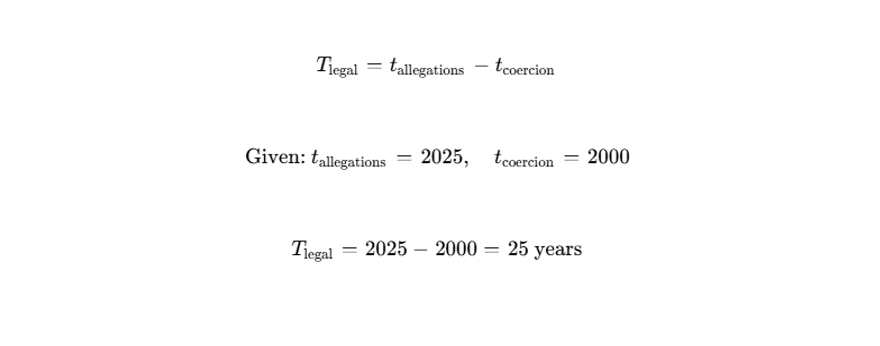
This quarter-century delay highlights the profound structural barriers faced by individuals seeking accountability from national security agencies. By dragging out proceedings over decades, the state can exhaust the financial, emotional, and physical resources of vulnerable complainants, effectively using the passage of time as a secondary shield against legal consequences.2
Conclusions
The administrative and judicial trajectory of Ariaratnam v. CSIS establishes several critical principles for the governance of national security and human rights in Canada 2:
- The Inviolability of Human Rights Oversight: National security operations cannot remain insulated from human rights legislation.2 The use of coercive tactics to exploit vulnerable asylum seekers, followed by the deployment of classified clinical files to block their employment, constitutes a form of systemic discrimination that human rights tribunals are fully mandated to review.2
- Rejection of Temporal Fragmentation: Administrative tribunals cannot legally ignore a documented, multi-decade storyline of systemic discrimination by reducing it to a single calendar event.2 The “continuing practice” provisions of the CHRA must be interpreted broadly to encompass the entire lifecycle of classified intelligence records and their ongoing impact on an individual’s life and livelihood.2
- Tribunal Independence and Procedural Ownership: Once a human rights complaint is referred to the CHRT, it belongs strictly to the complainant.2 The government cannot invoke parallel national security review mechanisms, such as NSIRA, to indefinitely delay or hijack human rights proceedings.2
- Addressing the Mowat Costs Gap: The asymmetry of resource allocation in national security litigation remains a major barrier to justice.2 The restriction on awarding legal costs under the Mowat precedent leaves human rights complainants facing massive financial deficits, even in the event of a successful liability ruling.2 Legislative reform of the CHRA is urgently required to restore the tribunal’s power to award legal costs, ensuring that vulnerable citizens can realistically hold powerful state institutions to account.2
This article was co-authored by Kagusthan Ariaratnam, Gemini, and Google DeepMind.
About the Authors
-
Kagusthan Ariaratnam is a seasoned professional at the intersection of technology and innovation, bringing deep industry expertise and strategic vision to the exploration of complex digital landscapes.
-
Gemini is a state-of-the-art multimodal AI model from Google. Designed to process and reason across various types of information—including text, code, audio, image, and video—it serves as an adaptive collaborator in research, creativity, and problem-solving.
-
Google DeepMind is a world-leading AI research laboratory committed to solving intelligence to advance science and benefit humanity. By developing increasingly capable and general-purpose AI systems, DeepMind continues to push the boundaries of what is possible in the digital age.
Works cited
- Kagusthan Ariaratnam – Wikipedia, accessed on May 21, 2026, https://en.wikipedia.org/wiki/Kagusthan_Ariaratnam
- Canada dispatch: Human Rights Tribunal limits government delay tactics in national security cases – Jurist.org, accessed on May 21, 2026, https://www.jurist.org/news/2025/11/canada-dispatch-tribunal-rules-government-cannot-use-national-security-to-delay-refugees-case-against-intelligence-service/
- Court orders review of former informant’s human rights complaint …, accessed on May 21, 2026, https://www.cbc.ca/news/canada/court-commission-csis-1.6970875
- Beyond the Archetype: Agency, Trauma, and Institutional Betrayal in the Narrative of Kagusthan Ariaratnam – Project O Five, accessed on May 21, 2026, https://projectofive.ca/beyond-the-archetype-agency-trauma-and-institutional-betrayal-in-the-narrative-of-kagusthan-ariaratnam/
- Between Two Wars: The Child Soldier Who Became A Double Agent—and Now Fights Extremism – Interview – Eurasia Review, accessed on May 21, 2026, https://www.eurasiareview.com/10102025-between-two-wars-the-child-soldier-who-became-a-double-agent-and-now-fights-extremism-interview/
- From Child Soldier to Defense Analyst: Kagusthan Ariaratnam | Podcast by ONPOD, accessed on May 21, 2026, https://projectofive.ca/8684-2/
- AFFIDAVIT of Kagusthan Ariaratnam (a.k.a Murali) – Project O Five, accessed on May 21, 2026, https://projectofive.ca/affidavit-of-kagusthan-ariaratnam-a-k-a-murali/
- 1 Court File No. FEDERAL COURT B E T W E E N: KAGUSTHAN …, accessed on May 21, 2026, https://judicialreviewlaw.ca/docs/T-1228-22%20-%20Application.pdf
- Report to the Canadian Human Rights Commission Concerning Section 13 of the Canadian Human Rights Act and the Regulation of Hate Speech on the Internet – à www.publications.gc.ca, accessed on May 21, 2026, https://publications.gc.ca/collections/collection_2016/ccdp-chrc/HR4-33-2008-eng.pdf
- KAGUSTHAN ARIARATNAM Applicant -and- CANADIAN …, accessed on May 21, 2026, https://judicialreviewlaw.ca/docs/T-1228-22%20-%20Factum.pdf
- Evidence – JUST (37-2) – No. 35 – House of Commons of Canada, accessed on May 21, 2026, https://www.ourcommons.ca/DocumentViewer/en/37-2/JUST/meeting-35/evidence
- SCHOOL OF SOCIAL WORK Graduate Student Handbook 2012-2013 – Western Michigan University, accessed on May 21, 2026, https://files.wmich.edu/s3fs-public/attachments/u57/2013/graduate-student-handbook-2012-13.pdf
- Ariaratnam v. Canada (Attorney General) – Hameed Law, accessed on May 21, 2026, https://hameedlaw.ca/cases/case/ariaratnam_v_canada_attorney_general
- About – Judicial Review Law, accessed on May 21, 2026, https://judicialreviewlaw.ca/about
- Cases – Judicial Review Law, accessed on May 21, 2026, https://judicialreviewlaw.ca/cases
- Canada (Canadian Human Rights Commission) v. Canada (Attorney General) – SCC Cases, accessed on May 21, 2026, https://decisions.scc-csc.ca/scc-csc/scc-csc/en/item/7969/index.do
- Nicholas Pope – Hameed Law, accessed on May 21, 2026, https://hameedlaw.ca/our_team/nicholas_pope