

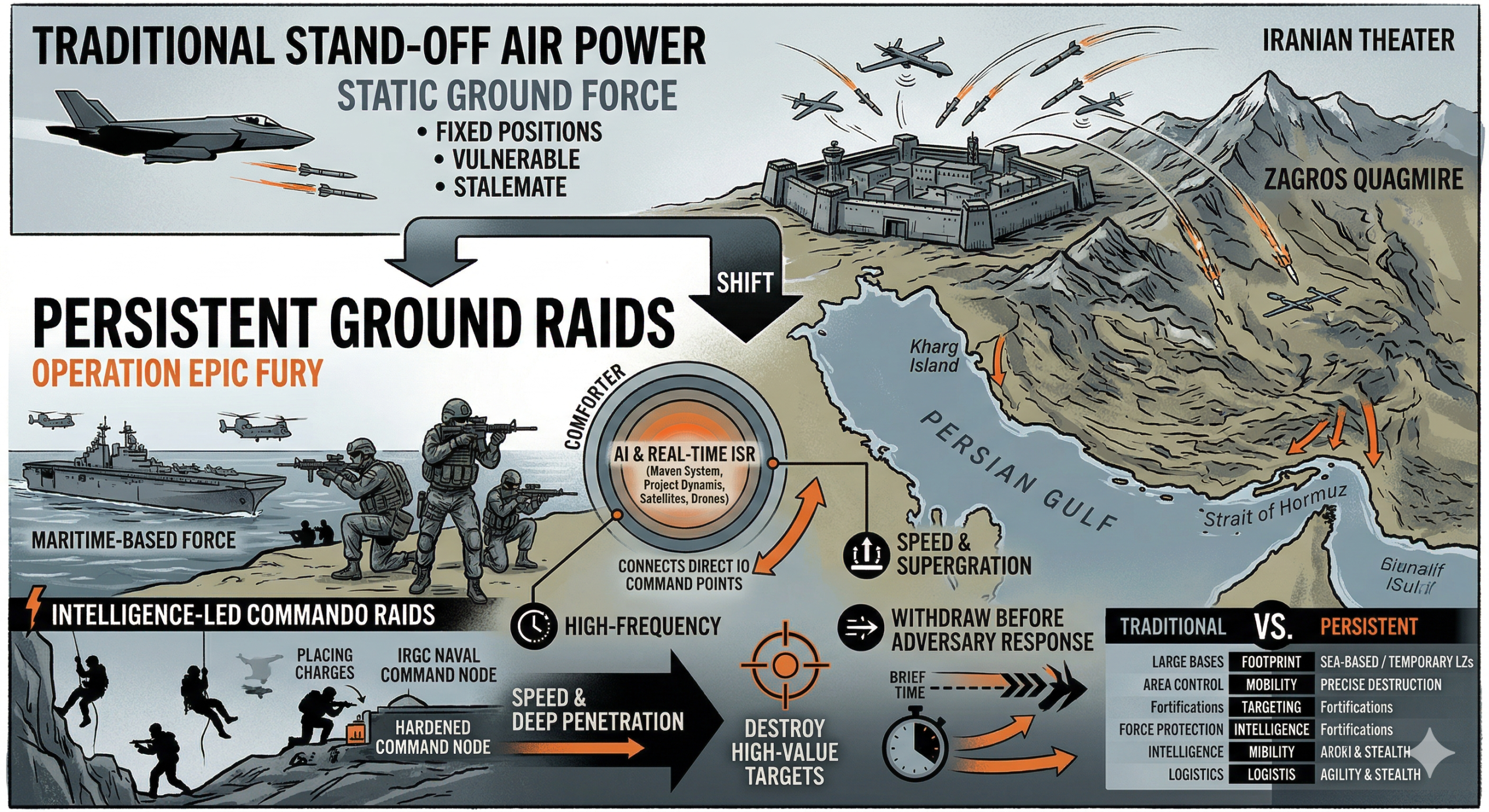
The escalation of the 2026 Iranian conflict, codified as Operation Epic Fury, has reached a critical juncture where the limitations of traditional stand-off air power have necessitated a fundamental shift in US military strategy.1 While the initial phase of the campaign, which commenced on February 28, 2026, focused on the large-scale degradation of Iranian air defenses and missile infrastructure, the resilience of the Islamic Revolutionary Guard Corps (IRGC) and the persistent closure of the Strait of Hormuz have forced the Pentagon to consider a more direct, albeit non-static, ground intervention.3 The evolving doctrine focuses on high-frequency, intelligence-led commando raids executed by US Marines and Special Operations Forces (SOF), designed to strike high-value targets and withdraw before the adversary can mount a coordinated response.6
This strategic framework explicitly rejects the establishment of a static force on Iranian soil, recognizing that any fixed position would be highly vulnerable to Iran’s sophisticated asymmetric arsenal of drone swarms and ballistic missiles.8 Instead, the US military is leveraging its technological superiority in artificial intelligence (AI) and real-time Intelligence, Surveillance, and Reconnaissance (ISR) to turn the Iranian landscape into a series of isolated target sets.10 By maintaining a maritime-based force that utilizes ship-to-shore-to-ship maneuver, the US aims to achieve its objectives of nuclear interdiction and maritime security without triggering the catastrophic attrition associated with a full-scale mainland invasion.8
Theoretical Foundations of Expeditionary Raiding
The transition to a raid-based strategy is not merely a tactical adjustment but a profound return to the principles of expeditionary warfare, adapted for the 21st-century digital battlefield.12 A raid is defined by a specific target, a limited timeframe, and an effect that is fundamentally different from a war of conquest.12 Unlike a traditional invasion, which seeks to hold territory and control populations, a raid seeks to destroy specific capabilities and gather intelligence, leveraging mobility and topographical knowledge as primary defense mechanisms.12
The current strategy draws on the “barbarian” war-fighting style, which recognizes relative weakness in certain domains—such as the risk of high-casualty battles—and compensates through speed and deep penetration in unexpected locations.12 In the Iranian context, this means utilizing the Persian Gulf as a sanctuary from which small, lethal units can strike at Iran’s southern littoral and withdraw back to the safety of the fleet.8 The goal is to provide the Commander-in-Chief with “maximum optionality” while minimizing the “Zagros quagmire”—the natural mountain barriers and narrow passes that would turn a land campaign into a high-casualty war of attrition.6
The Operational Concept of Persistent Raiding
Persistent raiding involves the continuous application of short-duration, high-impact missions that keep the adversary in a permanent state of reaction.12 Effectiveness in contemporary irregular warfare depends on integrated tactical units, intelligence-enabled maneuver, and sustained operational reach.16 The US military is operationalizing this by embedding real-time ISR directly into the command-and-control (C2) architecture of its raid forces, ensuring that every movement is cued by the most current data.14
| Tactical Element | Traditional Static Force | Persistent Raid Force |
| Footprint | Large, fixed bases (e.g., Green Zone) | Sea-based platforms / temporary LZs 5 |
| Mobility | Convoy-based, vulnerable to IEDs | Heliborne (Osprey/Super Stallion), amphibious craft 15 |
| Targeting | Area control, population security | Precise destruction of strategic infrastructure 7 |
| Force Protection | Fortifications, air defense batteries | Agility, stealth, and rapid extraction 8 |
| Intelligence | Broad-area, reactive reporting | Targeted, cued, and real-time ISR 14 |
The logic of the persistent raid force is to transform the battlefield from a contested plane into a network of “fleeting and time-sensitive targets”.22 This requires a radical truncation of the “sensor-to-shooter” gap, where the time elapsed between identifying a target and delivering lethal effects is reduced to seconds rather than minutes.10
The 2026 Conflict: Operation Epic Fury and the Impasse of Air Power
The initiation of Operation Epic Fury on February 28, 2026, represented the largest US military buildup in the Middle East since the 2003 invasion of Iraq.2 Within the first 24 hours, US and Israeli forces established effective control of the airspace from western Iran to central Tehran, striking approximately 200 air defense systems.3 Despite this initial success, the conflict quickly entered a state of “munitions transition,” where the US began burning through its supply of standoff cruise missiles, firing over 850 Tomahawks in the first month.4
The Limitations of Standoff Strikes
As of late March 2026, the volume of Iranian missile fire targeting Israel had decreased significantly, from 90 missiles per day at the war’s start to an average of 10 per day.24 However, the remaining Iranian assets are increasingly located in “hardened, underground facilities” that are resilient to single air strikes.23 The IRGC has adapted by using road-mobile air defenses that “pop up out of nowhere” and “exotic” loitering surface-to-air missiles (SAMs) to challenge US air supremacy, especially in eastern Iran.23
The realization that air power alone cannot “obliterate” the Iranian nuclear program or permanently reopen the Strait of Hormuz has led to the deployment of the 31st Marine Expeditionary Unit (MEU) and the command element of the 82nd Airborne Division.1 These forces are tasked with physically securing high-value assets that air strikes can only temporarily disable, such as the enriched uranium at Parchin or the naval command nodes at Kharg Island.8
Geopolitical Pressures and Public Sentiment
The shift to a raid-based strategy is also a response to intense domestic and international political pressures. A joint poll by the Associated Press and the National Opinion Research Center found that 62% of US respondents strongly oppose the use of ground troops in Iran, with only 12% in favor.8 By framing ground operations as “limited raids” rather than a “ground invasion,” the administration seeks to achieve military objectives while avoiding the domestic political fallout of a prolonged occupation.4
Furthermore, regional partners like the UAE, Saudi Arabia, and Jordan have faced Iranian retaliation for hosting US assets.4 This has led to restrictions on the use of regional airbases for offensive strikes, making sea-based ground raids from the Persian Gulf a more viable operational necessity.2
Organizational Architecture of the Raid Force
The force structure required for persistent raids is built around high-readiness, specialized units capable of rapid deployment and independent operation. The primary assets involved are the 31st MEU, the 15th MEU, and elements of the 82nd Airborne Division, supported by US Navy Carrier Strike Groups 3 and 12.2
The 31st Marine Expeditionary Unit (MEU): The “Savage” Force
The 31st MEU, headquartered at Camp Hansen, Okinawa, is the US Marine Corps’ only permanently forward-deployed MEU and serves as the primary crisis response force for the current theater.15 Known by the nickname “Savage,” the 31st MEU is a Special Operations Capable (SOC) Marine Air-Ground Task Force (MAGTF) comprising approximately 2,500 Marines and Sailors.15
The 31st MEU’s subordinate units provide the balanced capabilities necessary for littoral raids:
- Ground Combat Element (GCE): Battalion Landing Team (BLT) 3rd Battalion, 1st Marines. This unit is reinforced with artillery, amphibious vehicles, and a specialized small-boat capability for coastal raids.15
- Aviation Combat Element (ACE): Marine Medium Tiltrotor Squadron 265 (Reinforced), which operates MV-22B Ospreys, CH-53E Super Stallions, and F-35B Lightning II stealth fighters.15
- Logistics Combat Element (LCE): Combat Logistics Battalion 31, responsible for the rapid sustainment and “lily pad” resupply operations that allow the raid force to function without land-based infrastructure.15
The Maritime Raid Force (MRF) and Force Reconnaissance
Within the MEU, the Maritime Raid Force (MRF) is the specific task force organized for direct-action missions on ships, ports, and oil rigs.20 The MRF is composed of three platoons: a Force Reconnaissance platoon for the assault, an Amphibious Reconnaissance platoon for support, and a Battalion Landing Team security platoon.28 These units train extensively in Close Quarters Battle (CQB), rappelling, breaching, and night-time marksmanship to take enemy forces by surprise.20
The Force Reconnaissance Marines are the elite vanguard of the MRF. They utilize stealth and speed to secure targets before the larger security element arrives.20 During Operation Epic Fury, these units have been observed conducting “Realistic Urban Training Exercises” (RUTEX) to prepare for high-stakes missions on Iranian coastal targets.31
The 82nd Airborne Division and Rapid Reinforcement
The deployment of approximately 2,000 soldiers from the 82nd Airborne Division’s command element adds a layer of rapid deployment capability that complements the Marine Corps’ littoral focus.1 The 82nd Airborne is designed for “forced entry” operations, where paratroopers can be dropped to secure critical nodes like airfields or nuclear sites, facilitating the arrival of subsequent raid waves or extraction teams.7 This “Multi-Island Gambit” strategy relies on the 82nd to provide the “hammer” to the Marines’ “scalpel” in the southern theater.11
Technical Sovereignty: AI-Enabled Intelligence and the Targeting Web
The doctrine of persistent raiding is enabled by a radical technological transformation in battle management. The central nervous system of this operation is the Maven Smart System (MSS) and the broader digital orchestration layer known as Project Dynamis.10 These systems create a “transparent, data-centric kill web” that allows US forces to operate with a decisive advantage in decision speed.10
The Maven Smart System (MSS) and Project Dynamis
The Maven Smart System, adopted as an enterprise solution in September 2025, fused data from satellites, drones, and human intelligence to provide a common tactical picture (CTP).10 Project Dynamis is the digital engine that allows this data to be used for machine-to-machine targeting.10
The results of these breakthroughs are quantifiable and transformative:
- Airspace Deconfliction: Using a unified joint data mesh, the Marine Corps reduced airspace deconfliction times by up to 80%.10 This allows for the simultaneous use of artillery (HIMARS), naval fire support, and close air support during a ground raid without the risk of fratricide.10
- Targeting Cycles: The time it takes for a sensor to acquire a target, verify it, and pair it with a shooter has shrunk from 20 minutes to a matter of seconds.10
- Machine-to-Machine Workflow: Target data now passes through multiple domains and distinct networks with significantly less manual input, allowing for a high-intensity, “agentic” workflow.10
Persistent Intelligence, Surveillance, and Reconnaissance (ISR)
The requirement to “continue to monitor and gather real-time intelligence” is met through a multi-layered ISR network that combines space-based sensors with “stay-behind” ground assets.32
Layered ISR Architecture for Persistent Monitoring
| ISR Component | System / Platform | Function in Raid Doctrine |
| Space-Based | Infrared Satellites | Initial detection of missile heat signatures 32 |
| High-Altitude | RQ-4 Global Hawk / B-2 ISR | Deep-penetration surveillance of mainland command nodes 2 |
| Tactical UAVs | MQ-9 Reaper / LUCAS | 24-hour loitering, strike, and real-time data streaming 22 |
| Maritime ISR | USVs / Autonomous Boats | Passive recording of RF emissions in A2/AD zones 26 |
| Ground Sensors | Unattended Ground Sensors (UGS) | Seismic/acoustic monitoring of infiltration routes 33 |
| Human Intelligence | Unit 504 / Case Officers | Recruitment of local agents for real-time reporting 38 |
The use of Unattended Ground Sensors (UGS) is particularly critical for post-raid monitoring. These sensors can be seeded throughout the area of operations (AO) during a commando raid to cover areas not occupied by troops.33 This allows US planners to monitor if Iranian forces attempt to re-occupy a destroyed site or move mobile missile launchers back into a sanitized zone.33
Human Intelligence and Real-Time Recruitment
The role of human intelligence (HUMINT) has been reaffirmed by the 2026 conflict. Israel’s Unit 504, a secretive branch of the Intelligence Directorate, has been instrumental in gathering real-time intelligence from detainees and agents deep inside Iranian territory.38 This involves case officers meeting with local sources in unfamiliar terrain to extract information on military production sites and internal regime security.38
The integration of HUMINT with signals intelligence (SIGINT) allows US and Israeli planners to assess the “second- and third-order effects” of their raids.21 For instance, a raid on an IRGC command node is followed by persistent monitoring of the local communication environment to gauge the regime’s level of disruption and their subsequent movements.21
Geographic Objectives: The Littoral Campaign and Nuclear Interdiction
The target set for US commando raids is meticulously selected to maximize strategic impact while minimizing the risk of a general war. The primary focus is the southern littoral, which serves as the “center of gravity” for Iran’s power projection.11
The Multi-Island Gambit: Controlling the Strait of Hormuz
The “Multi-Island Gambit” is an active planning scenario for the seizure of strategic islands that control the Strait of Hormuz.11 By seizing these islands, the US and its GCC partners aim to dismantle Iran’s A2/AD capabilities without a mainland ground invasion.11
- Kharg Island: As Iran’s primary oil export terminal, handling approximately 90% of crude exports, it is the regime’s economic lifeline.9 While US officials have stated that “seizing it is not difficult,” the challenge lies in “protecting your guys once they are there” due to its proximity to mainland drone and artillery fire.8
- Qeshm Island: The largest island in the Gulf, containing extensive underground missile complexes and coastal radars.11 High-resolution ISR allows US planners to map these bunkers with “unprecedented fidelity” before launching Marine heliborne assaults.11
- Larak Island: A critical node for controlling maritime traffic through the narrowest part of the Strait. Raids here focus on “finding and destroying weapons” capable of targeting shipping.7
- Abu Musa and the Tunbs: These islands are contested between Iran and the UAE. Capturing them would restore regional sovereignty and remove Iranian launch squads that threaten GCC infrastructure.7
Nuclear Interdiction and High-Value Targets
Beyond the islands, the US is preparing for ground raids deep inside Iran to secure highly enriched uranium.7 Secretary of State Marco Rubio noted that “people are going to have to go and get it,” referring to nuclear material that air strikes cannot safely neutralize.1
Key targets for these raids include:
- Parchin Military Complex: A site linked to nuclear research and ballistic missile production.26
- Marine Industries Organization (MIO): Headquartered in Tehran, this organization oversees the production of naval weapons and unmanned surface vessels (USVs).26
- Physics Department at IUST: Targeted for its involvement in ballistic missile and nuclear research.26
These raids are expected to be “fast and precise,” involving the capture of strategic sites followed by a “quick exit after gathering intelligence”.7
Tactical Execution: Ship-to-Shore Maneuver and Extraction
The execution of persistent raids relies on the seamless integration of air and sea platforms to insert and extract forces across the Iranian littoral. The 31st MEU utilizes the America-class amphibious assault ship USS Tripoli (LHA 7) as its primary launch platform.7
The Mechanics of the Raid Cycle
A typical raid cycle involves the following stages:
- Cued Insertion: Stealth F-35B fighters or electronic warfare (EA-18G Growler) aircraft sanitize the landing zone (LZ) of air defenses.2 The raid force is then inserted via MV-22B Ospreys or CH-53E Super Stallions, which provide high-speed, long-range transport.15
- Objective Action: The MRF or SOF units execute the mission—destroying a missile launcher, seizing nuclear material, or raiding a command node.7 During this phase, real-time ISR from overhead Reapers provides constant situational awareness, warning the team of any approaching enemy reinforcements.10
- Suppression and Support: AC-130W Stinger II gunships or land-based HIMARS (using ATACMS or PrSM missiles) provide precision fires to suppress IRGC counter-attacks.23
- Rapid Extraction: The team is extracted via helicopter or boat before the IRGC can mobilize a heavy response.8 The entire operation is measured in hours, not days.12
Logistical Efficiency and “Lily Pad” Operations
To maintain this tempo without static bases, the MEU utilizes “Expeditionary Advanced Base Operations” (EABO).18 This involves establishing temporary, remote refueling and rearming points—”lily pads”—on uninhabited islands or in friendly territory.15 This distributed maritime posture ensures that the US force is “unparalleled in lethality, adaptability, and strength” while remaining elusive to Iranian sensors.44
Iranian Asymmetric Responses and Asynchronous Resistance
The primary threat to US raid forces is Iran’s “swarm saturation” doctrine, which utilizes low-cost, high-volume technology to overwhelm sophisticated US defenses.10
The Shahed Drone Threat
Iranian Shahed-series loitering munitions pose the greatest risk to advancing ground units and their naval launch platforms.10 These drones:
- Low Visibility: Use fiberglass and plastic materials to reduce radar cross-sections and gas-powered engines that emit minimal heat, making them difficult for infrared sensors to track.32
- Autonomous Navigation: Operate using pre-programmed GPS routes rather than radio signals, rendering traditional electronic warfare (EW) jamming less effective.32
- Swarm Tactics: Aim to overwhelm Aegis and Patriot systems through sheer volume.10
Passive Anti-Stealth and the Majid System
The IRGC has also deployed passive thermal detection systems, such as the “Majid” and “Herz-9,” to counter US stealth assets like the F-35 and B-2.41 These systems do not emit radar signals, allowing them to track the heat signatures of US aircraft without alerting the pilot’s onboard sensors.41 The claim that Iran has hit US stealth fighters indicates that “airspace control can no longer be guaranteed” through stealth alone, necessitating even more cautious, raid-based maneuvers.22
The Western Border and Proxy Pinning
On the Iranian mainland, the IRGC has threatened to “set on fire” any US troops on the ground.6 To prevent these rapid-reaction units from reinforcing the southern islands, the US and Israel have engaged in “western border pinning”.11 This involves strikes on Iranian border guard outposts in places like Siranband and the possible arming of Kurdish resistance groups (PJAK).11
By creating a “feint” in the Zagros mountains, US planners aim to pin 20-30% of the IRGC’s available forces in the north, away from the littoral raid theater.11
Geopolitical and Economic Implications of a Persistent Raid Posture
The economic impact of the 2026 war has been catastrophic. The closure of the Strait of Hormuz and the destruction of Iranian vessels have rattled global markets.1 Iranian attacks on regional desalination plants—which provide 41-99% of drinking water for the UAE, Qatar, and Bahrain—threaten a humanitarian collapse.11
The Cost of Modern Warfare
The 2026 National Defense Authorization Act (NDAA) reflects this shift toward high-intensity conflict, allocating $161 billion for munitions and modern platforms.45 The Navy and Marine Corps received the largest share, $67 billion, specifically to strengthen maritime power projection and naval aviation.45
| Munition / Platform | FY2026 Funding | Strategic Priority |
| PAC-3 Interceptors | $2.6 billion | Defense against ballistic/cruise missiles 45 |
| Precision Strike Missile (PrSM) | $480 million | Long-range, land-based precision strikes 45 |
| F-35C (Navy Stealth) | $2.1 billion | Power projection in contested airspace 45 |
| Virginia-class SSN | $2.7 billion | Undersea dominance and stealth insertion 45 |
| Guided-MLRS | $1.1 billion | Precision support for ground maneuvers 45 |
Bayesian Risk Analysis and Strategic Probability
Military strategists utilize networked tail-risk modeling to assess the likelihood of the persistent raid strategy’s success versus the risk of escalation.11
Let be the probability of strategic success (neutralizing A2/AD and reopening Hormuz). Baseline estimates place at approximately 0.25 (25%).11 However, the model is highly sensitive to input variables:
- Israeli Air/Intel Support: (adds 7% to success mass due to mainland degradation).11
- Limited Footprint: (reduces the risk of triggering a “regime-survival” total war).11
- Russian/Chinese Involvement: Acts as a multiplier on “Internationalization” probability, extending the conflict by 3-6 months.11
The model suggests that if the success probability can be raised to 0.35 through superior ISR and coordination, the net expected outcome flips to positive, justifying the risk of the “Multi-Island Gambit”.11
Conclusion: Toward a New Paradigm of Military Intervention
The 2026 Iranian conflict has demonstrated that the era of massive, static troop deployments is coming to an end, replaced by a doctrine of persistent, high-precision raiding.8 The US strategy of “ship-to-shore-to-ship” maneuver, powered by AI and real-time ISR, allows the military to achieve strategic objectives—such as the neutralization of nuclear facilities and the opening of global shipping lanes—while maintaining a level of agility that provides its own force protection.8
The integration of the 31st MEU’s specialized raid capabilities with the Maven Smart System represents the “final blow” option for dismantling the Iranian military apparatus.7 While the risks of Iranian asymmetric retaliation are significant, the alternative—a static ground war in the Zagros mountains—is assessed as a certain failure.9 As the conflict enters its second month, the success of Operation Epic Fury will depend on the ability of US and Israeli commanders to maintain a high-frequency tempo of “in and out” missions that deny the Iranian regime any sanctuary or stability on its own soil.8 The persistent monitor-raid-monitor cycle ensures that every Iranian response is cued for a subsequent strike, creating a feedback loop of degradation that air power alone could never achieve.14
This article was co-authored by Kagusthan Ariaratnam, Gemini, and Google DeepMind.
About the Authors
-
Kagusthan Ariaratnam is a seasoned professional at the intersection of technology and innovation, bringing deep industry expertise and strategic vision to the exploration of complex digital landscapes.
-
Gemini is a state-of-the-art multimodal AI model from Google. Designed to process and reason across various types of information—including text, code, audio, image, and video—it serves as an adaptive collaborator in research, creativity, and problem-solving.
-
Google DeepMind is a world-leading AI research laboratory committed to solving intelligence to advance science and benefit humanity. By developing increasingly capable and general-purpose AI systems, DeepMind continues to push the boundaries of what is possible in the digital age.
Works cited
- War on Iran: What troops is the US moving to the Gulf? – Al Jazeera, accessed on March 29, 2026, https://www.aljazeera.com/news/2026/3/25/war-on-iran-what-troops-is-the-us-moving-to-the-gulf
- 2026 United States military buildup in the Middle East – Wikipedia, accessed on March 29, 2026, https://en.wikipedia.org/wiki/2026_United_States_military_buildup_in_the_Middle_East
- Middle East Special Issue: March 2026 – ACLED, accessed on March 29, 2026, https://acleddata.com/update/middle-east-special-issue-march-2026
- Iran ‘hits’ US AWACS, air tankers: What else has it targeted in past month? – Al Jazeera, accessed on March 29, 2026, https://www.aljazeera.com/news/2026/3/29/iran-hits-us-awacs-air-tankers-what-else-has-it-targeted-in-past-month
- Operational gains against Iran continue, but threats to US forces persist – FDD, accessed on March 29, 2026, https://www.fdd.org/analysis/2026/03/19/operational-gains-against-iran-continue-but-threats-to-us-forces-persist/
- Pentagon readies ‘for weeks of US ground operations’ in Iran _ US-Israel war on Iran News _ Al Jazeera.pdf
- How the Pentagon could carry out ground operations in Iran and …, accessed on March 29, 2026, https://www.indiatoday.in/world/story/us-military-prepares-for-targeted-ground-operations-in-iran-hormuz-raids-capturing-kharg-island-2888600-2026-03-29
- Pentagon prepares ground operations in Iran: Raids, Kharg island …, accessed on March 29, 2026, https://www.livemint.com/news/world/iran-war-escalation-pentagon-draws-up-ground-operation-plans-as-thousands-of-us-troops-arrive-in-middle-east-11774748893704.html
- Ground war next? US readies Iran options as troops move: What we know, accessed on March 29, 2026, https://gulfnews.com/world/americas/ground-war-next-us-readies-iran-options-as-troops-move-what-we-know-1.500489863
- A U.S. Ground Invasion of Iran Would Face 1 Million Troops, 4,000 …, accessed on March 29, 2026, https://www.19fortyfive.com/2026/03/a-u-s-ground-invasion-of-iran-would-face-1-million-troops-4000-tanks-and-mountains-that-favor-the-defenders/
- The Multi-Island Gambit: A Risk Analysis of U.S.–Israel–GCC …, accessed on March 29, 2026, https://www.indrastra.com/2026/03/the-multi-island-gambit-usisraelgcc.html
- Barbarians and the Character of the Competition (Chapter 2), accessed on March 29, 2026, https://www.cambridge.org/core/books/return-of-the-barbarians/barbarians-and-the-character-of-the-competition/76674BCC881F174D689E04B62F201D3B
- Building upon McRaven’s Foundation: Operational and Strategic Principles of Special Air Operations – Irregular Warfare Initiative, accessed on March 29, 2026, https://irregularwarfare.org/articles/building-upon-mcravens-foundation-operational-and-strategic-principles-of-special-air-operations/
- Remaining Timely and Relevant: Two Key Challenges for Army’s Intelligence Capability Post-Afghanistan, accessed on March 29, 2026, https://researchcentre.army.gov.au/library/australian-army-journal-aaj/volume-9-number-2-winter/remaining-timely-and-relevant-two-key-challenges-armys-intelligence-capability-post-afghanistan
- 31st Marine Expeditionary Unit – Wikipedia, accessed on March 29, 2026, https://en.wikipedia.org/wiki/31st_Marine_Expeditionary_Unit
- Revitalizing Integrated Tactical Units to Combat West Africa’s Irregular Militant Groups, accessed on March 29, 2026, https://africacenter.org/publication/asb47en-integrated-tactical-units-west-africa/
- If US plans Iran ground war, where does it launch it from?, accessed on March 29, 2026, https://thefederal.com/category/international/us-plans-iran-ground-invasion-west-asia-crisis-donald0trump-middle-east-west-asia-strait-of-hormuz-persian-gulf-236718
- ‘China Marines’ attack, refine platoon tactics during 31st MEU EABO exercise, accessed on March 29, 2026, https://www.31stmeu.marines.mil/Media-Room/Videos/?videoid=665264&dvpTag=osprey
- Videos – Pacific Marines, accessed on March 29, 2026, https://www.marforpac.marines.mil/Media-Room/Videos/videoid/434024/
- Maritime Raid Force – Marines.mil, accessed on March 29, 2026, https://www.marines.mil/News/Marines-TV/videoid/288832/dvpTag/pro/
- Secret Weapon: High-value Target Teams as an Organizational Innovation StratEgiC PErSPECtivES 4, accessed on March 29, 2026, https://inss.ndu.edu/Portals/68/Documents/stratperspective/inss/Strategic-Perspectives-4.pdf
- Iran ‘hits’ US AWACS, air tankers: What else has it targeted in past month? – Al Jazeera, accessed on March 29, 2026, https://www.aljazeera.com/amp/news/2026/3/29/iran-hits-us-awacs-air-tankers-what-else-has-it-targeted-in-past-month
- The Misconception That Air Supremacy Has Been Achieved Over Iran, accessed on March 29, 2026, https://www.twz.com/news-features/the-misconception-that-air-supremacy-has-been-achieved-over-iran
- Iran Update Special Report, March 27, 2026 | ISW, accessed on March 29, 2026, https://understandingwar.org/research/middle-east/iran-update-special-report-march-27-2026/
- The US-Israel campaign in Iran – The International Institute for Strategic Studies, accessed on March 29, 2026, https://www.iiss.org/online-analysis/online-analysis/2026/02/the-us-israel-campaign-in-iran/
- Daily Report: The Second Iran War – March 29, 2026 (18:00), accessed on March 29, 2026, https://israel-alma.org/daily-report-the-second-iran-war-march-29-2026-1800/
- Videos – 31st Marine Expeditionary Unit, accessed on March 29, 2026, https://www.31stmeu.marines.mil/Media-Room/Videos/videoid/665264/dvpTag/Indo-Pacific/
- Maritime Raid Force | Military.com, accessed on March 29, 2026, https://www.military.com/special-operations/maritime-raid-force.html
- Sustaining in Jordan: the MRF takes to KASOTC to brush up on tactics proficiency, accessed on March 29, 2026, https://www.26thmeu.marines.mil/News/Article/Article/1506369/sustaining-in-jordan-the-mrf-takes-to-kasotc-to-brush-up-on-tactics-proficiency/
- S. Central Command | Operation Epic Fury, accessed on March 29, 2026, https://www.centcom.mil/OPERATIONS-AND-EXERCISES/EPIC-FURY/?videoid=428774&dvpmoduleid=41413&dvpTag=Albrecht
- Videos – 31st Marine Expeditionary Unit, accessed on March 29, 2026, https://www.31stmeu.marines.mil/Media-Room/Videos/?videoid=657684&dvpTag=OKINAWA
- A web of sensors: How the US spots missiles and drones from Iran, accessed on March 29, 2026, https://space4peace.org/a-web-of-sensors-how-the-us-spots-missiles-and-drones-from-iran/
- Swarming and the Future of Warfare – RAND, accessed on March 29, 2026, https://www.rand.org/content/dam/rand/pubs/rgs_dissertations/2005/RAND_RGSD189.pdf
- COMPOSITE INDEX 1921-2025 Table of Contents – Fort Benning, accessed on March 29, 2026, https://www.benning.army.mil/infantry/magazine/content/pdf/20260105%20Infantry%20Index.pdf
- Inside the high-stakes US defence system tracking Iran missiles and drones, accessed on March 29, 2026, https://m.economictimes.com/news/defence/inside-the-high-stakes-us-defence-system-tracking-iran-missiles-and-drones/articleshow/129753855.cms
- Electromagnetic Spectrum Operations – CRFS, accessed on March 29, 2026, https://www.crfs.com/electromagnetic-spectrum-operations
- 11-L-0559/0SD/57413 – Executive Services Directorate, accessed on March 29, 2026, https://www.esd.whs.mil/Portals/54/Documents/FOID/Special_Collection/Donald_Rumsfeld_Snowflakes_Litigation_Release/11-L-0559_Sixteenth_Release_Bates_57413-57912.pdf
- First women operatives cross enemy lines: inside Israel’s covert human intelligence 504 unit, accessed on March 29, 2026, https://www.ynetnews.com/magazine/article/rku5sl0511l
- What to know about U.S. shifting targets, new deployments and diplomatic double game as conflict enters Day 30?, accessed on March 29, 2026, https://english.news.cn/20260330/b207854685c541f69e50bb7b9179b283/c.html
- Iran Update Special Report, March 28, 2026 | ISW, accessed on March 29, 2026, https://understandingwar.org/research/middle-east/iran-update-special-report-march-28-2026/
- Iran strikes at the myth of US air supremacy – The Cradle, accessed on March 29, 2026, https://thecradle.co/articles/iran-strikes-at-the-myth-of-us-air-supremacy
- Bataan Amphibious Ready Group, 26th Marine Expeditionary Unit train in sea control with AC-130W in Arabian Gulf, accessed on March 29, 2026, https://www.marines.mil/News/Marines-TV/?videoid=753871&dvpmoduleid=599&dvpTag=air
- CAMPAIGN PLAN – Marine Forces Reserve, accessed on March 29, 2026, https://www.marforres.marines.mil/portals/116/Docs/CmdDeck/Campaign%20Plan/2026%20Campaign%20Plan.pdf
- Winter 2026 Full Issue – U.S. Naval War College Digital Commons, accessed on March 29, 2026, https://digital-commons.usnwc.edu/cgi/viewcontent.cgi?article=8490&context=nwc-review
- Inside the 2026 National Defence Authorization Act | Atlas Institute for International Affairs, accessed on March 29, 2026, https://atlasinstitute.org/inside-the-2026-national-defence-authorization-act/