

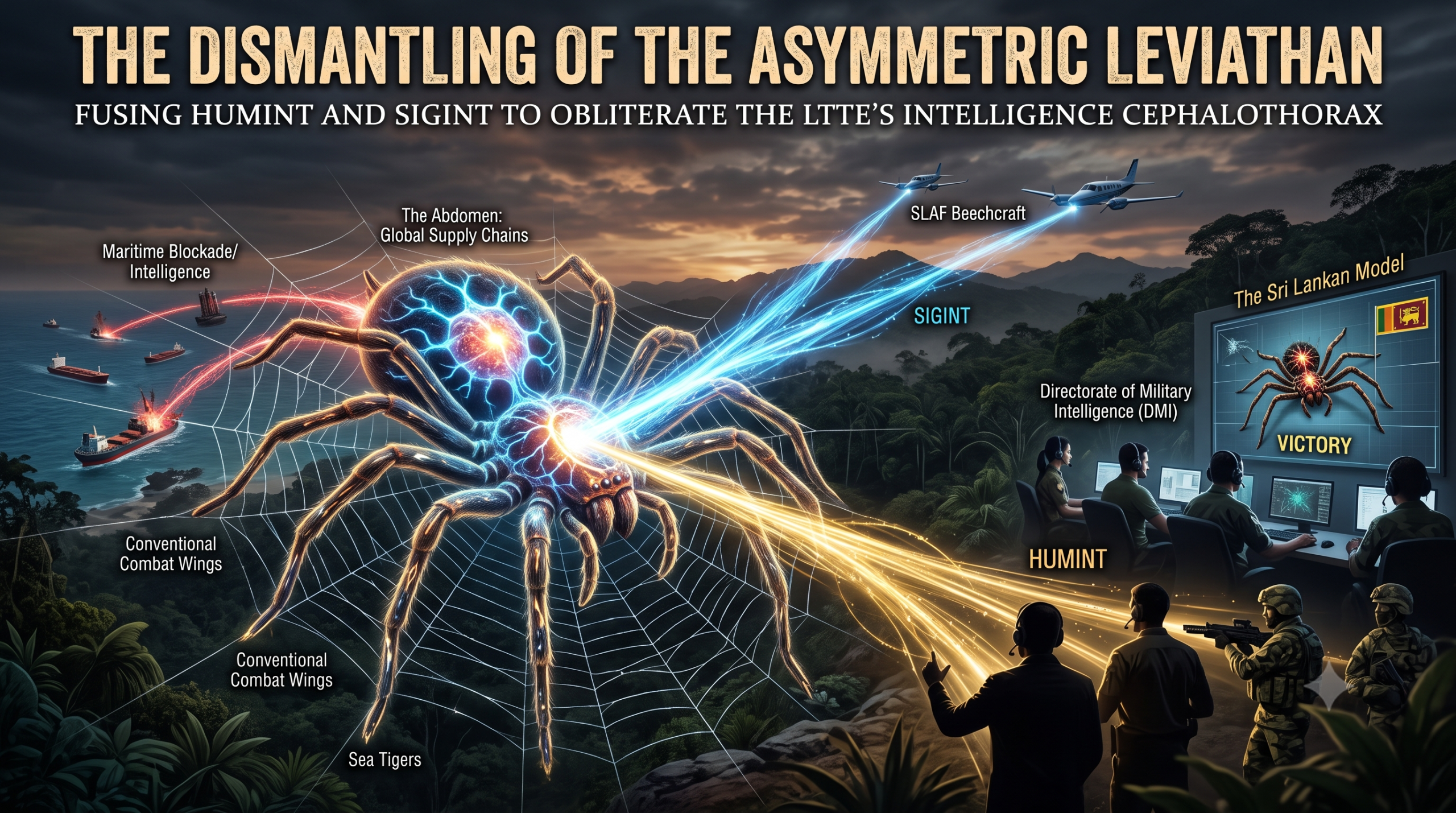
The anatomical architecture of the order Araneae provides a compelling biological framework for analyzing the structural vulnerabilities of highly centralized asymmetric insurgent organizations.1 In a spider, the traditional segmentations found in other arthropods are fused into two primary tagmata: the abdomen and the cephalothorax.2 Crucially, the nervous system is characterized by extreme centralization, with all ganglia fused into a single mass located entirely within the cephalothorax.2 The limbs—the eight legs used for locomotion and striking—are completely dependent upon this central neural mass for coordination, sensory processing, and motor control.2
For nearly three decades during the Sri Lankan Civil War, the state security apparatus repeatedly faltered by focusing its military might on the “limbs” of the Liberation Tigers of Tamil Eelam (LTTE)—its conventional ground regiments, its naval combat wing (the Sea Tigers), and its rudimentary aviation branch (the Air Tigers).1 While the state waged a bloody and often futile war of attrition against these combat appendages, the LTTE’s “abdomen”—its global diaspora fundraising, state-of-the-art international shipping networks, and maritime supply chains—continually fed nutrients and heavy weaponry to the insurgent body.1
Real victory was only achieved during the conflict’s final phase (2005–2009) when the Sri Lankan security forces, led by the Directorate of Military Intelligence (DMI), shifted from a localized, reactive counterinsurgency posture to a highly centralized, enemy-centric strategy of systemic decapitation.1 By systematically targeting the “cephalothorax” of the LTTE spider—specifically the supreme leadership of Velupillai Prabhakaran and the dense, highly secretive neural network of the Tiger Organization Security Intelligence Service (TOSIS)—the military intelligence apparatus paralyzed the entire insurgent body.1 This strategic collapse was engineered not through raw force alone, but through the deliberate, sophisticated fusion of Human Intelligence (HUMINT) and Signals Intelligence (SIGINT), which systematically infiltrated, blinded, and dismantled the most formidable insurgent intelligence wing in modern history.1
The Anatomy of the Asymmetric Spider
To evaluate the systemic collapse of the LTTE, it is essential to map the organizational components of the insurgent movement against the biological tagmata of the spider analogy. The survival of the insurgent apparatus depended on the seamless flow of resources from the abdomen to the combat appendages, all coordinated by the centralized commands of the cephalothorax.1
This structural centralization meant that while the combat appendages could inflict massive tactical damage, they were fundamentally incapable of autonomous survival.1 If the central neural pathways of the cephalothorax were disrupted, the limbs would fail to coordinate, the shipping lines of the abdomen would be left unprotected, and the entire asymmetric organism would undergo rapid, irreversible paralysis.1
The Structural Architecture of TOSIS
The primary cognitive shield of the LTTE cephalothorax was the Tiger Organization Security Intelligence Service (TOSIS).1 Originally established in 1983 and formally consolidated in 1986 by infusing the pre-existing BETA-2 intelligence cell, the service initially received foundational tradecraft training on Indian soil from instructors of the Research and Analysis Wing (RAW).1 Pottu Amman (Shanmugalingam Shivashankar), a close associate of Prabhakaran, was appointed as the head of TOSIS in mid-1988, expanding it into a highly professional, multi-layered national intelligence organ.1
To preserve absolute security, the LTTE divided its intelligence wing in 1993 into two highly compartmentalized sub-units: the National Intelligence Service and the Military Intelligence Service.1 This dual-service structure allowed the leadership to cross-check raw data, verify assessments, and mitigate the risk of disinformation.1
The National Intelligence Service
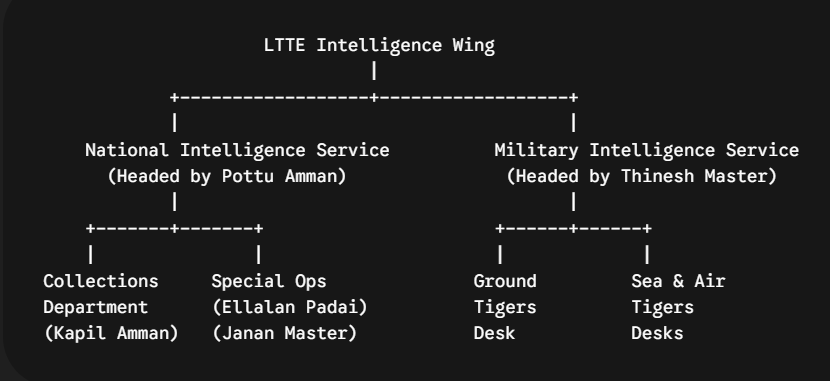
Headed directly by Pottu Amman, this service operated as the strategic espionage and counter-espionage apparatus of the LTTE de facto state.1 It was structured into five specialized departments:
- Collections Department (Thakaval Sekatippu Pirivu): Directed by Pottu Amman’s long-time deputy, Kapil Amman (Rajadurai Selvaraja).1 It was the largest department, tasked with managing human intelligence networks, counter-espionage, internal security, and running the National Intelligence Detention and Interrogation Centre.1
- Research and Publications Department (Aaivu Mattrum Veliyeeddu Pirivu): Headed by Mathavan Master (Ragunathan Pathmanathan).1 This department focused on information analysis and production, creating daily situation reports, weekly summaries, and detailed monthly files on Sri Lankan military capabilities.1 It managed the service’s databases, press libraries, and communications.1
- Special Operations Division (Ellalan Padai): Headed by Janan Master, the Principal Agent Handler of the intelligence wing.1 This highly secretive division planned, prepared, and executed the LTTE’s most sensitive “Black Ops,” including the assassinations of heads of state and the sabotage of economic infrastructure.1 The elite suicide squadron, the Black Tigers (Karum Puligal), was attached to this division under the direct command of Prabhakaran.1
- Training and Technology Department (Payitchi Mattrum Tholilnudpa Pirivu): Also headed by Mathavan Master.1 This department was responsible for training spies at “Base 22” (the Kalviyankadu training camp in the Jaffna Peninsula) and developing advanced operational technologies.1 These technologies included customized suicide vests, modified vehicle-borne improvised explosive devices (VBIEDs), and specialized spy tools.1
- Administration and Records (Nirvaakam Mattrum Arikkai Pirivu): Headed by Sankar, this division managed the wing’s personnel, finance, logistics, and welfare databases.1
The Military Intelligence Service
Established in 1993 under the leadership of Thinesh Master (alias Ilanthirayan), a brilliant, university-educated military advisor to Prabhakaran, this service was designed to keep tactical military intelligence strictly separated from civil espionage.1 It comprised four focused desks:
- Ground Tigers Collections Department: Dedicated to gathering real-time intelligence on the Sri Lankan Army (SLA), including divisional structures, regimental boundaries, and the movement of heavy artillery and armored units.1
- Sea Tigers Collections Department: Focused on the Sri Lanka Navy (SLN), mapping naval bases, monitoring shipping corridors, and reconstructing detailed schematics of every class of SLN combat vessel with the aid of international naval directories.1
- Air Tigers Collections Department: Focused on the Sri Lanka Air Force (SLAF), tracking airfield layouts, radar installations, oil storage locations, and jet fighter rotations.1
- Administration and Records: Handled the logistical and administrative support unique to military intelligence operations.1
Tactical Tradecraft and the Cult of Martyrdom
TOSIS achieved its high level of operational efficiency by combining professional espionage tradecraft with an extreme, religiously-tinged culture of self-sacrifice.1 In 1984, Prabhakaran ordered all LTTE cadres to permanently carry a glass phial of potassium cyanide (the Kuppi) around their necks, establishing an absolute code of silence.1 Cadres were under strict instructions to swallow the cyanide if cornered, prioritizing the protection of the network over personal survival.1 This code was reinforced by high-profile examples, such as Seelan (Charles Lucas Anthony), who ordered a subordinate to shoot him in the head in July 1983 to prevent capture, and the mass suicide of 17 captured Tigers in October 1987.1
This culture of self-sacrifice reached its peak in the recruitment and deployment of the Black Tigers.1 The LTTE did not view these suicide operations as acts of self-destruction, but rather as “self-gifts” (Aatma Dhaan) for the liberation of the Tamil homeland.1 The Black Tigers were not grouped into a separate military unit; instead, they were hand-picked, highly-trained operators embedded secretly within regular combat units.1 Their membership was kept strictly confidential, revealed to their peers only after their deaths in action.1
The tactical tradecraft of these suicide operations was meticulously planned, showing a high level of technical and operational sophistication.1
The Technology of Asymmetric Striking
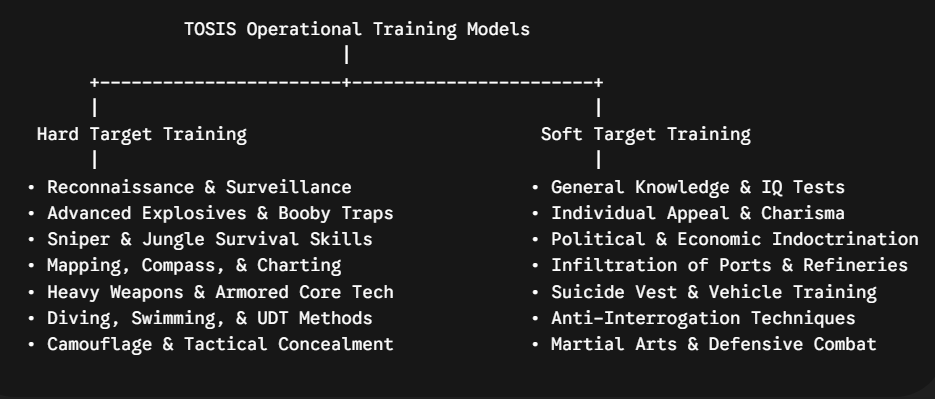
TOSIS developed two distinct training regimens based on the nature of the target in question 1:
1. Hard Target Operations
When targeting heavily defended military complexes, naval vessels, or airbases, the attack squads underwent intensive physical and technical preparation.1 This included tactical mapping, advanced camouflage, and weapon modifications.1 Notable operations included:
- The Nelliady Central College Attack (July 5, 1987): Captain Miller (Vallipuram Vasanthan) drove a modified Tata truck packed with RDX (acting as a VBIED) directly into a Sri Lankan Army camp during “Operation Liberation,” killing himself and 128 soldiers.1 Miller was celebrated as the pioneer of suicide bombings, and July 5th was established as Karumpuli Naal (Black Tigers Day).1
- The Katunayake Air Force Base Raid (July 24, 2001): A party of 12 Black Tigers, wearing Sri Lankan military uniforms over their suicide jackets, infiltrated the primary airbase and adjacent international airport.1 They destroyed six jet fighters, two military helicopters, and two civilian Airbus passenger planes, severely damaging the state’s air capabilities.1
- Operation Ellalan (October 22, 2007): A group of 21 Black Tigers infiltrated the Anuradhapura Air Force Base after extensive reconnaissance overseen by Col. Charles and Sasikumar Master.1 The commandos neutralized anti-aircraft positions and destroyed or damaged eight aircraft, including a Beechcraft 200T signal intelligence plane.1
2. Soft Target Infiltrations
For operations targeting political figures, economic infrastructure, or commercial areas, TOSIS emphasized deep-cover infiltration, psychological manipulation, and strategic deception.1 Operatives spent years building elaborate “legends”—complete false histories backed by forged documents—to blend seamlessly into government-controlled areas.1 Key operations included:
- The Assassination of Rajiv Gandhi (May 21, 1991): Code-named “Operation Wedding,” this plot involved a nine-member autonomous team commanded by Sivarasan.1 The team operated independently of the LTTE’s established networks in Tamil Nadu.1 They utilized a highly sophisticated, low-profile explosive belt developed by TOSIS technicians, containing 500 grams of RDX and ten thousand 0.2mm steel balls, activated by a dual-switch mechanism.1 The suicide bomber, Dhanu (Thenmozhi Rajaratnam), bypassed security by pretending to offer Gandhi a traditional flower garland before kneeling at his feet and detonating the charge.1
- The Assassination of President Ranasinghe Premadasa (May 1, 1993): Conceived by Janan Master, this operation involved a 23-year-old operative named Babu (Kumarakulasingham Veerakumar).1 Babu spent two years living near the Presidential Palace in Colombo, running a modest grocery store as a cover.1 He systematically befriended the President’s personal security detail and entourage, allowing him to get close enough to Premadasa during a May Day parade to detonate his suicide vest without raising suspicion.1
Internal Rifts and Paranoia: The Purge of Mahattaya
Despite its formidable reputation, TOSIS possessed a critical structural vulnerability: the extreme, systemic paranoia of its leadership.1 This paranoia was exploited in the early 1990s by India’s RAW in a covert operation designed to destabilize the LTTE from within.1 Following the assassination of Rajiv Gandhi, RAW targeted Gopalaswamy Mahendrarajah (alias Mahattaya), the popular deputy leader of the LTTE and special military commander of the Vanni district, who had built a strong personal power base during his training in India.1
RAW cultivated Mahattaya as a high-level mole, promising to support him as the future leader of a Federal Tamil State if he successfully deposed Prabhakaran.1 Operating through an intermediary code-named “Engineer,” Mahattaya began transmitting real-time tactical intelligence to RAW.1 This intelligence windfall led to several highly damaging blows to the LTTE’s command-and-control, including:
- The Death of Thileepan: Mahattaya advised RAW that the political wing leader’s public hunger strike was merely a diplomatic bluff by Prabhakaran, encouraging Indian authorities to let Thileepan die, which allowed Mahattaya to take over the political wing.1
- The Sinking of the MV Ahat: In January 1993, Mahattaya tipped off RAW about the highly secretive maritime journey of Kittu (Sathasivam Krishnakumar), a senior LTTE commander returning from Europe on a cargo vessel.1 The Indian Navy intercepted the ship, forcing Kittu and nine other cadres to blow up the vessel, killing themselves to avoid capture.1
TOSIS’s counterintelligence wing, led by Kapil Amman, grew suspicious when “Engineer” returned from India to Jaffna through government-controlled Colombo without drawing the attention of Sri Lankan security forces.1 Pottu Amman placed both Mahattaya and “Engineer” under physical and electronic surveillance, and TOSIS signals units subsequently intercepted encrypted transmissions confirming their contact with RAW officers.1
On March 31, 1993, Mahattaya was arrested at the Suthumalai camp.1 His arrest triggered a massive, year-long internal purge within the LTTE.1 Hundreds of cadres, including highly respected battlefield commanders like Balraj and Theepan, were subjected to aggressive interrogation.1 The investigation concluded that nearly 600 militants had been compromised by the RAW network; 257 of them were executed by firing squad on December 28, 1994, alongside Mahattaya.1
While the purge successfully eliminated RAW’s immediate network, it left deep psychological scars within the LTTE.1 It destroyed the internal trust between the leadership and the mid-level officer corps, eroded organizational morale, and created a climate of suspicion that made future regional divisions and defections far more likely.1
Severing the Appendages: The Defection of Karuna Amman
The most significant structural division in the history of the LTTE occurred in March 2004, when Vinayagamoorthy Muralitharan (Colonel Karuna Amman), the special military commander of the Batticaloa and Ampara districts, defected from the northern-dominated leadership.1 Karuna commanded a highly trained eastern force of approximately 6,000 combatants, which had long felt marginalized by the northern-centric policies of Prabhakaran and Pottu Amman.1
The Sri Lankan Directorate of Military Intelligence (DMI) engineered and exploited this regional rift.1 When Karuna broke away, the DMI immediately moved to protect, rehabilitate, and integrate his faction.1 Reorganized as a pro-government paramilitary force under the TMVP banner, Karuna’s fighters became highly effective partners in the state’s counterinsurgency campaign.1
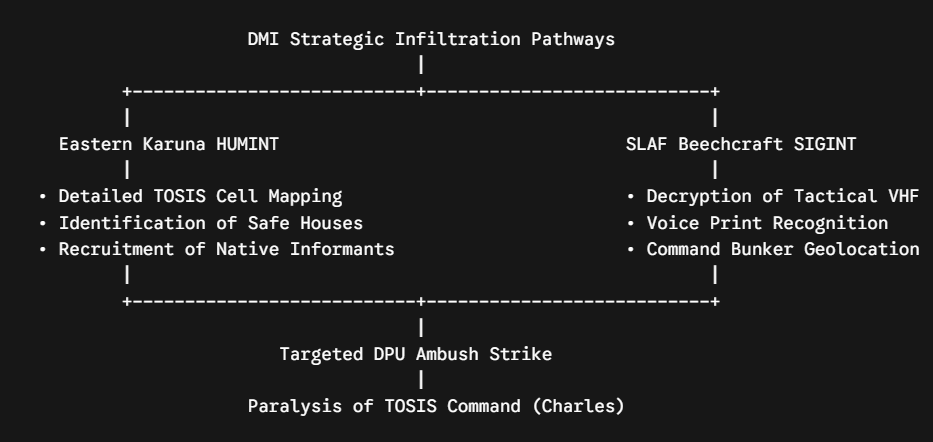
The defection of Karuna’s faction stripped the LTTE of its primary source of combat recruitment and created a devastating human intelligence gap within TOSIS.1 Karuna and his commanders possessed intimate, detailed knowledge of the LTTE’s structures 1:
- Sleeper Cell Identification: Karuna’s networks identified and mapped dozens of TOSIS sleeper agents and safe houses across Colombo and the Southern Province, allowing the state to systematically dismantle the insurgent intelligence apparatus in urban areas.1
- Special Force Integration: TMVP cadres served as point-men, trackers, and local guides for the Sri Lankan Army’s Deep Penetration Unit (DPU/LRRP), allowing special forces to infiltrate deep into LTTE-controlled territories.1
- Command Structure Reconstruction: Karuna provided the DMI with detailed dossiers on the psychological profiles, family backgrounds, and vulnerabilities of the top 20 icons of the LTTE leadership, allowing the military to plan highly targeted psychological and kinetic operations.1
Operation Sangeetha: Weaponizing Soft Power and Cognitive Infiltration
While kinetic force was used against hard targets, the DMI recognized that the rank-and-file cadres of TOSIS could be systematically targeted through highly unconventional psychological operations.1 This strategy was formalized into Operation Sangeetha, a joint RAW-DMI project that systematically weaponized cultural soft power to induce cognitive ruptures within the insurgent ranks.16
The LTTE’s ideology was highly totalitarian, demanding the absolute suppression of all individual, non-political human longings—such as the desire for romantic love, family bonds, and personal peace—equating any such longings with fundamental weakness and betrayal of the sacrifice required for Eelam.16 Cadres were forced into a state of severe sensory and emotional deprivation.16
Operation Sangeetha exploited these repressed emotional vulnerabilities by establishing a continuous psychological pipeline.16 DMI and RAW operatives systematically broadcasted and disseminated popular South Indian cultural products—most powerfully, the highly emotional and melodious musical compositions of South Indian maestros Ilayaraja and A.R. Rahman—into Tiger-controlled territories and intelligence communication channels.16
This auditory and cultural infiltration targeted the emotional core of the cadres, creating profound cognitive dissonance.16 The nostalgic, humanistic, and romantic themes of the music directly collided with the cold, self-sacrificial demands of the LTTE’s suicide-cult ideology.16 This psychological friction eroded the cadres’ will to fight, broke their ideological brainwashing, and led to a quiet but massive wave of defections.16 Many of these culturally induced defectors were subsequently formalized into the state’s intelligence pipelines, converting emotional surrender into highly valuable hard tactical intelligence.16
The Spotter Force Multiplier Theory (SFMT)
To systematically dismantle the remaining urban networks of TOSIS in Colombo and other major cities, the DMI implemented a highly structured human intelligence tradecraft known as the Spotter Force Multiplier Theory (SFMT).1
In any highly compartmentalized, cell-based asymmetric network (where members of the same cell operate in silos and do not know each other, communicating only through safe houses and intermediaries), traditional search-and-interrogate methods are highly inefficient and frequently counterproductive, often resulting in human rights abuses that further alienate the local population.1 SFMT operates on the premise of recursive network analysis: you can only identify and map the members of a secret organization by utilizing the organization’s very own captured or defected members.1
The operational mechanics of SFMT are structured as follows:
- Identification of a Candidate: State security forces identify and arrest a genuine, low-level or mid-level member of a compartmentalized cell (e.g., a sleeper agent or safehouse keeper).1
- Rehabilitation and Indoctrination: Instead of utilizing aggressive physical interrogation, which often yields false data and hardens resolve, the subject undergoes a brief, compassionate rehabilitation process.1 They are treated with dignity, provided medical care, and systematically won over using “soft power” techniques to shift their loyalty.1
- Transition to “Spotter”: Once reformed, the individual is deployed as a “spotter”.1 Operating under the guidance of military intelligence handlers, the spotter uses their intimate knowledge of the organization’s codes, safe houses, and non-verbal behaviors to identify other members of the network.1
- Exponential Multiplication: As new members are spotted and apprehended, they are subjected to the same compassionate rehabilitation process.1 These new assets are then deployed as additional spotters.1 This creates a rapid, self-multiplying cascade of human intelligence—a true “force multiplier”.1
This system allowed the DMI to bypass the strict compartmentalization of TOSIS cells.1 For example, when TOSIS attempted to execute a coordinated attack on the Colombo Port, they utilized harbor employees cultivated as resident agents, who in turn communicated only through safe houses and intermediaries.1 By applying SFMT, the DMI was able to recursively trace the network back, locate the safe houses, and dismantle the entire cell before the attack could be executed.1
The SIGINT-HUMINT Fusion and the Elimination of the Cephalothorax
During the final phase of the war (2005–2009), the DMI systematically fused this massive influx of human intelligence with advanced signals intelligence.1
On the signals front, the Sri Lanka Signals Corps and specialized DMI units systematically intercepted and decrypted the LTTE’s complex tactical radio transmissions.1 To achieve wide-area aerial surveillance and communications interception, the Sri Lankan Air Force deployed specialized Beechcraft 200T aircraft modified specifically for Signals Intelligence (SIGINT) duties.1 These aircraft were capable of executing wide-area electronic sweeps, mapping the electromagnetic spectrum over the Vanni jungles, and identifying the precise coordinates of LTTE communication masts, command bunkers, and mobile transmission rigs.1
By fusing this SIGINT data with the HUMINT provided by Karuna’s TMVP networks, the DMI achieved a level of target acquisition and identification that was previously impossible.1 Real-time radio intercepts were instantly cross-correlated with Karuna’s insider knowledge of LTTE personalities, voice signatures, and operational habits.1
The most significant tactical milestone of this fused intelligence strategy was the targeting of Colonel Charles (Shanmuganathan Ravishankar), the director of the newly created LTTE Military Intelligence Wing and the primary coordinator of all external “Black Tiger” operations outside the north and east.1 Charles was the tactical brain behind the group’s most devastating urban operations, including the Central Bank bombing and the Katunayake Airport raid.1 On January 5, 2008, a claymore mine ambush executed by the Army’s Deep Penetration Unit (DPU/LRRP) in the Mannar District successfully targeted and killed Colonel Charles.8
The removal of Charles physically decapitated the LTTE’s military intelligence leadership, severely degraded their command-and-control, reduced their operational tempo, and blinded their ability to execute mass-casualty retail terror or retaliatory “Black Ops” in Colombo and the South during the critical final phases of the war.1
The Strategic Squeezing of the Abdomen: Sinking the Floating Armories
While the fusion of HUMINT and SIGINT systematically blinded the cephalothorax, the state moved to starve the asymmetric spider’s physical mass—its “abdomen”.1 The survival of the LTTE de facto state depended on the constant inflow of heavy military supplies shipped via international maritime transit routes.1
Following the 9/11 attacks, the global security paradigm shifted, facilitating international intelligence cooperation.1 Under the coordination of the Chief of National Intelligence (CNI), Sri Lankan intelligence integrated inputs from global powers (including Indian and US intelligence agencies) to identify and track the LTTE’s clandestine cargo vessels.1 These “floating armories” operated deep in international waters, acting as mobile supply warehouses containing thousands of tons of RDX, artillery shells, and advanced weapons systems.1
The Sri Lanka Navy leveraged this real-time strategic intelligence to launch deep-sea intercept missions, systematically hunting down and sinking nearly all of the LTTE’s merchant warehouse ships.1 This complete denial of the high seas achieved several critical strategic results:
- It permanently severed the LTTE’s maritime logistics support, upon which their physical survival depended.1
- It starved the conventional combat wings of heavy ammunition, mortar shells, and spare parts, rendering their conventional-grade weapons useless.1
- It physically isolated the LTTE leadership within a rapidly shrinking, heavily monitored pocket of land in the Vanni.1
Conclusion: Decapitation as a Paradigm of Modern Counterterrorism
The military defeat of the LTTE in May 2009 stands as one of the few instances in modern military history where a highly structured, heavily armed asymmetric movement was completely and decisively obliterated.1 This rare victory was not achieved through brute force alone, but through a highly coordinated, intelligence-led campaign that targeted the “cephalothorax” of the organization—its centralized decision-making and cognitive command structure—rather than expending resources in a futile, endless struggle against its “eight legs”.1
The systematic dismantling of the Tiger Organization Security Intelligence Service (TOSIS) provides critical strategic lessons for contemporary global security.1 By engineering the defection of Colonel Karuna, weaponizing the soft power of South Indian popular culture through Operation Sangeetha, and implementing the recursive Link Analysis of the Spotter Force Multiplier Theory, the Sri Lankan military effectively turned the LTTE’s highly structured networks against themselves.1
When this massive influx of human intelligence was fused with advanced signals intelligence—intercepting tactical radio transmissions, utilizing airborne SIGINT platforms, and decrypting communication codes—the state gained a state of total informational dominance.1 This tactical fusion allowed the security forces to surgically target and eliminate key intelligence coordinators, such as Colonel Charles, while international intelligence collaboration systematically choked off the maritime supply lines of the group’s logistics network.1
With its global logistics paralyzed, its internal networks compromised, and its intelligence wing structurally blinded, the LTTE’s central leadership was left physically isolated and intellectually starved.1 The final military operations in the Vanni did not have to contend with a highly coordinated, intellectually agile command network, but with a blind, desperate, and starved remnant.1 The obliteration of the LTTE’s cephalothorax demonstrates that in asymmetric warfare, the ultimate key to victory lies not in the conventional destruction of combat regiments, but in the systematic, intelligence-led decapitation of the organization’s cognitive core.1
Works cited
- Kagusthan Ariaratnam – Classified – TOSIS – A Typical Terrorist Tradecraft .pdf
- List of spiders of Sri Lanka – Wikipedia, accessed on July 6, 2026, https://en.wikipedia.org/wiki/List_of_spiders_of_Sri_Lanka
- SURRENDER OF FERRARI COMMANDERS IN BALOCHISTAN – LankaWeb, accessed on July 6, 2026, https://www.lankaweb.com/news/items/2017/01/30/surrender-of-ferrari-commanders-in-balochistan/
- Directorate of Military Intelligence (Sri Lanka) – Grokipedia, accessed on July 6, 2026, https://grokipedia.com/page/directorate_of_military_intelligence_sri_lanka
- The Taming of the Tigers: An MWI Contemporary Battlefield Assessment of the Counterinsurgency in Sri Lanka – Modern War Institute, accessed on July 6, 2026, https://mwi.westpoint.edu/taming-tigers-mwi-contemporary-battlefield-assessment-counterinsurgency-sri-lanka/
- (PDF) A Case of Tigers and Talibans: The Applicability of the Sri Lankan Counterinsurgency Model in Pakistan’s Insurgent War – ResearchGate, accessed on July 6, 2026, https://www.researchgate.net/publication/336672387_A_Case_of_Tigers_and_Talibans_The_Applicability_of_the_Sri_Lankan_Counterinsurgency_Model_in_Pakistan’s_Insurgent_War
- Chief of National Intelligence – Grokipedia, accessed on July 6, 2026, https://grokipedia.com/page/chief_of_national_intelligence
- Military Intelligence Corps (Sri Lanka) – Grokipedia, accessed on July 6, 2026, https://grokipedia.com/page/military_intelligence_corps_sri_lanka
- List of commanders of the LTTE – Wikipedia, accessed on July 6, 2026, https://en.wikipedia.org/wiki/List_of_commanders_of_the_LTTE
- The Tamil Tigers’ Intelligence Wing: TOSIS – – Grey Dynamics, accessed on July 6, 2026, https://greydynamics.com/the-tamil-tigers-intelligence-wing-tosis/
- AFFIDAVIT of Kagusthan Ariaratnam (a.k.a Murali) – Project O Five, accessed on July 6, 2026, https://projectofive.ca/affidavit-of-kagusthan-ariaratnam-a-k-a-murali/
- Book Review: Spy Tiger – The 05 File – A child soldier turned double agent – SADF, accessed on July 6, 2026, https://www.sadf.online/book-review-spy-tiger-the-05-file-a-child-soldier-turned-double-agent/
- Charles (Tamil militant) – Wikipedia, accessed on July 6, 2026, https://en.wikipedia.org/wiki/Charles_(Tamil_militant)
- Long Range Reconnaissance Patrol (Sri Lanka) – Wikipedia, accessed on July 6, 2026, https://en.wikipedia.org/wiki/Long_Range_Reconnaissance_Patrol_(Sri_Lanka)
- Long Range Reconnaissance Patrol (Sri Lanka) – Military Wiki | Fandom, accessed on July 6, 2026, https://military-history.fandom.com/wiki/Long_Range_Reconnaissance_Patrol_(Sri_Lanka)
- Operation Sangeetha: The Cultural Defection Pipeline — How the Music of Madras Obliterated the Tigers – Project O Five, accessed on July 6, 2026, https://projectofive.ca/operation-sangeetha-the-cultural-defection-pipeline-how-the-music-of-madras-obliterated-the-tigers/
- Beijing’s Legal Weapon for Forced Minority Assimilation – Project O, accessed on July 6, 2026, https://projectofive.ca/beijings-legal-weapon-for-forced-minority-assimilation/
- Sri Lankan intelligence agencies – Wikipedia, accessed on July 6, 2026, https://en.wikipedia.org/wiki/Sri_Lankan_intelligence_agencies
- Sri Lanka Air Force – 4Aviation, accessed on July 6, 2026, https://www.4aviation.nl/wp-content/uploads/2017/01/Sri-Lanka-may11-Scramble-Stefan-Goossens.pdf
- Operational and Technical SIGINT–2020 Foresight – DTIC, accessed on July 6, 2026, https://apps.dtic.mil/sti/tr/pdf/ADA277013.pdf
- Shanmuganathan Ravishankar alias “Col” Charles was a Low Profile Tiger who Masterminded High Profile Attacks Outside North and East. – dbsjeyaraj.com, accessed on July 6, 2026, https://dbsjeyaraj.com/dbsj/?p=85354
- FLOATING ARMOURIES IMPLICATIONS AND RISKS – Omega Research Foundation, accessed on July 6, 2026, https://omegaresearchfoundation.org/storage/2024/05/Floating-Armouries-Implications-and-Risks.pdf
- Floating Armouries in the Indian Ocean, accessed on July 6, 2026, https://www.files.ethz.ch/isn/191515/SAS-Research-Note-52.pdf