

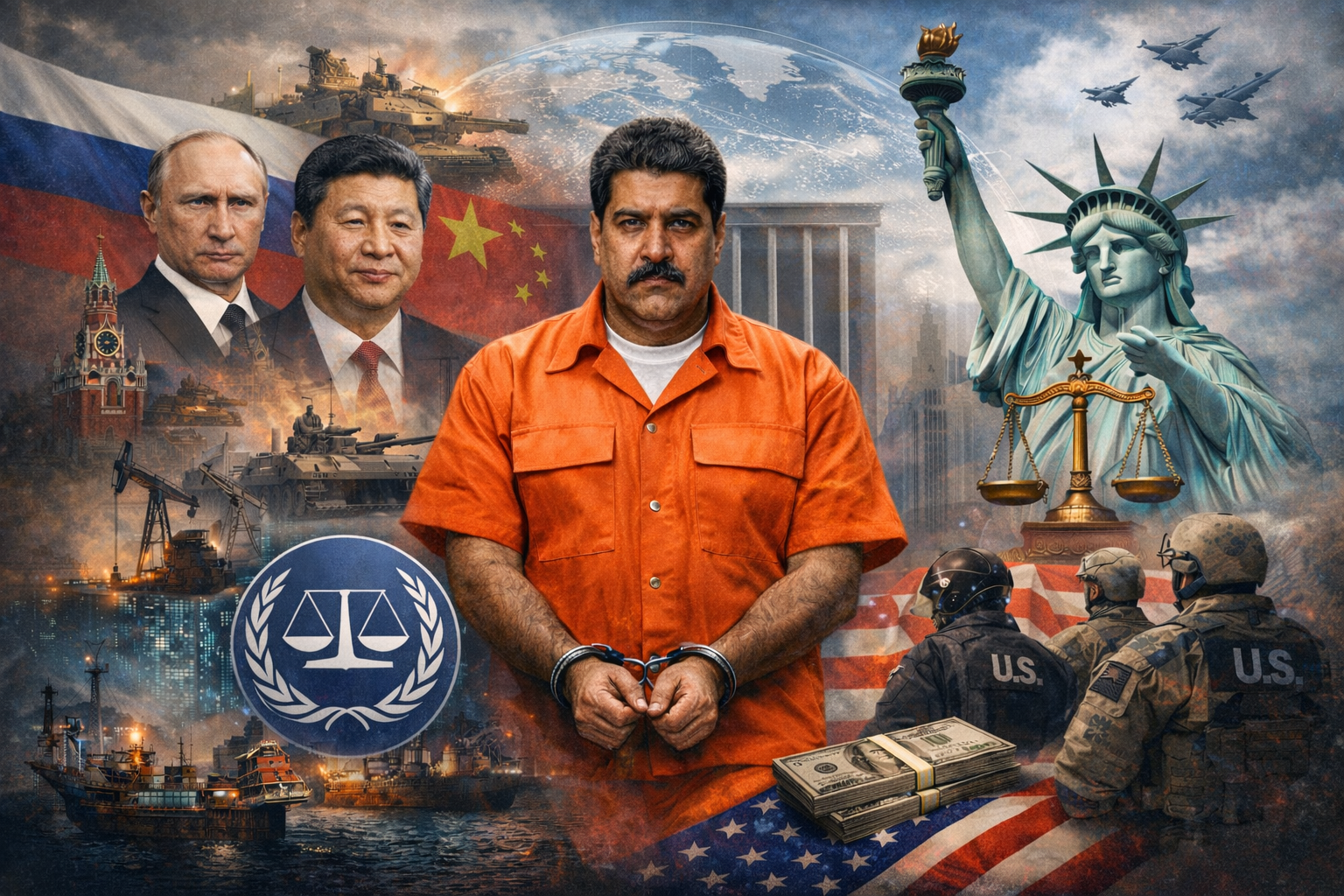
The arrest of Venezuelan President Nicolás Maduro—whether through international legal mechanisms, coordinated sanctions, or extradition under universal jurisdiction—should serve as a defining blueprint for how the international community, led by the United States, confronts authoritarianism and dictatorship around the world. For decades, dictators have survived not because of legitimacy or popular support, but because of geopolitical hesitation, fragmented enforcement of international law, and great-power rivalry. The Maduro case exposes both the costs of inaction and the emerging contours of a new strategy for holding authoritarian leaders accountable.
American foreign policy has never been driven solely by idealism. Any claim that the United States advances democracy abroad without regard to its own strategic interests—oil, minerals, shipping lanes, technology, and security architecture—is simply unrealistic. Under President Donald Trump, this reality was no longer disguised. His administration pursued a transactional and interest-driven foreign policy that treated authoritarian regimes less as ideological adversaries and more as strategic obstacles. In this context, Maduro’s isolation and potential arrest represent not an anomaly, but a model.
Accountability, Not Regime Change
The significance of Maduro’s case lies in its emphasis on personal accountability rather than conventional regime-change wars. Unlike the post-9/11 interventions that relied overwhelmingly on military force, the pressure applied against the Venezuelan regime combined sanctions, diplomatic isolation, financial restrictions, criminal indictments, and international coordination. This approach reflects a broader shift in American foreign policy—from blunt military dominance to precision-based pressure shaped by legal, financial, and technological leverage.
For over twenty years, U.S. foreign policy was constrained by what is commonly known as Maslow’s hammer: if all you have is a hammer, everything looks like a nail. Military power became the default response to complex political problems, often producing unstable outcomes. The Maduro model suggests an alternative—one that targets authoritarian leaders personally, delegitimizes their rule internationally, and constrains their ability to operate within the global system.
Strategic Competition and the New Global Order
This shift is occurring alongside a deeper transformation in U.S. global strategy. American power is no longer defined solely by aircraft carriers and troop deployments, but by technological supremacy—control over data, semiconductors, cyber capabilities, artificial intelligence, and global financial systems. In this new environment, authoritarian governments aligned with China or Russia are increasingly viewed as nodes within a hostile strategic network rather than isolated domestic actors.
Any pro-China or pro-Russian regime that enables foreign military access, intelligence operations, or technological penetration will inevitably fall under American scrutiny. The Maduro regime, backed by Russia, China, and Iran, exemplifies this alignment. His potential arrest therefore sends a broader message: authoritarian leaders cannot indefinitely shelter behind great-power rivalry to evade accountability.
China, Sharp Power, and Authoritarian Protection
Beijing’s role in sustaining authoritarian regimes adds urgency to this blueprint. Traditionally guided by Sun Tzu’s maxim that “the supreme art of war is to subdue the enemy without fighting,” China has long favored indirect influence through economic leverage and strategic patience. However, the rise of “wolf warrior diplomacy” signals a departure from this restrained posture.
While China publicly insists—echoing Mao Zedong—that it will not attack unless attacked, its actions increasingly contradict this claim. Chinese foreign policy now frequently employs coercion, intimidation, and interference abroad. Western scholars, including researchers at the Balsillie School of International Affairs, argue that China relies less on hard or soft power and more on “sharp power”: cyberwarfare, industrial espionage, disinformation, and covert political interference.
Authoritarian regimes such as Venezuela and Sri Lanka have benefited from this model. In exchange for loyalty and access, Beijing provides diplomatic cover, financial lifelines, and surveillance technologies that entrench authoritarian rule. This makes the Maduro blueprint even more critical—demonstrating that external backing does not guarantee impunity.
Sri Lanka and the Global Relevance of the Maduro Model
Sri Lanka offers a parallel case that underscores the global relevance of this approach. For more than thirty years, successive chauvinistic governments have failed to pursue an equidistant foreign policy. Instead, they have consistently tilted toward China, enabling opaque debt arrangements, strategic infrastructure control, and potential intelligence cooperation that undermine democratic institutions.
As in Venezuela, authoritarian governance in Sri Lanka has been sustained not merely by domestic repression, but by foreign patronage. This is precisely why the Maduro blueprint matters. Legal accountability, targeted sanctions, international isolation, and exposure of financial networks provide a means to confront authoritarianism without large-scale military intervention.
Smart Power Over Brawny Failure
Western democracies increasingly recognize that sustainable influence requires “smart power,” a blend of hard and soft power articulated by Joseph Nye. The failure of purely militarized solutions over the past two decades has made this clear. The Maduro case demonstrates how smart power can be operationalized: freezing assets, restricting travel, pursuing indictments, mobilizing multilateral institutions, and delegitimizing authoritarian leaders globally.
If Chinese wolf warrior diplomacy continues to grow more aggressive, it risks repeating America’s earlier mistakes—appearing strong while producing diminishing strategic returns. In contrast, the Maduro blueprint shows how targeted, lawful pressure can weaken authoritarian systems from within.
A Blueprint for the Future
The potential arrest of Nicolás Maduro should not be viewed as an isolated Latin American issue. It should be understood as a precedent—a signal that military- and intelligence-backed authoritarianism and totalitarianism will no longer be tolerated under the guise of sovereignty or geopolitical convenience. From South America to South Asia, including Sri Lanka, authoritarian leaders must recognize that alignment with foreign powers and repression at home will carry personal consequences.
In the emerging global order, the most effective weapon against dictatorship is not invasion, but accountability. If the United States and its allies can institutionalize the Maduro model—grounded in law, technology, and coordinated pressure—it may finally offer a credible and sustainable response to authoritarianism worldwide.